
July 30 - A federal appeals court has ruled that Enbridge is responsible for trespassing by operating a segment of its Line 5 pipeline beneath land held by a northern Wisconsin tribe, while also allowing the company a longer period to carry out a reroute and instructing a fresh assessment of monetary damages.
The 7th U.S. Circuit Court of Appeals in Chicago reviewed appeals from a June 2023 district court decision that required Enbridge to pay the Bad River Band of the Lake Superior Tribe of Chippewa Indians $5.15 million in restitution, plus additional sums to cover ongoing trespass, and to relocate the pipeline within three years. That three-year deadline has since lapsed but had been placed on hold pending appellate proceedings.
Writing for the three-judge panel, Circuit Judge Michael Scudder made clear that Enbridge must remove the pipeline from the tribe’s land, while explaining why the court would not adhere to the original three-year timetable. Scudder stated that the shorter timetable was overly aggressive given broader public concerns - including the potential harm to consumers from an abrupt shutdown, possible diplomatic complications with Canada, and requirements under a 1977 U.S.-Canadian treaty that governs transit pipelines.
"Make no mistake: Enbridge must remove the pipeline from the [tribe’s land]," Scudder wrote. "The grace period we direct the district court to afford Enbridge is the product of the broader public context in which the pipeline operates, and it does not reflect our approval of the company’s behavior."
The court directed the district judge to adopt measures aimed at ensuring the reroute proceeds as quickly as practical.
Enbridge did not provide an immediate comment. Josh Handelsman, an attorney representing the tribe, said his client is reviewing the appeals court’s decision.
Line 5, constructed in 1953, transports up to 540,000 barrels of oil per day through the Great Lakes region from Canada and includes roughly 12 miles of pipeline that run beneath the Bad River Reservation. The district judge in Madison, Wisconsin - U.S. District Judge William Conley - issued the damages award and ordered the reroute after a non-jury trial.
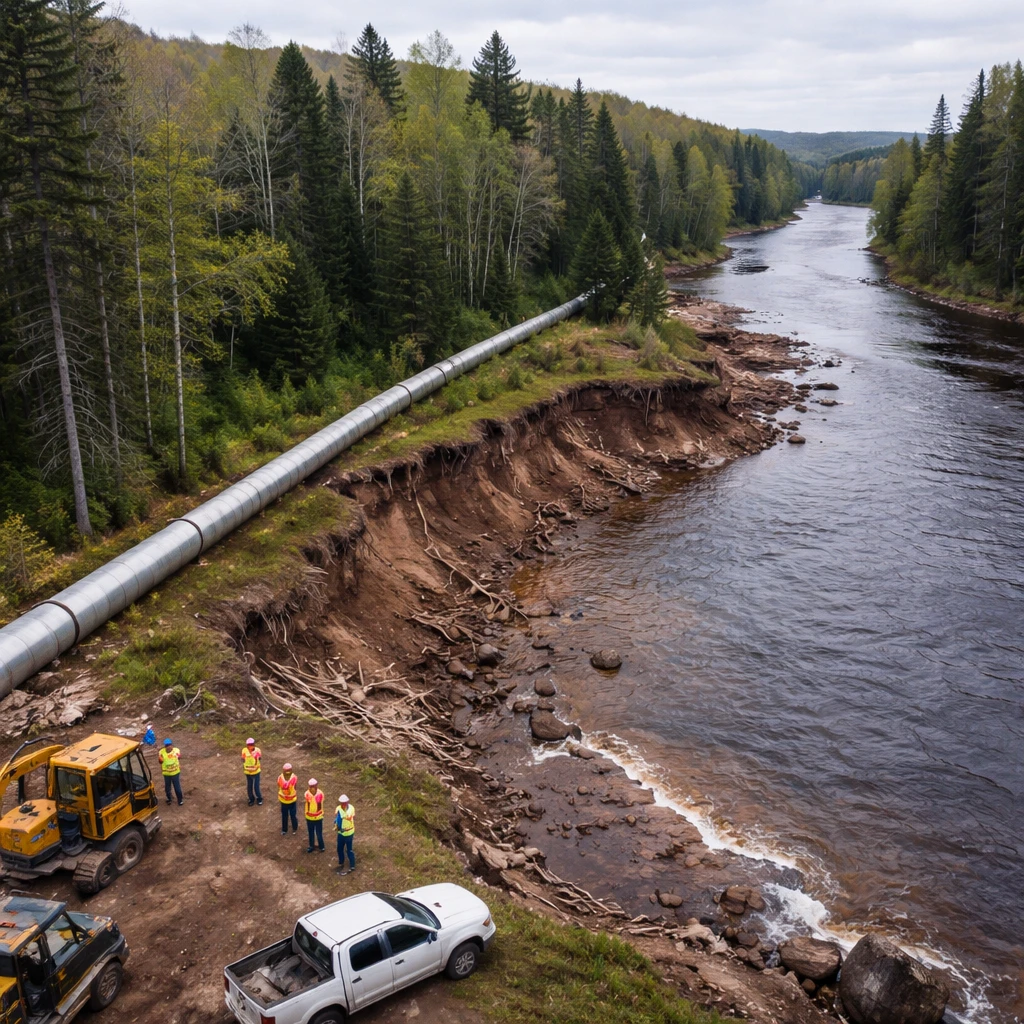
The Bad River Band had previously warned that erosion of a riverbank in spring had diminished protections for the pipeline and argued that a shutdown was necessary because of that threat.
On the issue of monetary relief, the appeals court found fault with how the district court calculated damages. Scudder concluded that the district court had improperly "double-counted" by factoring in both Enbridge’s profits tied to the trespass and the economic advantage the company gained from postponing reroute expenses. The court returned the damages issue for recalculation, indicating the new computation should take into account the ongoing nature of the trespass, any interest that may be owed, and the conduct of both parties regarding efforts to reroute.
The appeals panel declined to affirm a nuisance finding against Enbridge, ruling that federal law preempted the tribe’s nuisance claim.
Legal positioning around land rights in the case rests on differing easement terms. Enbridge held an easement on some tribal parcels that extended through 2043, while rights-of-way for other parcels lapsed in 2013. The tribe filed suit in 2019 after negotiations outside of court failed to resolve the dispute.
Key points
- The 7th U.S. Circuit Court of Appeals affirmed Enbridge’s liability for trespass and ordered the company to remove the pipeline from tribal land, while granting additional time for rerouting.
- Damages previously awarded by the district court were sent back for recalculation due to concerns the lower court double-counted Enbridge’s economic benefits.
- Sectors affected include the energy and pipeline infrastructure sectors, with potential downstream impacts on consumer fuel supply and cross-border energy transit arrangements.
Risks and uncertainties
- Uncertainty over timing and cost of rerouting the pipeline - this creates risk for the energy and infrastructure sectors as project timelines and capital expenditures are reconsidered.
- Potential for recalculated damages and associated interest to increase financial liability for the company, impacting the energy sector and company financials.
- Legal and regulatory ambiguity, including federal preemption issues and differing easement expirations on tribal parcels, which leaves outcomes and remedies subject to further court or administrative action.