
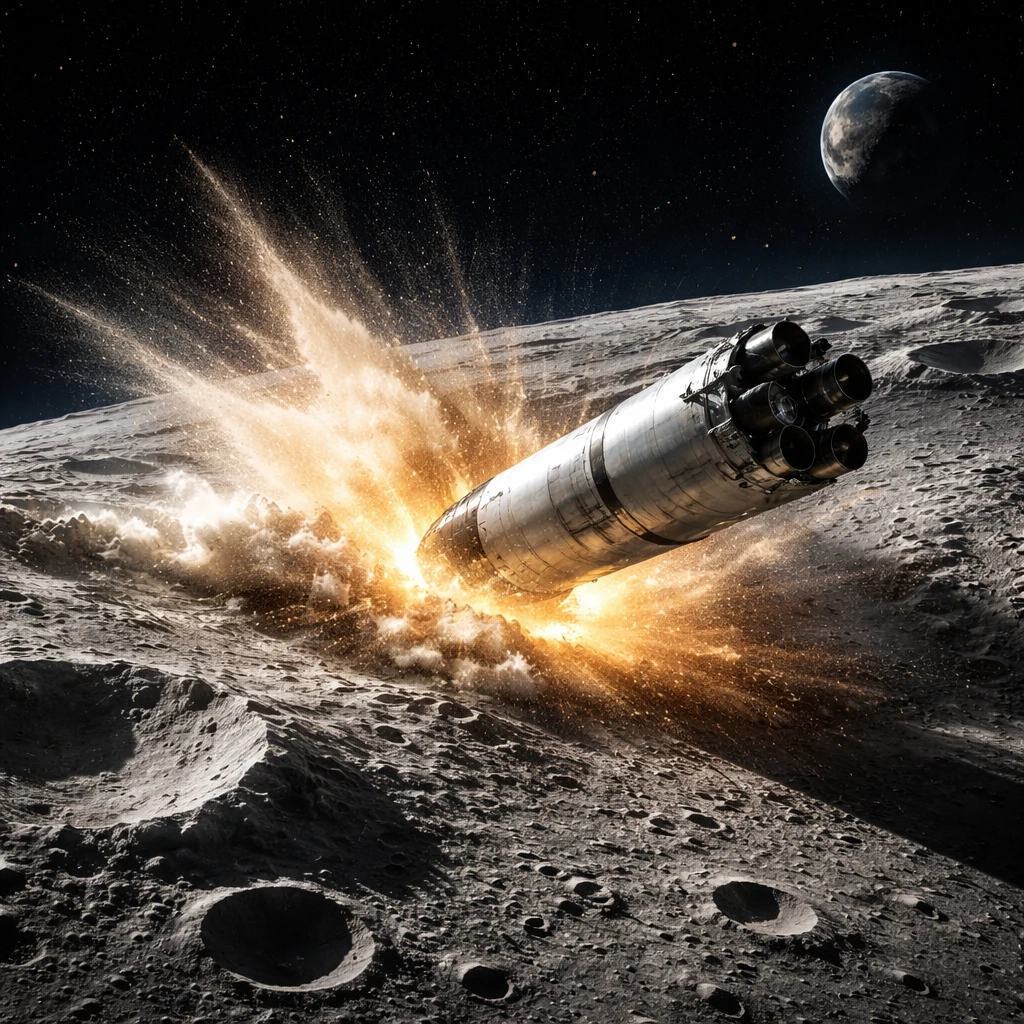
A sizeable piece of orbital debris - the second stage of a SpaceX Falcon 9 rocket - is forecast to slam into the Moon in the early hours of Wednesday, after drifting in space since it launched a lunar lander in January 2025. The object, roughly the size of a school bus and weighing four metric tons (4,000 kg), is expected to impact the lunar surface at about 2:35 a.m. ET (0635 GMT) at a velocity of approximately 5,400 miles per hour (8,690 kph).
SpaceX has characterized the collision as unintentional. The stage had been used to boost a Firefly Aerospace lander toward the Moon earlier this year and, after expending its propellant, remained in orbit unable to be steered back into Earth’s atmosphere or toward a controlled disposal path. Astronomers identified earlier this year that the inert stage was on a trajectory that would terminate at the Moon.
The impact site is expected to be Einstein Crater, located on the Moon’s western limb - a region that is frequently hard to observe from Earth. When the stage strikes, it should launch a plume of lunar dust that sunlight will likely illuminate, though the dust cloud will probably be challenging to discern with the unaided eye from Earth.
How the stage came to be on an impact course involves naturally occurring forces, according to SpaceX and independent observers. "What has happened is essentially a mixture of solar activity and gravity forces have put it on a path toward the moon," Julianna Scheiman, SpaceX director of NASA science and Dragon programs, told reporters on Monday.
Bill Gray, the developer of widely used astronomy software who published an analysis of the stage’s predicted collision in April, said the event may offer modest scientific value while underscoring concerns about the handling of spent hardware. "This may be of some - probably minor - scientific interest, and we may learn some things from it," he said. "It doesn’t present any danger to anyone, though it does highlight a certain carelessness about how leftover space hardware (space junk) is disposed of."
Typically, second stages that have delivered payloads to near-Earth orbits re-enter Earth’s atmosphere and either burn up or fall into the ocean. In contrast, missions that require greater thrust - such as launches aimed at carrying a lander to the Moon - can leave stages on long-lived trajectories instead of trajectories that safely decay. That difference left this particular Falcon 9 stage floating among thousands of other pieces of orbital debris that active satellites must avoid.
Impacts of space hardware on the lunar surface have occurred before, but are infrequent. A Chinese rocket stage struck the Moon in March 2022 following the completion of a lunar test mission. In 2009, NASA intentionally crashed a rocket stage into the Moon to study the resulting plume of material. Several attempted soft landings by spacecraft in recent years instead ended in crashes: Russia’s Luna-25 mission spun out of control and crashed in 2023, leaving a small plutonium-238 power source on the surface that officials said likely remains harmless; India’s Chandrayaan-2 lander crashed in 2019; and Israel’s Beresheet lander also crashed in 2019, with one of its payloads being microscopic tardigrades that may still be present on the lunar surface.
The U.S. space agency intentionally impacted stages from its Saturn V moon rocket into the lunar surface in the 1970s to study the seismic effects of such collisions.
NASA and SpaceX have discussed approaches to avoid future accidental lunar impacts, according to SpaceX. The concern is particularly pertinent as NASA intends to establish a lunar base and begin routine astronaut missions to the surface later this decade under its multibillion-dollar Artemis program, which would increase the value of protecting lunar assets and infrastructure from errant debris.
Key points
- A four-ton Falcon 9 second stage that launched a Firefly Aerospace lunar lander in January 2025 will hit the Moon early Wednesday at about 2:35 a.m. ET (0635 GMT) at roughly 5,400 mph (8,690 kph).
- The impact is unintentional and is expected to occur in Einstein Crater on the Moon’s western limb, producing a sunlight-illuminated dust plume that will be difficult to see with the unaided eye from Earth.
- Sectors potentially affected include the space industry and satellite operations, since the event highlights debris-management issues and the need to protect future lunar infrastructure under NASA’s Artemis plans.
Risks and uncertainties
- Ongoing orbital debris - The presence of spent rocket stages in long-lived orbits increases collision and avoidance demands for active satellites, affecting satellite operators and insurers.
- Threats to future lunar infrastructure - Uncontrolled impacts could endanger planned lunar assets and missions tied to government space programs and commercial lunar ventures.
- Observational limitations - The impact is likely to produce a dust plume that will be illuminated by sunlight but remains hard to observe from Earth, limiting immediate on-the-ground data for scientists.