
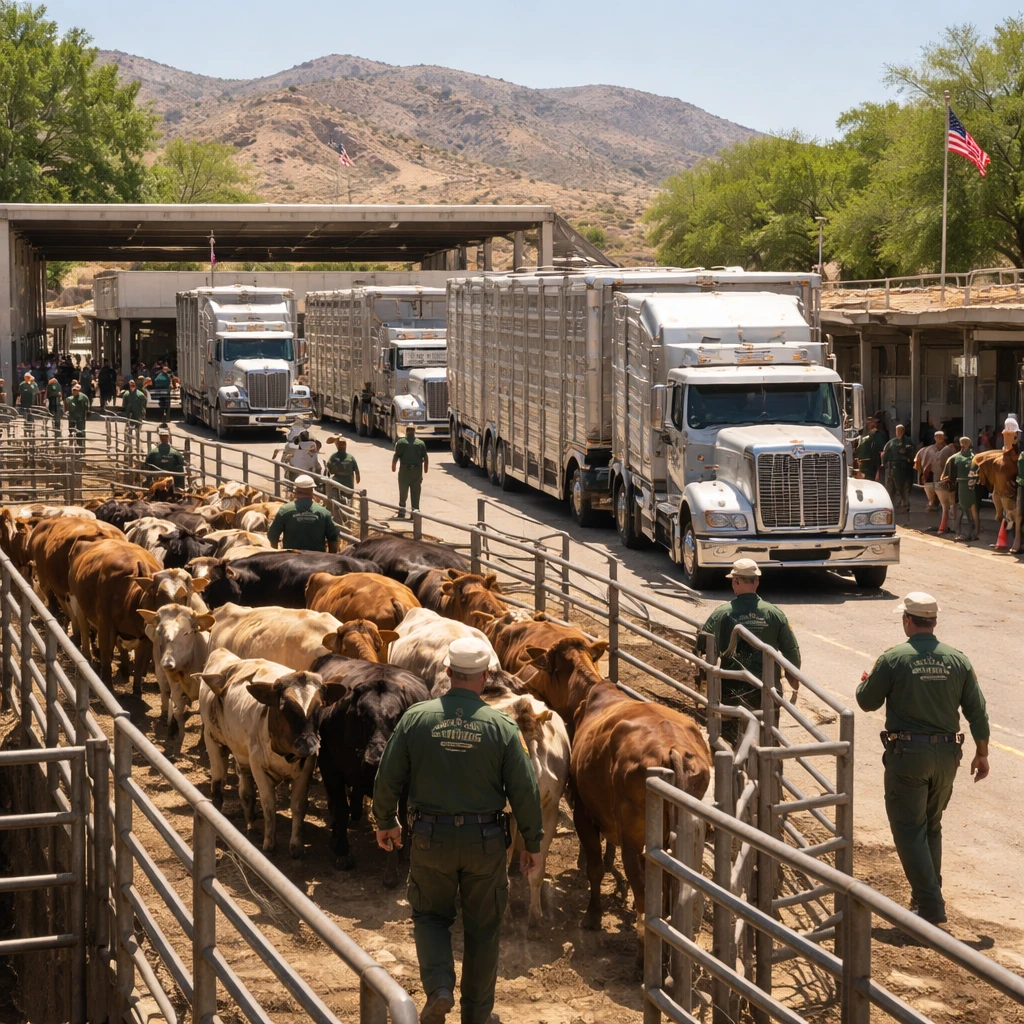
Tyson Foods shares climbed strongly in morning trading, gaining about 7.0% after the U.S. Department of Agriculture disclosed a coordinated, phased plan to resume imports of Mexican cattle through southern ports. The USDA said the first crossing to reopen will be Douglas, Arizona, on August 24, 2026, with two additional New Mexico ports to follow, a development that directly targets a prolonged supply constraint weighing on the company’s beef division.
The announcement comes against the backdrop of an import ban that has exceeded a year, which the USDA said had pushed U.S. cattle inventories to their lowest level in 75 years and contributed to record-high domestic beef prices. For Tyson, the easing of that restriction offers potential relief for input availability and cost pressures. Earlier this year, tight cattle supplies forced Tyson to close a major beef processing plant in Nebraska after operations became economically untenable under constrained supply conditions.
The USDA outlined the phased reopening as conditional on Mexico’s adherence to a screwworm control plan. Industry groups welcomed the approach: the Meat Institute - through its president - indicated that allowing Mexican cattle into U.S. processing channels would help packers better satisfy consumer demand. The conditional nature of the reopening means that progress depends on the agreed animal health measures being implemented.
Market reaction to the policy shift was not limited to Tyson. Rival JBS, which also shuttered a beef plant in Pennsylvania amid the same supply difficulties, experienced a sharp uptick in its shares alongside Tyson, signaling that investors viewed the USDA action as a sector-level positive for large-scale meat processors. Broader equity markets provided only modest support: the Dow Jones Industrial Average rose roughly 0.5%, while the S&P 500 was essentially flat and the Nasdaq posted a slight decline, indicating that the move in Tyson shares was driven primarily by company- and industry-specific news.
Analysts and investors are also focused on an upcoming earnings milestone: Tyson is scheduled to release third-quarter results on August 3, 2026. Consensus forecasts cited in market commentary project approximately 13% year-over-year growth in earnings per share for the period, a forward-looking catalyst that likely contributed to positive sentiment toward the stock.
Taken together, the combination of a clear policy reversal on cattle trade, the prospect of easing input constraints for Tyson’s beef operations, and an approaching earnings report created a compelling setup for the stock’s robust intraday move. Shares rose to about $61.50, moving well above the recent trading range near $57–$58.
Context and implications
- The USDA’s phased reopening is aimed at restoring cross-border cattle flows while making animal health safeguards a condition of access.
- Short-term supply relief could reduce cost pressures for U.S. beef processors who have faced elevated cattle prices and constrained throughput.
- Investor focus remains on company-level fundamentals and the upcoming earnings release as market participants assess how quickly imported cattle can alleviate the supply shortfall.