
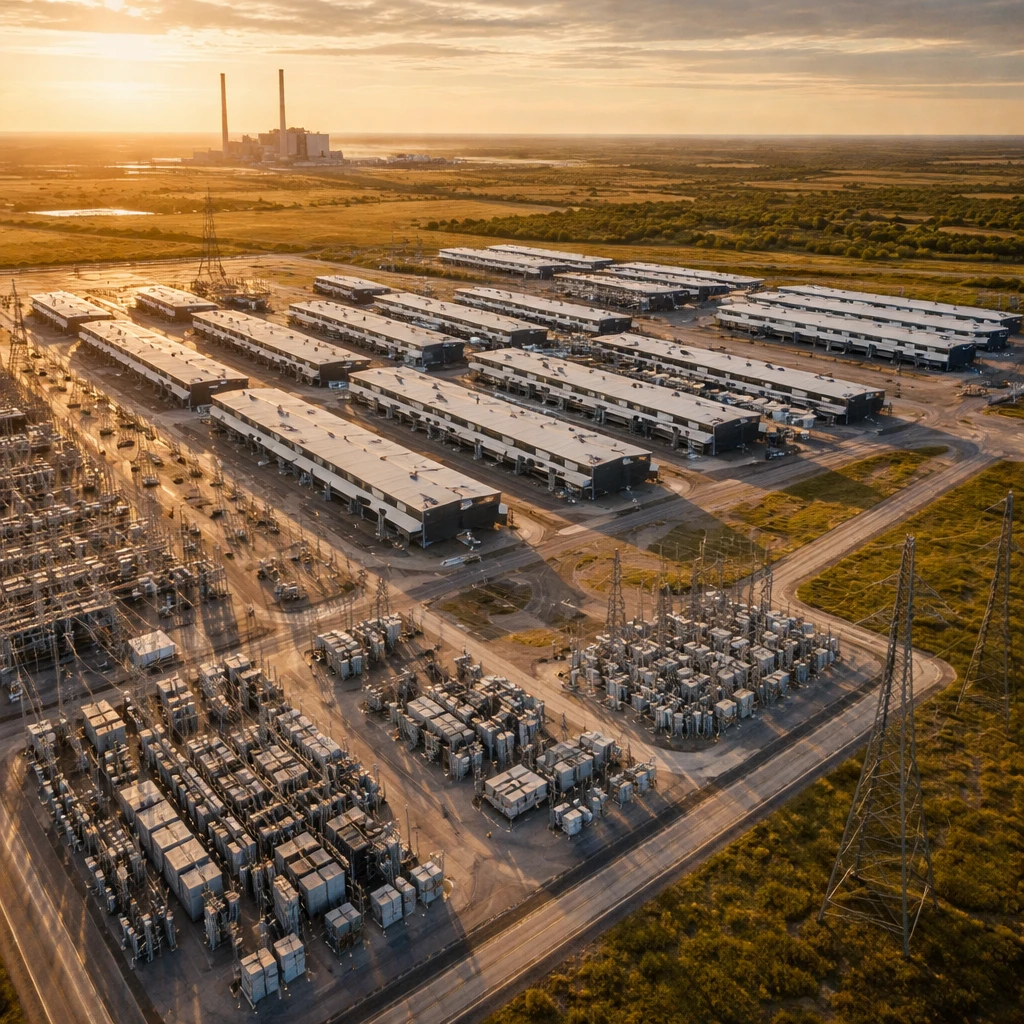
Riot Platforms vaulted higher in pre-market trading after unveiling a long-term contract to host Anthropic’s AI compute at its Rockdale, Texas campus. The agreement, which covers 191 megawatts of capacity for 20 years through June 2048 with extension options that could expand total value, has prompted investors to reprice not only Riot but the broader group of publicly traded bitcoin miners that hold large, contracted power footprints.
Under the terms announced, Anthropic’s commitment to Riot runs through mid-2048 and may be extended, potentially increasing the headline value. When paired with an earlier agreement Riot reached with AMD, the company now reports 241 megawatts of contracted capacity and nearly $9.8 billion in long-term revenue. At full delivery, Riot estimates this contracted portfolio could generate average annual revenue in the neighborhood of $520 million.
Analysts reacted quickly. H.C. Wainwright raised its price target on Riot to $40 from $25, and Needham moved its target to $30. Market participants are rewarding the predictability of contracted megawatts rather than exposure to mined bitcoin prices.
Sector reaction and comparative moves
Riot’s headline move drove a sympathy rally across major miners, although none matched Riot’s magnitude of gains. Pre-market and intraday quotes showed broad-based buying interest across names with material power portfolios:
- Riot Platforms (RIOT) - pre-market price rose to $23.64, up 21.9%.
- Cipher Mining (CIFR) - trading reflected gains in the high single digits.
- Hut 8 Corp (HUT) - shares were bid after the company’s large contracted backlog was highlighted.
- TeraWulf (WULF) - also saw positive moves consistent with its own Anthropic-related commitments.
- CleanSpark (CLSK) and Marathon Digital (MARA) - attracted buying interest, though performance varied by name.
All price and market-cap figures referenced were current as of Tue, Aug 11, 2026 at 10:33 AM EDT.
Where the deals already exist - and which companies lead
Riot’s transaction is not unprecedented. Several miners have already executed large, multi-decade data center leases with AI customers or have disclosed substantial contracted pipelines. Key examples include:
- Hut 8 Corp stands out as the sector’s leader by contracted AI data center value, with $26.6 billion across 949 megawatts of IT capacity. Its Beacon Point campus alone carries roughly $19.6 billion of base-term contract value. Hut 8 also closed $7.5 billion in investment-grade project financing in Q2, signaling institutional capital support for these projects.
- TeraWulf has signed a 20-year lease with Anthropic for a 401 megawatt campus in Hawesville, Kentucky, valued at $19 billion. That 401 megawatts exceeds Riot’s 191 megawatts commitment.
- Cipher Mining reports an $11.4 billion contracted revenue pipeline tied to a 5.3 gigawatt portfolio, although it is in transition. Cipher reduced hashing to focus on building its Black Pearl high-performance computing campus, a move that drove a year-over-year decline in Q2 bitcoin mining revenue.
- Marathon Digital is described as a laggard relative to its peers, down materially over the past year even as other miners appreciated significantly. Marathon’s board has added directors with energy and data center backgrounds, indicating a potential strategic shift toward AI infrastructure.
Why the Anthropic-Riot arrangement matters for the group
The deal carries implications that extend beyond Riot because it reinforces the thesis that bitcoin miners’ secured, low-cost power and site infrastructure are valuable to AI hyperscalers. The transmission mechanism laid out by market participants centers on two elements:
- Power as a strategic asset - Miners historically secured competitively priced, contracted electricity to support mining operations. Those same power contracts and interconnection agreements are attractive to AI compute customers that require large, reliable energy supply for sustained workloads.
- Revenue quality - Mining revenue is inherently volatile and correlated with cryptocurrency cycles. In contrast, long-term data center leases provide contracted, predictable revenue streams that lenders and institutional investors can underwrite. That shift in revenue mix is part of why analysts are modeling substantially higher, steadier operating income once these deals are fully operational.
Analysts at H.C. Wainwright projected a Riot net operating income range on a fully delivered basis that supports the firm’s higher target price. Nonetheless, the transition includes execution risk: several miners reported misses in recent quarters tied to the shift in operations. Cipher posted Q2 EPS below expectations as it curtailed hashing to facilitate campus builds, and Riot itself reported an adjusted Q2 EPS below consensus. The market appears willing to price in the long-term contracted cash flows rather than short-term results.
Which miners are best positioned for additional AI deals
Investor discussion has focused on firms with sizeable developable power and existing site infrastructure. Names often cited include Hut 8, with substantial utility capacity in Texas; Cipher, with a multi-gigawatt portfolio and new sites near San Antonio; Marathon, viewed as having optionality if it executes on a strategic pivot; and CleanSpark, where some analysts maintain upside to current share prices on valuation assumptions tied to its power assets.
Key takeaways
- The Riot-Anthropic agreement marks a high-profile example of bitcoin miners leveraging contracted power to host AI compute, and the deal has triggered a revaluation across the sector.
- Several miners already hold larger multi-decade commitments, underscoring that Riot’s arrangement is part of an ongoing trend rather than an isolated transaction.
- Execution and timing risk remain material as mining revenue can decline before data center revenues ramp; recent quarterly results from players that are transitioning illustrate that dynamic.
Conclusion
Anthropic’s commitments, when aggregated across counterparties, represent a sizable pipeline of compute demand that mines with gigawatt-scale, contracted power portfolios are positioned to serve. The market is rewarding contracted megawatts and the attendant revenue visibility, while also baking in the assumption that companies can execute on site conversions and financing. Investors and analysts will continue to monitor quarter-to-quarter results for evidence that data center income is replacing, rather than merely supplementing, declining mining receipts.