
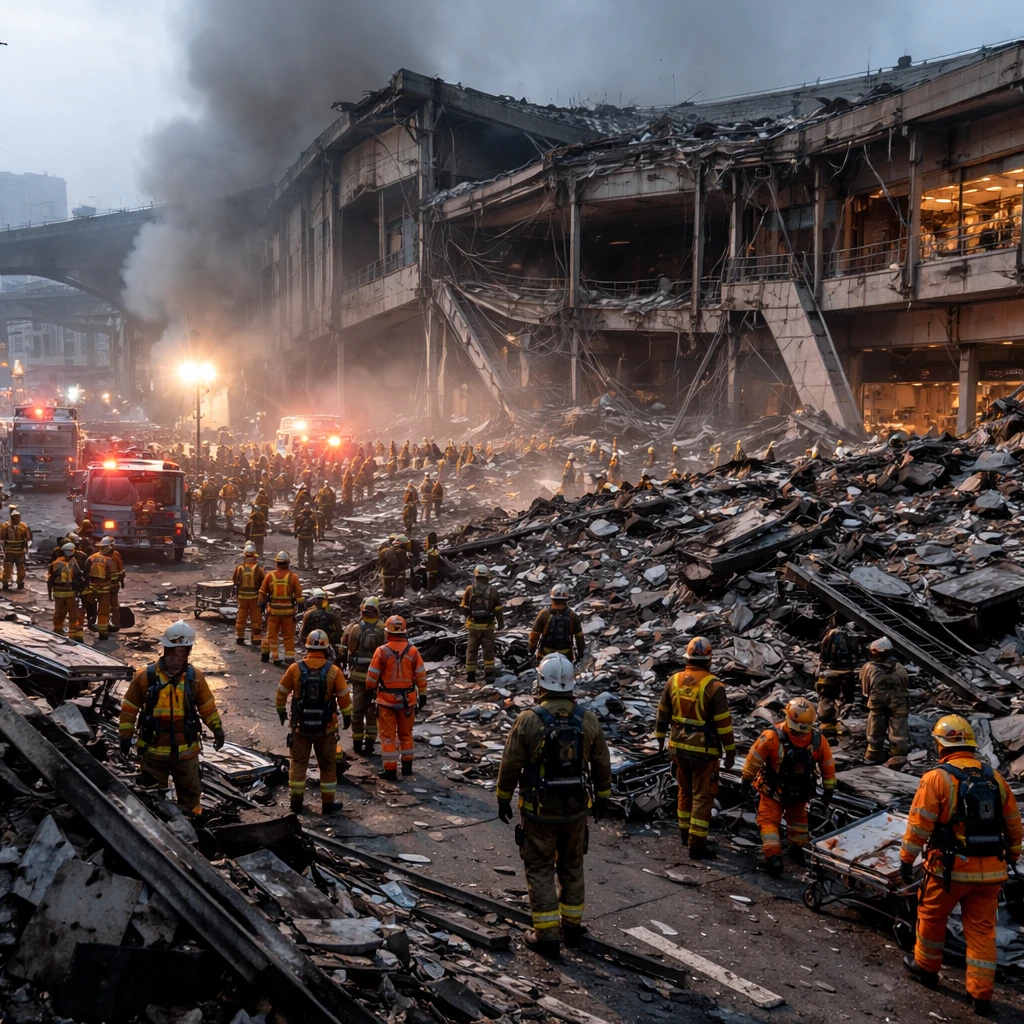
Rescue operations continued into Wednesday after a 7.1-magnitude earthquake shook southern Japan, leaving at least 13 people dead and widespread damage across central Kyushu. The temblor toppled parts of a large shopping centre near Kumamoto City, disrupted power to thousands of households and fractured roads in multiple municipalities.
Emergency teams managed to extract eight people from the rubble of a partially collapsed Aeon shopping mall close to Kumamoto, after what local reports said appeared to be an explosion about an hour after the initial quake on Tuesday. Of those pulled from the wreckage, three were later confirmed dead. The mall operator said that after checks of roughly 2,700 staff, four workers at the Kumamoto shopping centre remained unaccounted for. Customers had evacuated the building immediately after the initial shaking.
"Even now, there are people waiting to be rescued, and this is a race against time. We will marshal all available resources on the ground to save and rescue as many people as possible," Prime Minister Sanae Takaichi said at a briefing in Tokyo.
Authorities and media outlets said investigators were looking into whether a gas explosion contributed to the partial collapse of the mall. Rescuers reported smelling gas inside the building, and Japan’s top government spokesperson Minoru Kihara said the exact cause of the incident remained under investigation. Emergency fire rescue squads, police and about 170 army personnel concentrated their efforts on sections of the mall where calls for help had been received. Across the affected zone, more than 4,500 soldiers have been mobilised to assist recovery efforts.
In a separate incident, a chimney collapsed at a Nippon Paper Industries factory, leaving seven people missing and four others seriously injured, a local government official said. Hospitals around the prefecture were treating dozens of patients, and one facility in Uki city reported that a power outage had reduced its operations to the point of functioning like a field hospital.
Another hospital in Uki said it had taken in 86 injured people following the quake and subsequently suspended admissions because it could not handle additional emergency cases; three of the injured were described as having serious injuries. Emergency services logged 386 calls from residents seeking assistance or reporting collapsed structures, police said.
The quake’s epicentre was located about 20 km south of Kumamoto City, the largest city in central Kyushu with an estimated population of around 700,000. Yatsushiro, one of the hardest-hit cities, showed visible signs of structural damage: roofs were torn, a number of homes had partially collapsed, and roads leading to the coastal town were buckled and cracked. Part of a bridge gave way into the Kumagawa River, drawing residents to the scene.
Across the prefecture, authorities instructed roughly 260,000 people to move to evacuation centres. With temperatures climbing to around 34 degrees Celsius (93 degrees Fahrenheit) on Wednesday and more than 36,000 homes still without power, officials warned of increased heat stroke risk for displaced residents and those sheltering without adequate cooling.
Public warnings were also issued for the likelihood of further strong tremors for about a week in areas that experienced the strongest shaking, together with heightened risk of landslides on unstable slopes.
Several major manufacturers with operations in or near the quake zone announced pauses or adjustments to production. Plants run by Renesas Electronics, Sony, Tokyo Electron and Honda suspended operations, and Toyota Motor said it would halt work at three factories outside Kumamoto prefecture through Friday in consideration of supplier disruptions. TSMC evacuated staff from its local plant as a precaution and began resuming operations late on Tuesday, the company said.
The collapse of the Aeon mall drew intense attention. One side of the multi-level mall, which houses about 200 stores, was torn away in footage shown by local media, exposing steel supports and strewing debris across the adjacent parking area. Emergency teams focused on areas where they had received distress calls as they searched for survivors amid unstable structures and reports of gas smells.
Japan lies on the so-called Ring of Fire and accounts for a substantial share of the world's higher-magnitude earthquakes. A decade earlier, a devastating quake in Kumamoto killed 275 people, injured 2,739 others and damaged thousands of buildings, including portions of the city's historic castle. In Tuesday’s quake, several historic structures sustained damage as well, with shrines losing sections of heavy tiled roofs and a 17th-century tea house reported partially ruined.
Transport services were also affected. Operators said passengers aboard high-speed trains that were moving at the time of the quake sustained injuries and services were immediately suspended. The combination of structural damage, power outages and transportation halts has left authorities and businesses focused on search-and-rescue priorities and on stabilising logistics for both residents and industry.
Local officials continue to coordinate emergency medical care, evacuation sheltering and infrastructure repairs while investigators probe the causes of building collapses and the possible involvement of gas leaks. With many residents displaced and key factories offline, the immediate focus remains on saving lives and stemming further harm as rescue teams press through damaged zones.