
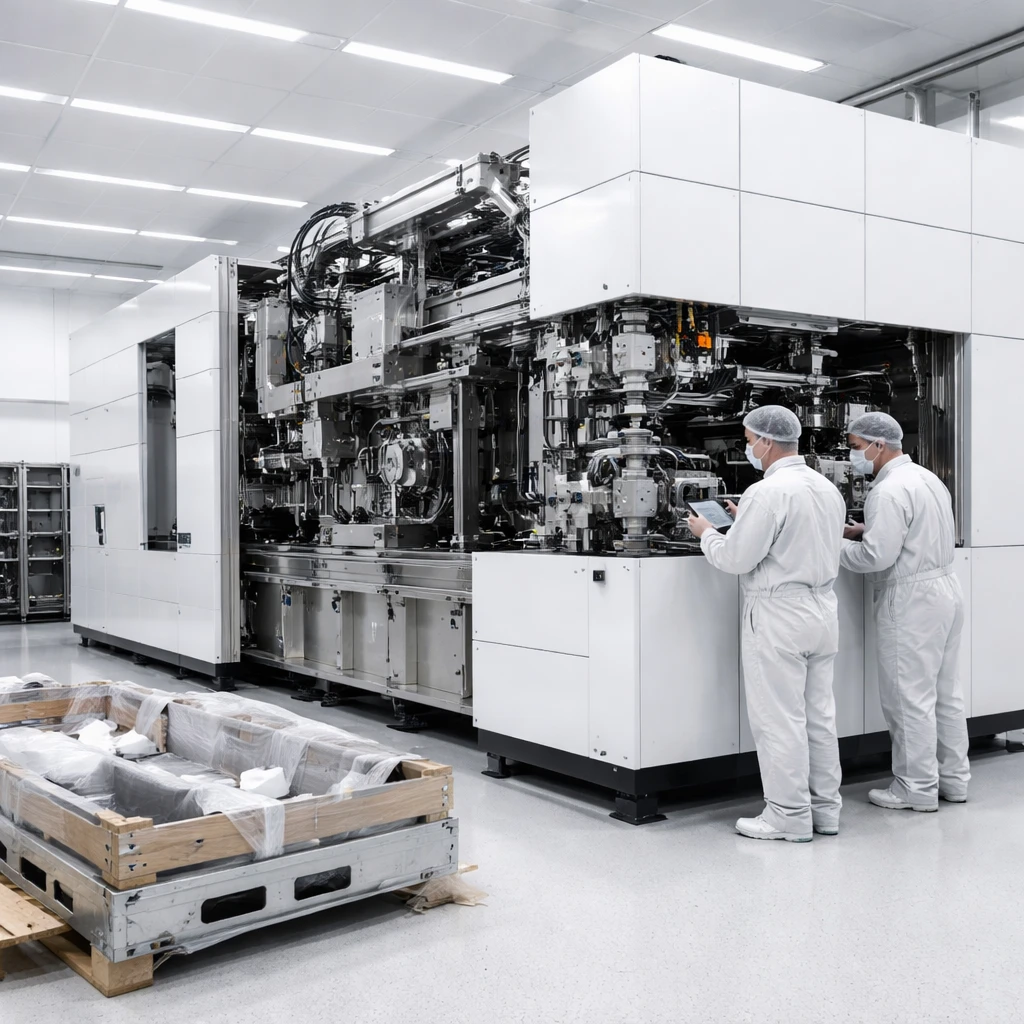
ASML's stock fell sharply in mid-day trading, sliding 7.9% to $1,776.18 as investors reacted to an intensifying dispute with U.S. officials over alleged export-control breaches. The core allegation communicated in recent meetings between U.S. Commerce Secretary Howard Lutnick and ASML leadership is that one of the company’s most sophisticated extreme ultraviolet (EUV) lithography systems may have been transported to China in violation of longstanding shipment restrictions.
ASML issued a clear rebuttal to the allegation, stating: "ASML has never shipped an EUV machine to China nor have we shipped to China any component, module or equipment specially designed to be used in an EUV machine." Senior administration officials told Bloomberg they possess evidence pointing to EUV-related components and transport equipment being shipped to China, though that material has not been made public and reportedly was not shared with ASML, a point the company has categorically denied.
Compounding the immediate regulatory overhang, a bipartisan congressional bill under consideration would ban all ASML deep ultraviolet (DUV) shipments to China - an end market that represents roughly 20% of the company’s projected 2026 revenue. That legislative threat is advancing through committee and introduces a separate potential constraint on a product line that contributes materially to ASML's top-line outlook.
Analyst sentiment has offered some offset: in the prior session both Wells Fargo and Bank of America raised their price targets on ASML, to $2,200 and $2,345 respectively. Those bullish revisions, however, were insufficient to counter the weight of the export-control headlines and investor concern over revenue exposure to China.
China remains ASML’s largest single market even as its share of sales has reportedly moved from about one-third of revenue toward nearer one-fifth. Given that shift, the unresolved dispute with U.S. authorities constitutes a tangible financial risk, particularly if regulatory actions or legislation limit ASML’s ability to serve that market.
The market backdrop offered no cushion. Technology and growth stocks were broadly weaker on the session, with the NASDAQ down 1.9% and the S&P 500 off 1.3%, a risk-off environment that tends to magnify selling pressure in high-valuation names such as ASML.
The combination of a specific, unresolved government allegation regarding an EUV shipment, the specter of sweeping new DUV export restrictions, and a risk-averse macro market pushed ASML well below its recent 52-week high of $1,959.04. Investors are now weighing the regulatory and revenue risks against the company's long-term demand drivers tied to semiconductor investment.
What to watch next
- Whether evidence cited by U.S. officials is disclosed publicly or shared with ASML.
- Progress of the bipartisan bill seeking to ban DUV shipments to China through committee stages.
- Market reaction as broader technology sector sentiment evolves.