
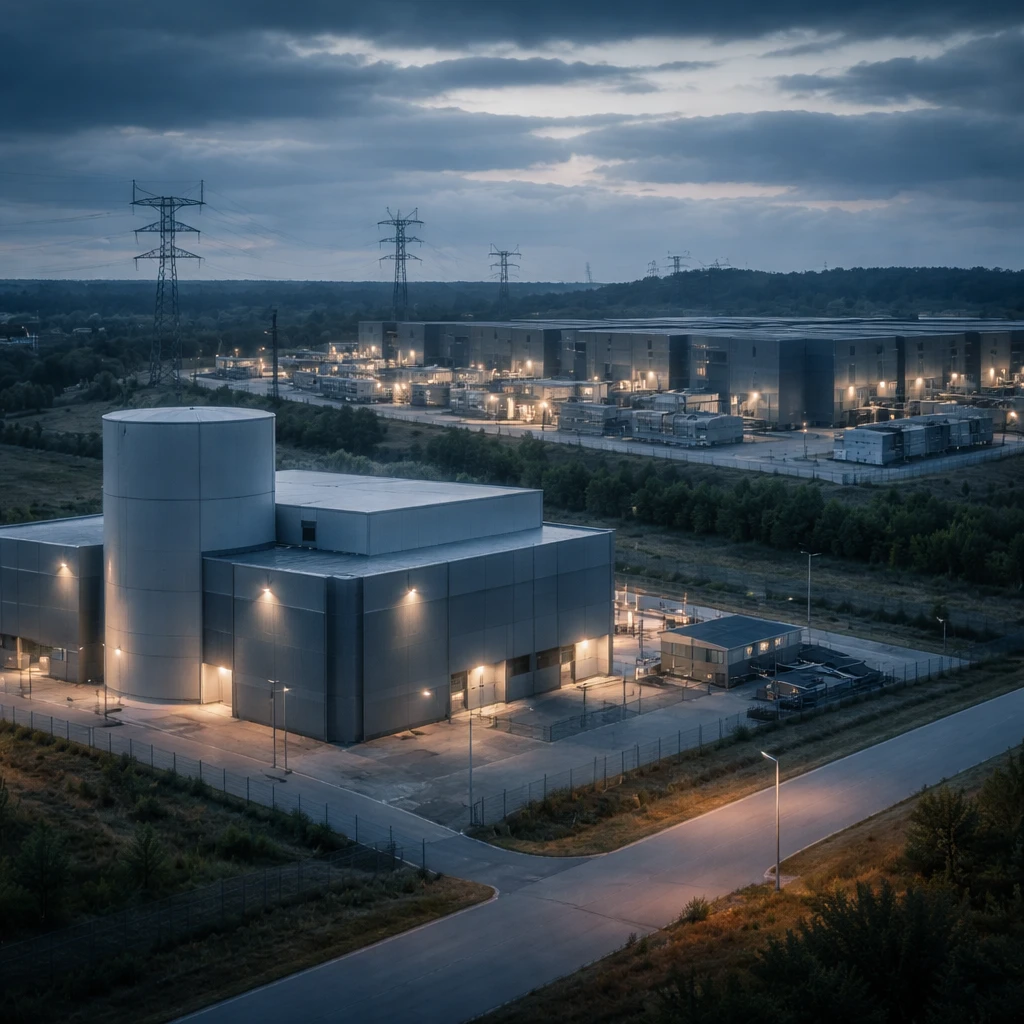
Overview
Oklo Inc was named on Jul 21, 2026 as a recipient of a $200 million federal initiative designed to fast-track nuclear reactor deployment for AI data centers, in partnership with Microsoft and Nvidia. The announcement represents a significant institutional endorsement for a company that remains pre-revenue, but the market reaction has left the stock trading at $40.66 - roughly 79% below its 52-week high of $193.84 and close to its annual floor of $39.53.
Macro backdrop: an acute power demand story
The near-term commercial case for Oklo rests on a widening mismatch between electricity supply and the needs of hyperscale AI operations. Goldman Sachs has raised its global data center capacity forecast to 217 GW by 2030 from a prior estimate of 168 GW, implying roughly $6 trillion in capital spending and with an expectation that 60 to 70% of new capacity will be sited in the U.S. At the same time, U.S. electricity demand is projected to grow at a 3.5% compound annual growth rate through 2030. The PJM grid in Northern Virginia, an area described in this context as the world’s data center hub, recently absorbed a roughly 3 GW demand shock. Those figures frame the problem Oklo is targeting: customers that need reliable, always-on power as AI deployments balloon.
The federal catalyst and what it means
Being chosen for a $200 million federal program alongside Microsoft and Nvidia gives Oklo a form of credibility that matters for a pre-revenue company. Pairing with two of the largest potential technology buyers signals commercial interest from powerful counterparties and serves as a de-risking event from the perspective of market perception. However, endorsement alone does not eliminate the fundamental execution and regulatory steps that must be completed before material revenue arrives.
Where the market sits now
Key trading metrics highlight the disconnect between narrative and valuation. Oklo shares are quoted at $40.66, up modestly on the day, with a market capitalization of $7.06 billion. The 52-week trading range is $39.53 to $193.84; year-to-date performance is down 45.16% and the six-month decline is 52.42%. On a technical front, the daily Relative Strength Index sits at 32.3, inside oversold territory. Intraday moves for the tech partners were mixed: Microsoft was higher while Nvidia traded lower in the same session.
The bullish case
- Federal and commercial validation: The $200 million federal initiative that pairs Oklo with Microsoft and Nvidia materially reduces some commercial uncertainty by demonstrating buyer interest and policy support.
- Product fit for AI customers: Oklo’s fast neutron small modular reactor design is positioned to serve data centers that require always-on power, which could translate into high-margin direct Power Purchase Agreements if scaled successfully.
- Structural demand tailwinds: Goldman’s upgraded data center capacity forecast, rising U.S. electricity demand, and the PJM grid shock underpin a clear need for dispatchable, continuous generation options.
- Valuation floor: Trading close to the 52-week low reduces immediate headline downside, although the floor itself could shift with new information.
- Analyst context: Pre-collapse analyst price targets from October 2025 ranged from $65 (UBS) to $175 (Canaccord Genuity), figures that now require reassessment given the company’s selloff and evolving fundamentals.
The bearish case
- Pre-revenue status and capital intensity: Oklo is not expected to generate reactor revenue until the latter part of 2027 at the earliest. Current cash burn, estimated at $65 to $80 million per year, implies notable dilution risk for equity holders unless additional capital is secured.
- Regulatory and permitting uncertainty: The company has not yet filed a Nuclear Regulatory Commission Combined License Application. Permitting delays are flagged as the single largest wildcard for timing and costs.
- Fuel supply exposure: Oklo’s model requires High-Assay Low-Enriched Uranium (HALEU), a supply chain element that remains heavily entangled with geopolitical risk and limited availability.
- Technical indicators and chart patterns: Short- and long-term technical reads across multiple timeframes register as 'Strong Sell' with momentum indicators such as MACD deep in negative territory and the Average Directional Index confirming trend strength. A weekly Dark Cloud Cover pattern observed on Jul 27 is cited as an additional bearish signal.
- Scale versus valuation: The company faces an estimated deployment cost of $2.4 billion for its stated plans while carrying a market capitalization of $7.06 billion despite no operating revenue, underlining the gap between ambition and current financials.
Investment take
Oklo represents a long-duration infrastructure proposition masked by venture-style execution risk. The problem set it seeks to solve is tangible and increasingly urgent for AI operators; the federal program and tech partnerships reinforce that narrative. Yet significant hurdles remain between policy validation and commercial profitability. The market's sharp de-rating reflects a shift to a 'show me' valuation where investors are demanding demonstrable regulatory progress and clearer evidence of scalable economics.
For investors who can tolerate binary outcomes and have a three- to five-year horizon, a small, staged exposure could be justified by the combination of oversold technicals, the federal catalyst, and the structural demand thesis. For more conservative participants, waiting for a filed COLA and visible NRC progress may offer lower-risk entry points, given that those milestones materially reduce the binary regulatory risk that now dominates Oklo’s outlook.
Summary
Oklo’s inclusion in a $200 million federal initiative alongside Microsoft and Nvidia strengthens the company's narrative in the face of escalating AI-related power demand. Nonetheless, deep valuation compression, near-term cash burn, unfiled regulatory applications, fuel supply concerns, and negative technical signals create a meaningful execution risk profile that investors must weigh against the macro opportunity.