
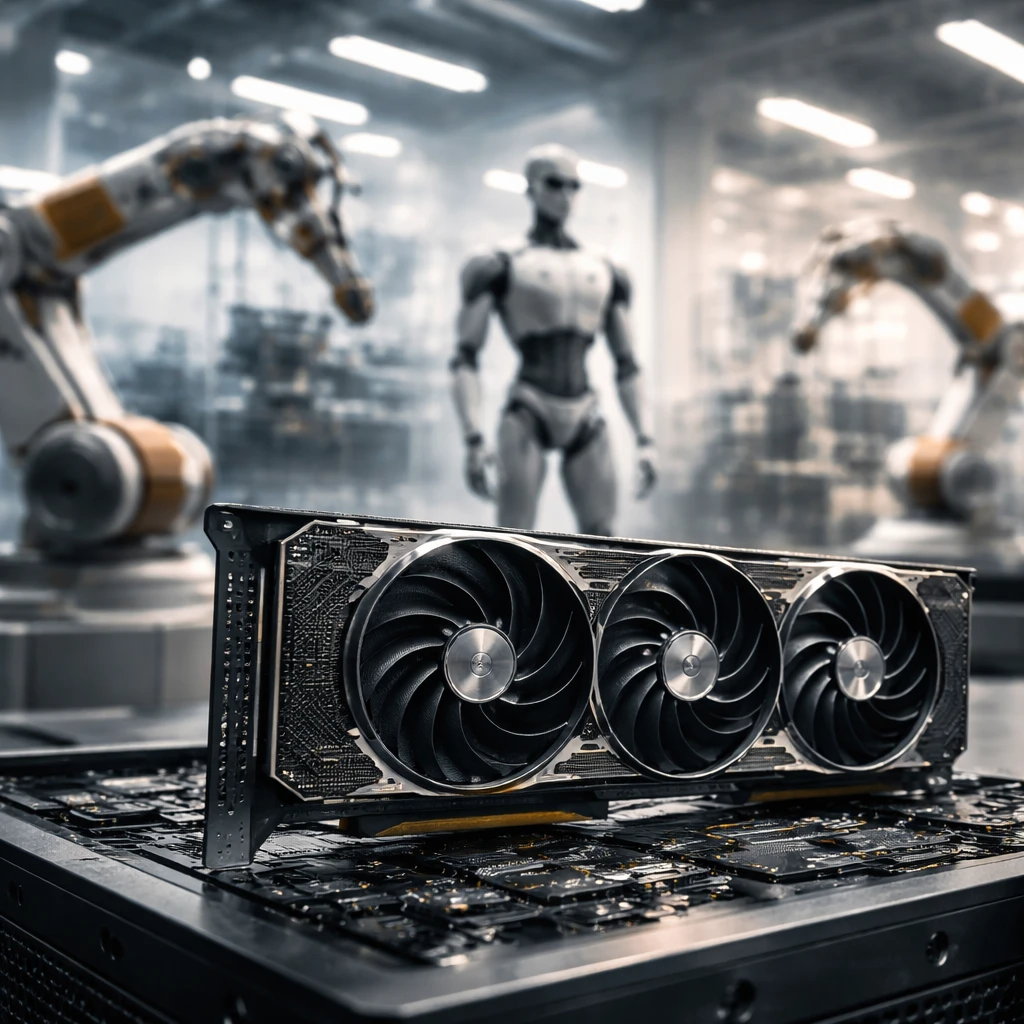
NVIDIA (NVDA) is emerging as the dominant infrastructure provider for what industry participants call "Physical AI" - the collection of robotics, humanoids and autonomous machines that require both simulated training environments and high-throughput inference in deployed systems. At $197.24, down 4.64% on the trading day, the pullback has prompted renewed debate over whether this is a tactical buying opportunity for investors focused on the robotics supply chain.
Physical AI has a consistent technical demand: simulation plus inference compute. NVIDIA offers both elements. On Jul 19, NVIDIA integrated its Omniverse libraries directly into its Agent Toolkit, enabling GPU-accelerated physics simulation and RTX sensor modeling inside 3D environments - the exact type of virtual training environments used to prepare agents and robotic controllers prior to real-world deployment. Earlier in the month, on Jul 15-16 in Tokyo, CEO Jensen Huang announced partnerships with Fanuc and Yaskawa Electric, two major industrial robotics firms, and stated that "AI will make robots smart, easily adaptable, and accessible." Those moves tie NVIDIA's compute and modeling software into the workflows of established robotics manufacturers.
Market metrics underline the scale and profitability of NVIDIA's business. The shares are trading at $197.24 following the decline, while the company reports revenue growth of +71% on a last-twelve-month basis, a market capitalization of roughly $4.9 trillion and a gross margin near 73.5%. Analysts' consensus for bullish price targets spans roughly $200 to $240. Observers also note that NVIDIA's CUDA ecosystem generates significant switching costs: even, per reports, DeepSeek remains heavily dependent on NVIDIA chips despite U.S. export restrictions. That ecosystem lock-in plays into the argument that NVIDIA functions as a picks-and-shovels provider to multiple robotics vendors rather than competing as a single robotic OEM.
By contrast, Tesla (TSLA) represents a higher-variance way to gain exposure to Physical AI. Tesla shares at $309.51 are cited as the "highest-upside, highest-risk" bet in this space. Optimus humanoid production in Fremont was described as imminent in late July/August in earlier commentary, and BofA projects as many as 1.2 million humanoid shipments by 2030. But Tesla faces a complex execution slate: it must scale robotics production while running its auto business, pursue a robotaxi rollout and absorb the effect of 14 analyst earnings-estimate downgrades. Those factors contribute to the view that Tesla carries greater operational and forecast risk versus a supplier like NVIDIA, which benefits regardless of which robotics OEM ultimately wins market share.
Key contrasts investors watch include potential competition from custom silicon developed by large cloud providers or other chipmakers, which could erode NVIDIA share; and valuation sensitivity, where high multiples mean growth shortfalls would materially affect expectations. Proponents argue NVIDIA's low price-to-earnings relative to near-term earnings growth - PEG-favorable in their view - and broad analyst support for sales expansion create a favorable trade-off. Skeptics point to elevated valuation metrics such as a high EV/EBITDA and the firm's beta near 2.1, which increases equity volatility and can magnify downside on market stress.
In short, NVIDIA is positioned as the infrastructure play for Physical AI: it supplies the compute, simulation tools and software that robotics firms integrate into their products. Today's 4.64% pullback - attributed in market commentary to competition from Chinese AI model efforts rather than anything specific to robotics - creates a divergence between short-term market noise and the longer-term case for an expanding robotics compute ecosystem. For investors, the choice frames as buying the armory of AI compute versus backing individual robot builders that must execute across manufacturing and commercialization hurdles.
Bottom line: NVIDIA acts as a horizontal supplier to the robotics and autonomous-systems market, capturing upside from multiple potential winners. The recent price decline is viewed by proponents as a tactical opportunity, while risks around competition and valuation remain key considerations.