
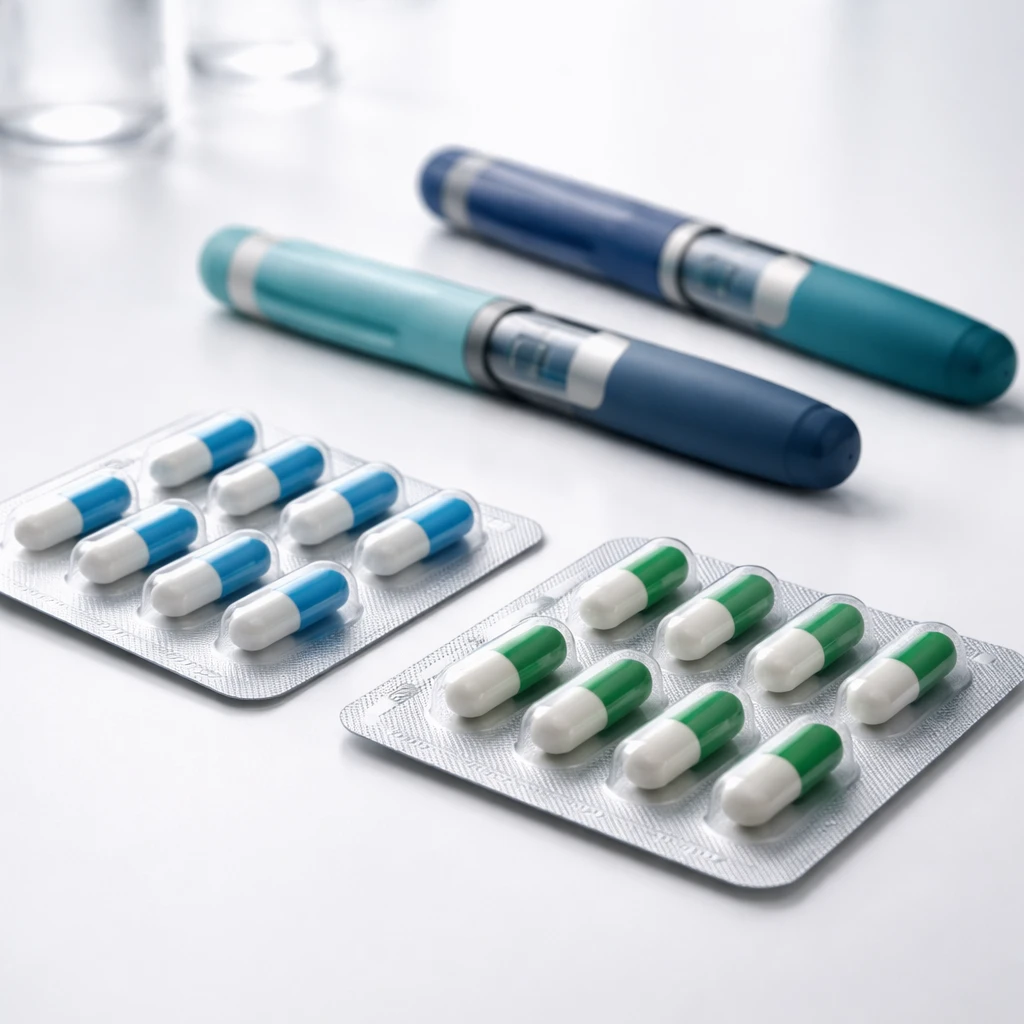
After a bruising period marked by profit warnings, leadership turnover and a sliding share price, Novo Nordisk is showing signs of regained momentum as it squares off with Eli Lilly in the contest for obesity treatments.
Investors who endured two difficult years for the Danish drugmaker have seen some relief recently. Novo's stock has risen about 35% from a March low, helped in part by uptake of its new oral Wegovy weight-loss pill. The pill is maintaining an edge over Lilly's more recent oral entrant, Foundayo, according to prescription data and analyst commentary.
The rivalry between Novo and Lilly is playing out as the obesity drug market expands rapidly. Analysts cited in recent reporting expect the U.S. market alone to exceed $100 billion by the end of this decade, making competition over market share especially consequential for both companies and for investors focused on the branded pharmaceuticals sector.
Context and investor outlook
Many shareholders and analysts say they will look for confirmation that Novo's rebound is durable when the company reports second-quarter results on August 5. Eli Lilly is scheduled to report on the same day, and analysts broadly anticipate continued strength in sales of its weight-loss and diabetes injections, Mounjaro and Zepbound.
Recent IQVIA prescription data indicate demand for oral Wegovy remains stronger than some analysts initially expected, and well above prescriptions for Lilly's Foundayo. Barclays cautioned, however, that IQVIA's figures may understate total Foundayo demand because they omit certain distribution channels. Barclays analyst James Gordon used Foundayo's generic name orforglipron and said, "One of the concerns had been that orforglipron from Lilly was going to come along and make things a lot tougher for oral Wegovy. But so far... orforglipron doesn’t really seem to have impacted the product."
What led to Novo's downturn and the path to recovery
Throughout 2025, Novo was largely on the defensive. A combination of U.S. pricing pressure and intensifying competition triggered four guidance cuts and erased billions in market value. The company also underwent executive change at the top and implemented a restructuring that reduced headcount by 9,000 jobs. A failed heart disease drug trial further constrained the firm's ability to demonstrate growth beyond its core obesity and diabetes franchises.
This year, Novo launched the oral formulation of Wegovy in the U.S. in January, and that product has been central to hopes that the worst of the company's recent troubles may be behind it. While oral Wegovy has boosted sentiment, the broader competitive landscape remains complex. Lilly's Zepbound injection overtook Wegovy injections last year and has kept a strong lead in the U.S., with weekly prescription volumes more than double those of Novo's injection in recent months.
HSBC analyst Rajesh Kumar framed the debate around timing: "The real question is...when is the inflection point? Which particular quarter looks like a trough, and then do we see growth back from that point?" He noted that expectations for 2026 have improved partially because generic competition to Wegovy is arriving later than previously expected, shifting some pressure into 2027 rather than removing it outright.
Competitive tactics and courtroom confrontation
Competition between the two companies has spilled beyond the pharmacy counter and into the courtroom. Novo sued Lilly last month in a U.S. federal court, accusing the rival of false advertising by using efficacy comparisons that Novo says omit its newer, higher-dose Wegovy. Lilly has denied the allegations.
BMO analyst Evan Seigerman characterized Novo's legal action as an attempt to be more "aggressive" and to "make some noise," even if the suit itself may not materially alter market share dynamics. He said the lawsuit reads in part like an effort to use publicity to shift perceptions.
Others offer a more skeptical view of litigation as a remedy for commercial positioning. Sven Borho, managing partner at Orbimed, said the suit is unlikely to overturn the U.S. perception that Zepbound is superior to Wegovy, and suggested Novo would need dealmaking in the obesity space to convince the market it can challenge Lilly over the long term.
Market expectations and what to watch
Analysts say Novo could modestly raise its full-year outlook if momentum in oral Wegovy persists, though the more important signal for many investors may simply be the absence of further profit warnings. Markus Manns, a portfolio manager at Union Investment, said that even without a guidance increase, it would be reassuring to see the company exit the era of repeated profit warnings.
With both companies reporting results on August 5, market participants will be watching sales trends for oral and injectable formulations, commentary on pricing and competition, and any management signals about the durability of revenue growth. Because prescription-level data can understate certain channels and because new formulations are still being absorbed by payers and prescribers, interpretation of sales figures will require careful attention.
Summary of implications
- Biopharmaceutical investors are monitoring whether Novo's improved stock performance and oral Wegovy demand indicate a lasting recovery.
- The outcome of the Novo-Lilly rivalry will affect market dynamics across obesity and diabetes treatments.
- Prescription trends, distribution-channel nuances and timing of generic entrants are central variables shaping near-term expectations.