
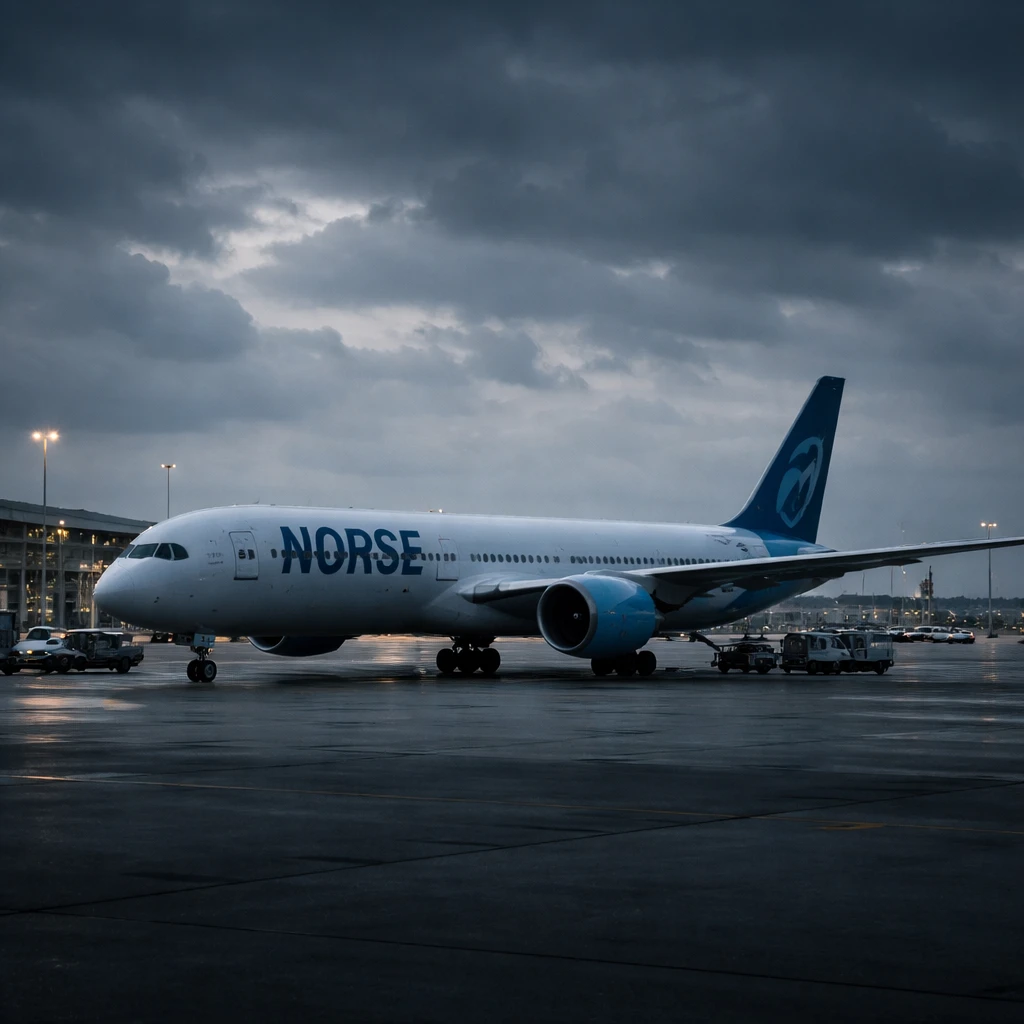
Norse Atlantic, the Norwegian low-cost long-haul carrier, stopped flying on Thursday and said it will file for bankruptcy if it cannot obtain urgent short-term financing. The airline described its liquidity situation as critical and signalled that without immediate funding the board intends to pursue insolvency proceedings.
The company attributed the deterioration in its finances to sharply higher fuel costs following the conflict linked to Iran, saying it had not hedged fuel and had been operating at reduced capacity. Those two pressures, the carrier said, have hit a business model that depends heavily on fuel-intensive, long-distance flights.
On Wednesday, Norse had issued a warning that it needed fresh funding to meet near-term liquidity requirements and continue operations, a statement that triggered an 85% collapse in its share price. Trading of the stock remained volatile on Thursday after the Oslo exchange placed Norse in a recovery box reserved for firms with acute financial uncertainty; by 1002 GMT the shares had ticked up roughly 9%, reflecting sharp intraday swings.
The scale of the value destruction has been stark. Market participants have seen around 99% of Norse’s market capitalisation vanish over the course of the year. That collapse accompanies a broader downturn in aviation linked to geopolitical tensions and to the dramatic run-up and volatility in jet fuel prices. The company noted that European jet fuel costs more than doubled in March following supply disruptions tied to the US-Israeli conflict with Iran and have remained elevated and unstable for months thereafter.
Fuel is a substantial input for airlines, typically accounting for about one-fifth of operating costs. For a carrier whose route network is concentrated on long-haul services, the impact of higher fuel is proportionately larger. Norse said it has returned all aircraft to bases across Norway, Sweden and Britain, according to comments from CEO Eivind Roald reported in a Norwegian business publication.
"If a short-term financing solution is not secured urgently, it is the Board's intention to file for bankruptcy," the airline said in a statement on Thursday.
The company is actively exploring a number of avenues to address the shortfall. It said it remains in talks with potential investors about a takeover that would include a financing package, and that it is considering other short-term financing options. However, the airline also cautioned that there is no guarantee a viable solution will be identified.
Norse launched a formal sale or merger process in July in an attempt to stabilise its balance sheet. In October the carrier disclosed an aircraft, crew, maintenance and insurance - commonly referred to as an ACMI - arrangement with Pakistan International Airlines under which two jets would be leased. On Wednesday, PIA reported that Norse unexpectedly suspended that arrangement, a disruption that forced PIA to cancel two flights.
Industry analysts said the sudden suspension of services and of deals such as the PIA ACMI arrangement would further undermine the airline’s ability to restart operations and to restore consumer confidence in making new bookings. "The suspension of flights makes it increasingly unlikely that the airline can return to operations. There will be an impact on customer confidence for new bookings," aviation analyst John Strickland said.
Norse is not alone in being pressed by the combination of higher fuel and market stress. The article cited another carrier, airBaltic, which entered Chapter 11 bankruptcy proceedings in September and has been undergoing restructuring to secure new financing.
Founded in 2021 by Bjorn Tore Larsen after Norwegian Air exited long-haul services during the pandemic, Norse built its fleet around 12 Boeing 787 Dreamliners and recruited many former staff from Norwegian. The startup aimed to relaunch budget transatlantic flying but lacked a regional feeder network that could bring connecting passengers onto its long-haul routes. Industry observers had previously warned that the absence of feeder services would make it harder to fill planes, a challenge compounded by seasonality and price-sensitive demand.
As scheduled operations struggled to produce profits, the carrier diversified into charter work and aircraft leasing. Yet those adjustments were not enough to offset the rapid increase in costs arising from the conflict-driven jet fuel surge and the operational constraints that followed.
"Long-haul, low-cost is a difficult model," said James Halstead, managing partner at Aviation Strategy. "Fuel accounts for a huge amount of costs, and it’s difficult to get a significant cost advantage against legacy network carriers. Demand is also fickle and highly price sensitive and seasonal."
The airline's statement and the surrounding market reaction underscore the fragile financing situation for smaller long-haul carriers when confronted with sudden cost shocks. The company’s movements in recent months - from initiating a sale process to signing and then suspending an ACMI deal - illustrate both the attempts to find alternative revenue and funding routes and the limits of those measures once operational continuity is interrupted.
Summary: Norse Atlantic has suspended all flights and warned that it will file for bankruptcy without urgent short-term financing. The carrier's cash position deteriorated amid a sharp rise in jet fuel costs linked to the Iran conflict and after operating with reduced capacity; it is in discussions with investors about possible takeover and financing options but says no viable solution is assured.