
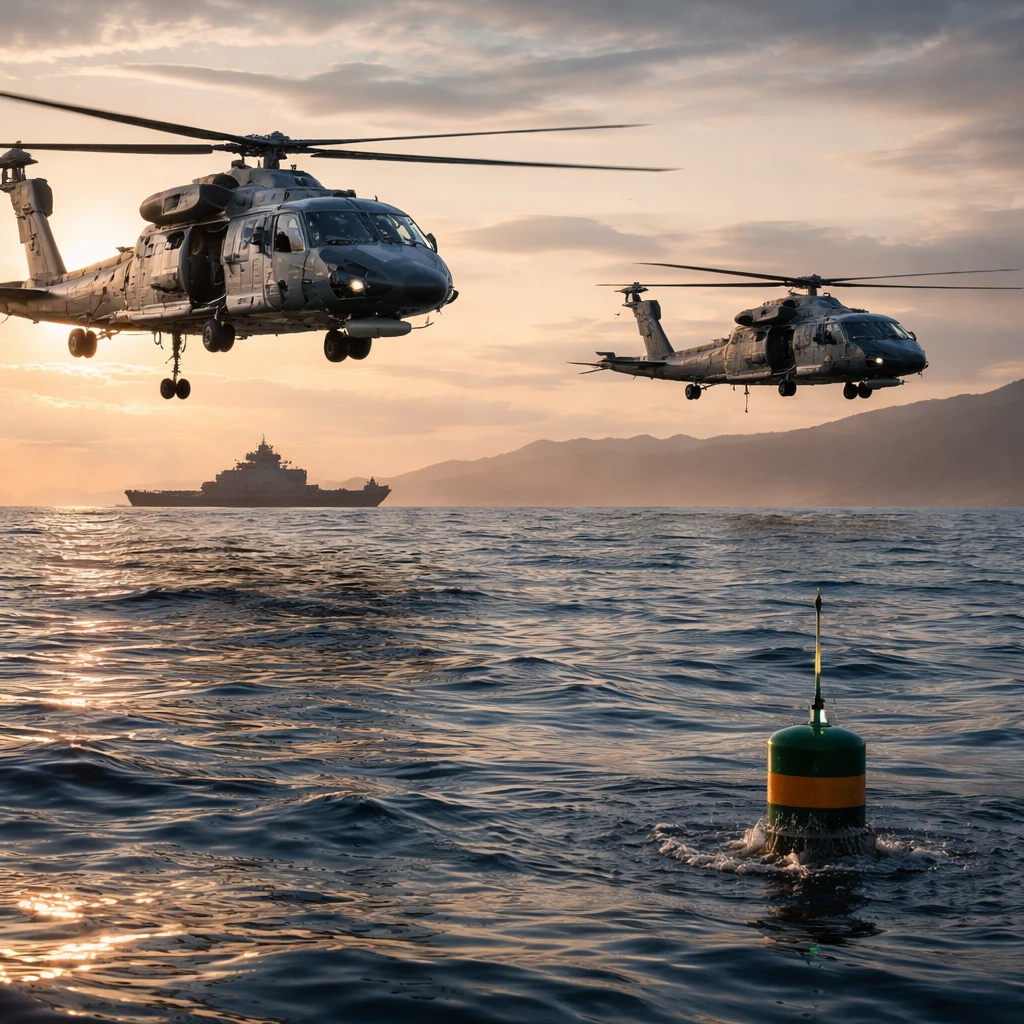
Lockheed Martin partnered with the U.S. Navy to demonstrate an artificial intelligence-enabled antisubmarine warfare tool during the RIMPAC 2026 exercises off Hawaii on Tuesday. The system, named SensorMAX, was integrated into flight operations to process underwater acoustic information and aid crews in identifying potential threats.
Two MH-60R helicopters outfitted with the technology carried out antisubmarine missions during the demonstration. Each helicopter deployed sonobuoys - sensors that pick up underwater sound - which streamed acoustic data into SensorMAX for analysis. According to Lockheed Martin, the system can handle up to eight simultaneous sonobuoy surveillance feeds, a capacity the company says is twice that of previous-generation systems.
A notable feature of SensorMAX is its ability to undergo rapid retraining. Ground operators were able to retrain the system's AI models on newly encountered sounds in less than five minutes and then push the updated models to the helicopters. The updated intelligence was transmitted using an encrypted data link, enabling the aircraft to receive software and model updates while still in flight. Lockheed Martin described the workflow as a continuous closed-loop process that includes capturing acoustic data, labeling it, retraining the models and deploying the refreshed models during active missions.
"Today’s battlespace requires the defense industry to accelerate capability delivery and seamlessly integrate commercial technology; at RIMPAC 2026 our mission focused engineers demonstrated exactly how we are meeting that challenge," said Devon Rodgers, vice president and general manager of Undersea Mission Systems at Lockheed Martin.
The company emphasized SensorMAX's portability and low weight, noting it can process mission data in airborne, maritime or ground environments. To support secure distribution of mission software and AI models to deployed aircraft, Lockheed Martin worked with FUSE Inc. The partnership enabled secure software delivery that does not interrupt operations while aircraft are deployed.
Lockheed Martin also stated that it is funding the development of the AI capabilities used in the demonstration from its own resources.
Summary
At RIMPAC 2026, Lockheed Martin and the U.S. Navy demonstrated SensorMAX, an AI and machine learning-based antisubmarine warfare system. Installed on MH-60R helicopters, SensorMAX processed acoustic inputs from sonobuoys, supported rapid retraining of models within minutes, and accepted encrypted updates during flight. The system handles up to eight simultaneous sonobuoy feeds and uses a continuous closed-loop process for model updates. Lockheed Martin partnered with FUSE Inc. to enable secure, uninterrupted software delivery and said it is developing these AI capabilities using company funds.