
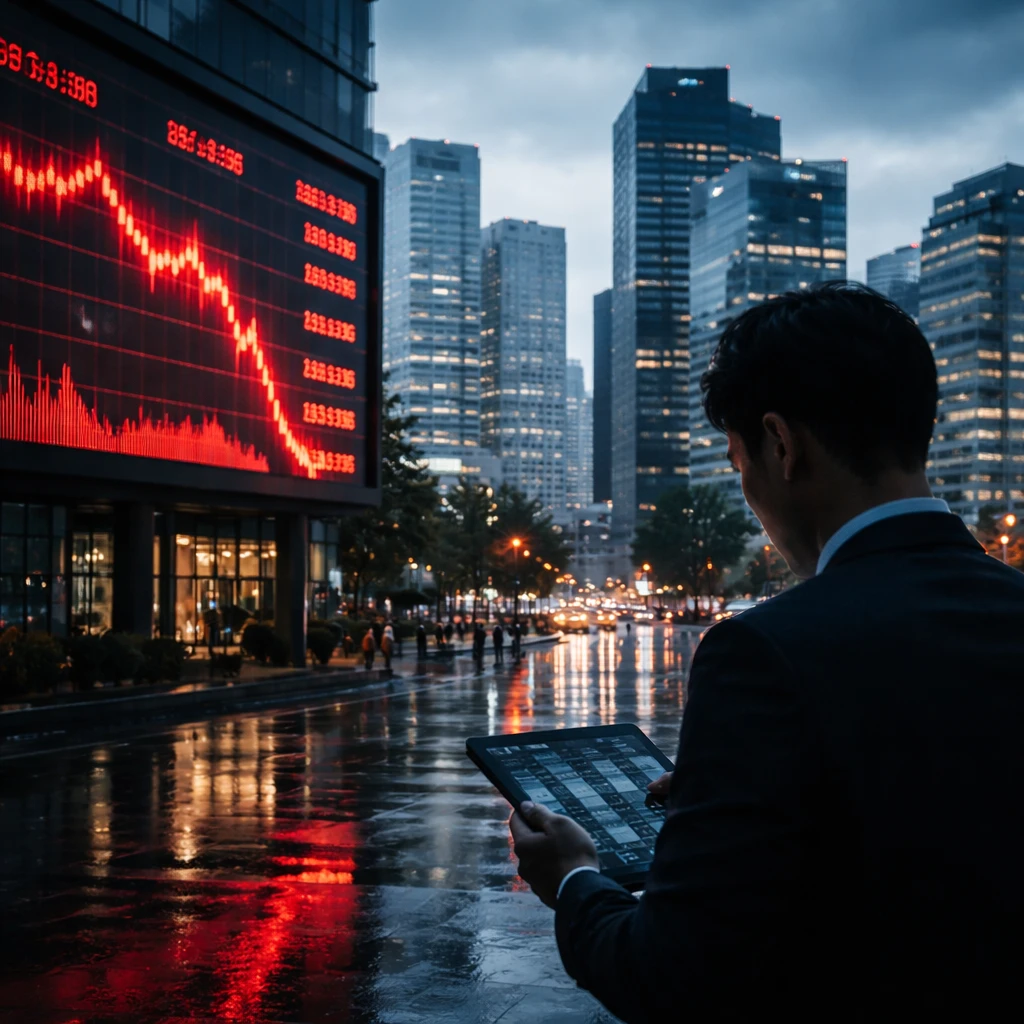
South Korea's headline equity gauge extended steep losses on Monday, tumbling more than 4% as investors turned back to semiconductor stocks that had rallied on last week's earnings reports. The decline wiped out much of a short-lived relief rally following a heavy 22% plunge in July, the index's deepest monthly drop since the global financial crisis in 2008.
Market focus remained fixed on the country's two memory-chip leaders. Samsung Electronics Co Ltd (005930) slid roughly 8% and SK Hynix Inc (000660) surrendered more than 7% on the day, applying substantial downward pressure to the broader benchmark. The two firms together make up more than half of the KOSPI's market weighting, a concentration that amplifies the index's sensitivity to shifts in sentiment toward AI-related equities.
Both companies had posted strong quarterly results in the prior week, yet the earnings releases failed to prevent renewed selling. Samsung reported an extraordinary increase in semiconductor operating profit - more than a 250-fold rise - and disclosed multi-year supply contracts with major data-centre customers, while cautioning that global memory shortages could last through 2028. SK Hynix also delivered record quarterly earnings, but investor unease lingered over what some see as overly optimistic forecasts for AI-driven demand.
July's correction laid bare how crowded the AI trade had become among market participants. Over the month, Samsung shares fell about 21% and SK Hynix tumbled around 35%, even as both stocks remained comfortably above their levels from a year earlier after sharp gains over the preceding 18 months. The scale of volatility was underscored by an unprecedented four trading halts among KOSPI constituents during July, marking a record for circuit-breaker suspensions.
Retail investor activity was a notable feature of the run-up and subsequent correction. Local estimates put inflows from individual investors into KOSPI shares at about 78 trillion won ($54.2 billion) during May and June, a surge linked to government market reform initiatives and the introduction of single-stock leveraged exchange-traded funds. In response to the extreme price moves, authorities temporarily halted new listings of such leveraged ETFs in mid-July and have since indicated intentions to introduce further measures aimed at stabilising markets and curbing excessive retail speculation.
Despite the recent turbulence and the severe July sell-off, the KOSPI remained one of the stronger major equity benchmarks so far in 2026. Market participants are now watching whether resilient corporate earnings and continued AI spending by large cloud and data-centre customers will be sufficient to rebuild investor confidence in South Korea's technology sector.
Contextual note: The market's recent swings reflect a combination of valuation concerns tied to AI expectations, signs of slower hyperscaler spending, and a period of concentrated retail participation. These factors together contributed to one of the steepest corrections the market has seen in decades.