
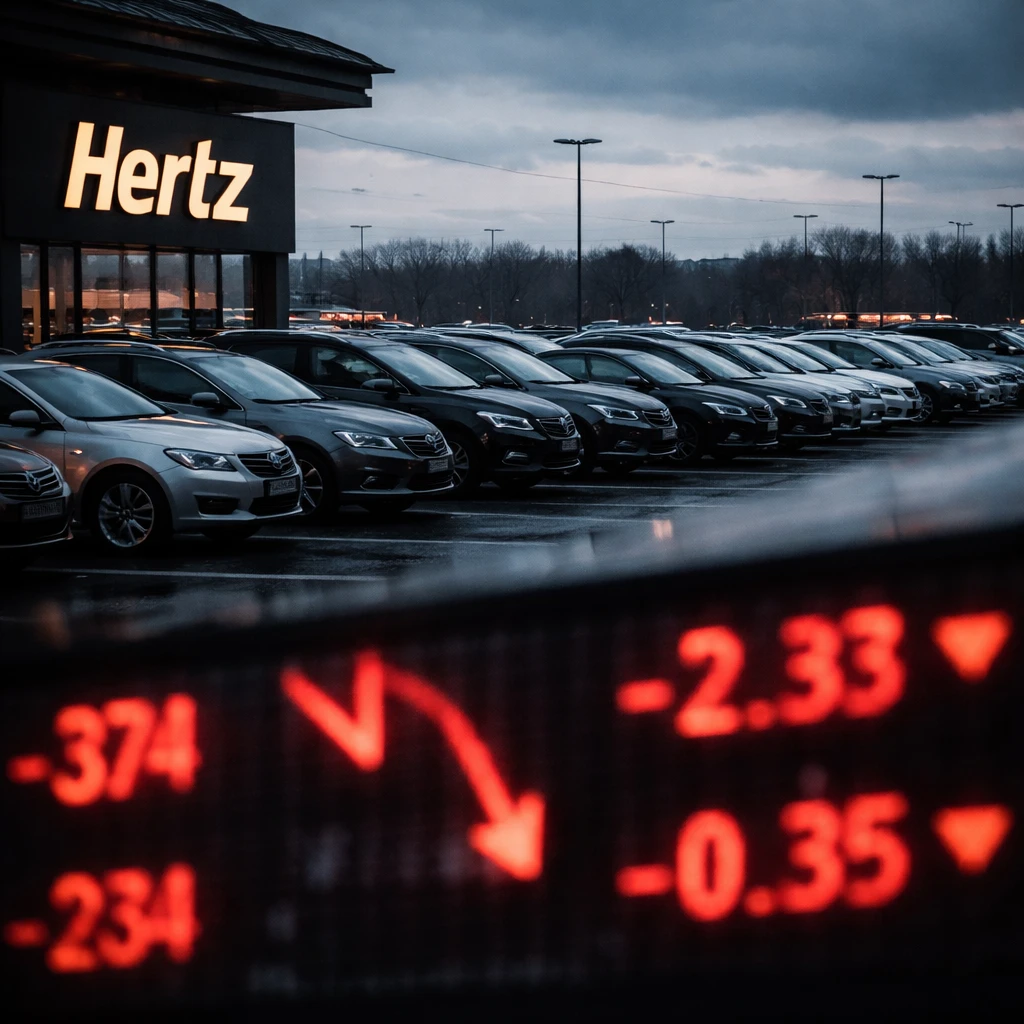
Hertz Global Holdings slipped 2.3% in pre-market trading, extending a steep sell-off that began the prior session after the company lowered its near-term earnings outlook and disclosed two concurrent financing transactions.
The company cut its second-quarter Adjusted Corporate EBITDA guidance to a range of $50 million to $80 million. Management attributed the downgrade to unexpected weakness in the used-car market, saying softness in May erased vehicle-sale improvements recorded in April and pushed depreciation costs higher.
At the same time Hertz revealed a paired set of capital-raising measures. The company initially announced a $300 million exchangeable senior notes offering alongside a $100 million common stock arrangement. As part of the equity plan, Hertz agreed to lend $100 million worth of shares to J.P. Morgan Securities. J.P. Morgan intends to sell those borrowed shares and use the resulting short position to facilitate hedging transactions for investors who participate in the separate notes offering.
Investor concern intensified when Hertz later priced and upsized the notes offering. The company set the exchangeable notes at an aggregate principal amount of $350 million, issued as 6.75% Exchangeable Senior First-Lien Secured PIK Notes due 2030 - an increase from the initially announced $300 million. Hertz said proceeds will be used to repay outstanding borrowings under its revolving credit facility and for general corporate purposes.
The stock move occurred amid weakness across the rental-car space, with competitor Avis Budget Group also posting a notable decline in sympathy. Broader market indexes provided little support: the Nasdaq was down about 0.4% and the S&P 500 slipped roughly 0.1%, although Hertz’s management actions and financing choices were the primary catalysts for the shares’ direction.
Market participants reacted to multiple signals at once. The combination of a weaker short-term earnings outlook, dilutive equity activity and an increase in leverage due to the payment-in-kind notes heightened investor wariness. Hertz shares are trading near a 52-week low of $2.95, a substantial drop from a 52-week high of $8.44, illustrating the steep deterioration in sentiment heading into the regular session.
Summary of the situation:
- Hertz trimmed Q2 Adjusted Corporate EBITDA guidance to $50 million - $80 million due to weaker used-car market conditions and higher depreciation.
- The company arranged two concurrent financings: a $100 million equity share loan to J.P. Morgan Securities and an exchangeable notes offering that was upsized to $350 million of 6.75% PIK notes due 2030.
- Proceeds from the notes are earmarked for repaying revolving credit borrowings and for general corporate purposes.