
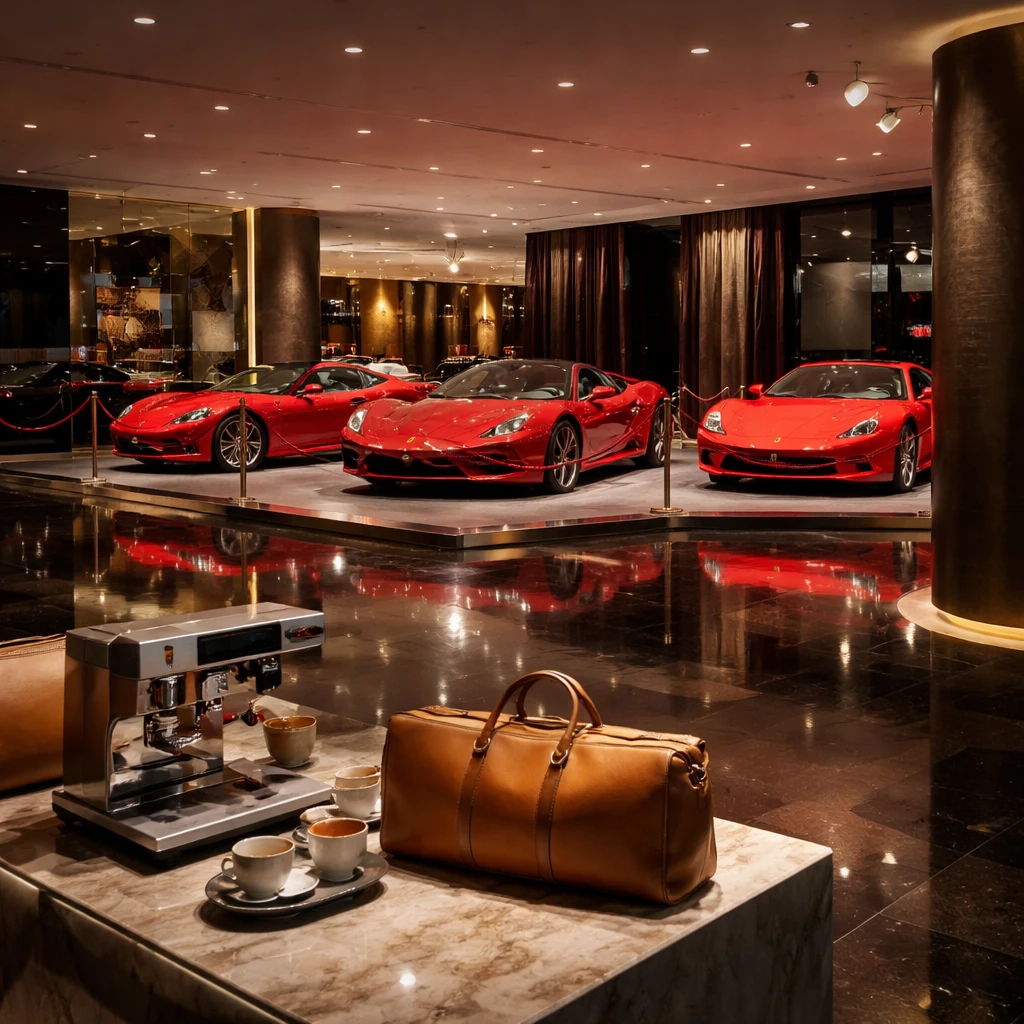
Ferrari (RACE) is trading at valuation multiples that more closely match luxury houses than traditional vehicle makers. The company sits at 41.9x earnings and 18.7x book value, metrics more commonly seen on the balance sheets of upscale conglomerates than on those of mass manufacturers. With a market capitalization of $80 billion against $8.39 billion of revenue, investors have signaled a reclassification in their minds: Maranello sells an idea, and the automobile serves as the highest-priced item in its offering.
Those conclusions are visible in the numbers before editorial commentary is necessary. Ferrari NV (RACE) closed at $417.93 on Sep 3, 2026, against a Fair Value estimate of $356.50 - implying the stock is already trading at roughly 14.7% above its intrinsic model. The market is assigning a value to Ferrari that goes beyond manufacturing economics; it is valuing mythology and the management of exclusivity. That approach aligns with what Ferrari's own financial statements have signaled over multiple reporting periods.
Margins and manufacturing do not tell the same story
Gross margins are a clear differentiator. Leading large-scale automakers typically post gross margins in the mid-teens. Toyota operates near 18%, Volkswagen near 15%, and a conventional automotive range centers between 14% and 20%. Ferrari’s reported gross margin for fiscal year 2025 was 51.7% - a level that does not fit the structural economics of high-volume car production. That kind of margin is consistent with premium luxury goods makers such as Hermès, LVMH or Moncler, where products primarily transmit brand value rather than raw utility.
Scarcity as an intentional commercial strategy
Limited annual production at Ferrari is often described as the result of artisanal manufacturing or factory constraints. The financial evidence suggests otherwise. Limiting the supply of vehicles is executed as a deliberate brand-management decision, analogous to how Hermès manages Birkin output. When a firm can sell every unit it produces and consciously chooses not to expand production, it is applying scarcity to protect pricing power and brand desirability. The automobile becomes a high-value piece of merchandise; the waiting list itself functions as a marketing mechanism.
This engineered scarcity has significant secondary-market effects. Internal-combustion Ferraris from before the electric-vehicle era have shown persistent value retention and appreciation that outpace typical collectible classes. There are structural reasons for this durability: no lithium battery degradation curves, no substantial mid-life battery replacement bills, fewer software-driven recalls, and no requirement for broadly available charging infrastructure. As the promises of electrification have met the realities of ownership cost and convenience, older internal-combustion Ferraris have accrued characteristics of alternative assets, supporting the brand more effectively than many new model launches.
Balance-sheet behavior and capital returns resemble a financial firm
Operational performance supports the brand thesis, and Ferrari’s capital structure clinches it. As of June 30, 2026, Ferrari’s Return on Equity was 45.4% and Return on Invested Capital was 25.2%. Those returns are not typical of manufacturing enterprises; they match the output of firms that have tailored their capital base to extract outsized financial returns from limited physical inputs.
Ferrari builds a relatively small number of cars, sets prices that the market accepts, and converts a large portion of revenue into free cash flow. Free cash flow nearly doubled between 2021 ($1.06 billion) and 2025 ($2.19 billion). The firm’s capital allocation further emphasizes this point: Ferrari is executing a €3.5 billion share repurchase program through 2030, funded from available cash, and launched a third €250 million tranche on September 2, 2026. Steady, cash-funded buybacks over multiple years look like the behavior of a balance-sheet-driven holding company rather than a manufacturer racing to finance platform development cycles.
How the metrics map to a luxury peer set
The following table reproduces reported and market-derived metrics as of Sep 4, 2026, and compares them with typical ranges for traditional automakers and luxury conglomerates.
| Metric | Ferrari (RACE) | Traditional Automaker | Luxury Conglomerate |
|---|---|---|---|
| P/E (Trailing) | 41.9x | 6-12x | 30-45x |
| Gross Margin | 51.7% | 14-20% | 45-65% |
| Price / Book | 18.7x | 0.8-2x | 10-20x |
| EV / EBITDA | 28.4x | 3-6x | 20-30x |
| Net Income Margin | 22.3% | 2-7% | 15-25% |
| ROE | 45.4% | 8-15% | 25-45% |
Every reported multiple places Ferrari in the luxury-conglomerate column. The market's interpretation is consistent: Ferrari has been revalued by investors to reflect a brand-management business more than a high-volume carmaker. The remaining tension is communicative: Ferrari’s own messaging continues to emphasize its automotive roots even as its financial architecture points in another direction.
The BMW comparison and the risk of brand dilution
The trajectory of BMW offers a cautionary example. BMW historically built a coherent aspirational automotive identity rooted in driving dynamics. That product-led rationale justified premium pricing. Over time BMW expanded into lifestyle categories and broadened its model set, which, together with design shifts and challenges in electric-vehicle rollout, contributed to a blurring of brand meaning for some customers. The lesson articulated by that example is straightforward: when a brand's product-to-purpose narrative becomes diffuse, marketing alone cannot fully restore its original coherence.
Ferrari is pursuing an alternative path but with similar trade-offs. The company has extended the brand into hotels, theme parks across three continents, and licensed consumer items including espresso machines and children’s go-karts. Those expansions multiply touchpoints for the logo and deepen revenue channels, but they also shift the car’s position from being the central product to serving as the flagship piece within a broader lifestyle catalog. The firm’s strategy is more elegant than a scattershot diversification, yet it raises the question of how the brand’s exclusivity and aura will be managed over time.
Operational outperformance is undeniable
Any critique must acknowledge Ferrari's operational achievements. Revenue increased from $4.86 billion in 2021 to $8.39 billion in 2025, a 73% expansion in four years. Net income margins widened from 19.5% to 22.3% over the same period. The dividend has grown for five straight years, and free cash flow has compounded with consistent reliability. A Return on Equity of 45.4% is exceptional in any sector and would be elite performance in financial services as much as in luxury goods.
The central point is not that Ferrari is poorly run. On the contrary, it is an exceptionally well-managed luxury operator that has been misclassified by conventional automotive peer sets. Investors who still benchmark Ferrari against Stuttgart and Tokyo peers are using an inaccurate comparables set. A more appropriate peer group exists among Parisian and Swiss luxury houses whose products function as brand-bearing icons.
Conclusion
Ferrari now functions as a luxury conglomerate that leverages limited-production automobiles as cornerstone assets for a broader brand platform. The car demonstrates the brand's authenticity; the logo is the primary asset; and scarcity is a central marketing tool. The company’s €3.5 billion buyback program, 51.7% gross margins, 45.4% ROE, and 41.9x earnings multiple are financial signatures of an enterprise that has crossed the boundary from manufacturer to brand steward.
At $417.93 per share and an $80 billion market capitalization, the market is paying a luxury premium for Ferrari’s identity. Given the firm's track record of revenue and margin expansion, that premium could be sustainable. Investors should be clear about what they are buying: not primarily a large-scale automaker with a continuous product-led engineering cycle, but a brand-management business built around an extraordinarily compelling origin story and a factory that keeps the legend credible.