
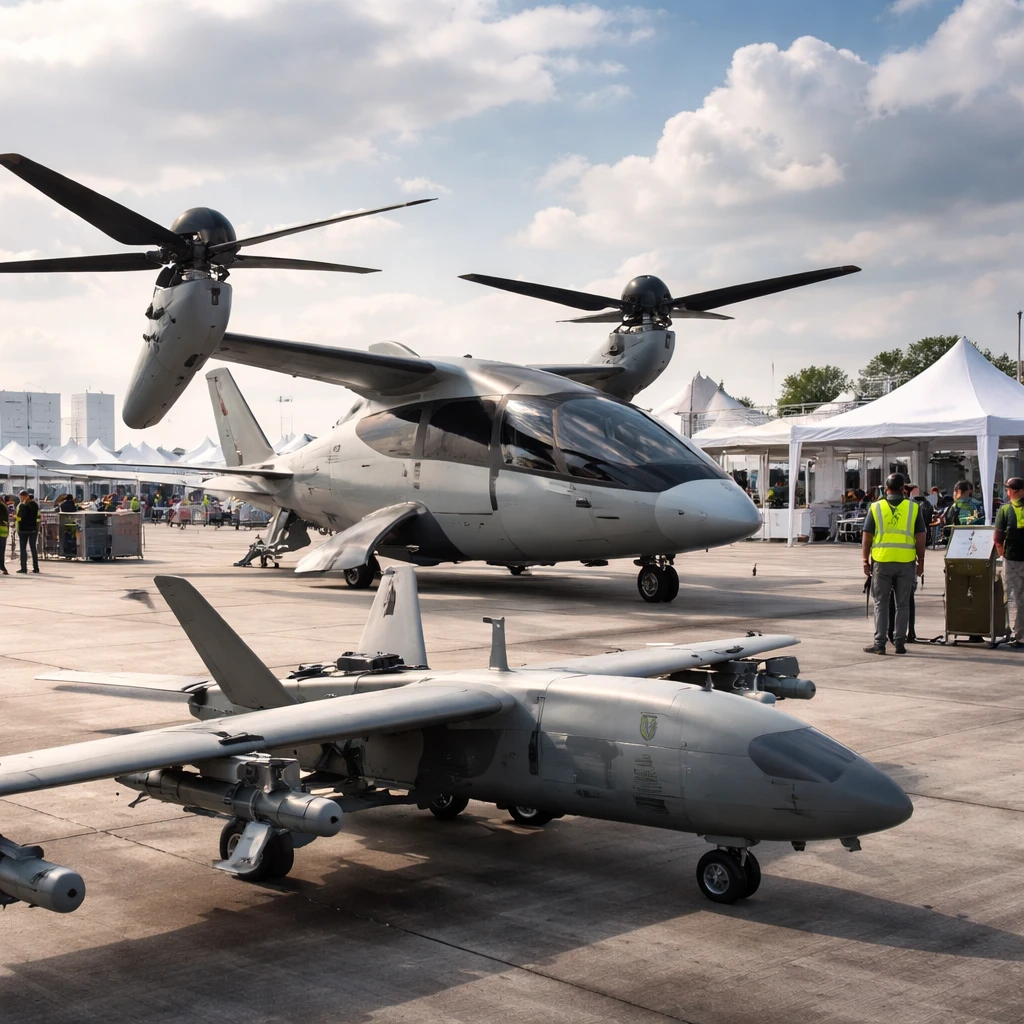
Companies that have been selling investors on a future of electric air taxis are redirecting effort toward defense customers as certification delays and higher-than-expected costs push the civil market farther into the future.
At a recent international air show, leading eVTOL developers presented military-focused variants of their aircraft and emphasized capabilities tailored to combat support, logistics and uncrewed missions. The move underscores a strategic pivot from the passenger-carrying, urban air mobility pitch many of these startups originally used to attract funding.
Industry executives argued the defense market presents fewer regulatory obstacles and clearer procurement paths. "Investors are excited about defense, because the industry is expanding rapidly and products can be fielded without the lengthy civil regulatory process," Archer Aviation CEO Adam Goldstein said at the show. "The time to field can be much shorter, and if you win a program there is known money at the end of the contract - very different from a new product category like (a civil) eVTOL."
Warfare in Ukraine and the Middle East has sharpened military demand for aircraft that can operate without runways, be deployed at lower cost than conventional platforms, and perform a variety of roles such as supply delivery, surveillance and medical evacuation. That demand profile is one factor driving aerospace startups to accelerate development of uncrewed and defense-capable versions of their designs.
One exhibitor unveiled an unmanned hybrid-electric aircraft developed with a defense technology firm and positioned for combat and logistical missions. Separately, Vertical Aerospace demonstrated a tiltrotor prototype that completed a transition flight at the show - lifting off with rotors vertical like a helicopter then tilting them forward to fly like a fixed-wing airplane.
Despite flight demonstrations, commercial certification remains a moving target. The UK-based company said it had again extended the target for certification and entry into service of its Valo aircraft by another year to 2029; three years earlier its goal had been 2025. The company’s shares have fallen by more than half over the past year, reflecting market unease about timelines and technological risk.
Investment analysts described the sector as high-risk and volatile because commercial success hinges on obtaining regulatory approval and integrating new technologies. "This is a volatile and risky sector, since it’s contingent on (regulatory) certification and contingent on developing and integrating a technology that is new and that is innovative," said Andres Sheppard, a senior investment analyst. "There are some sets of investors who are becoming perhaps a little bit less patient." He added that he remains confident eVTOLs will reach the market by the end of the decade, but companies will need to strengthen their finances in the interim.
Some developers have pursued dual-use development strategies. Beta Technologies, for example, has for several years been building both military and civil versions of its Alia eVTOL. The unmanned military variant, the MV250, was on display at the show. "Beta has focused on making sure that our defense product is identical to our commercial product," Beta CEO Kyle Clark said in an interview. "So, the motors, the rotors, the flight controllers, all the pieces in it are the same between the two products."
Beta’s approach also includes an electric conventional take-off and landing (CTOL) model alongside its eVTOL design. The company said it developed these configurations in parallel to lower costs and shorten development timelines. "That’s when you get that strategic advantage of doing both together, and that becomes an accelerant, not a drag or a distraction, but an accelerant to our commercial product," Clark said.
At the show, Beta announced a provisional order from a UK regional carrier for five CTOL aircraft, with options for an additional five. The company said commercial service for the CTOL model is expected to begin in 2029.
Sheppard expects the CTOL variant to become the first commercial electric aircraft certified by the U.S. Federal Aviation Administration, with a potential certification as soon as mid-2027, followed by an eVTOL certification in 2028. Meanwhile, other companies in the sector are balancing investor pressure, technological integration challenges and the need to shore up balance sheets while pursuing both commercial and defense markets.
Context for markets and operators
- Defense procurement offers clearer program revenue and faster fielding compared with civil certification for a new aircraft category.
- Operators such as regional airlines and logistics providers could be affected by timing shifts to commercial entry and certification of electric aircraft.
- Public market valuations for many eVTOL developers have weakened, reflecting investor concerns about timing, costs and regulatory risk.