
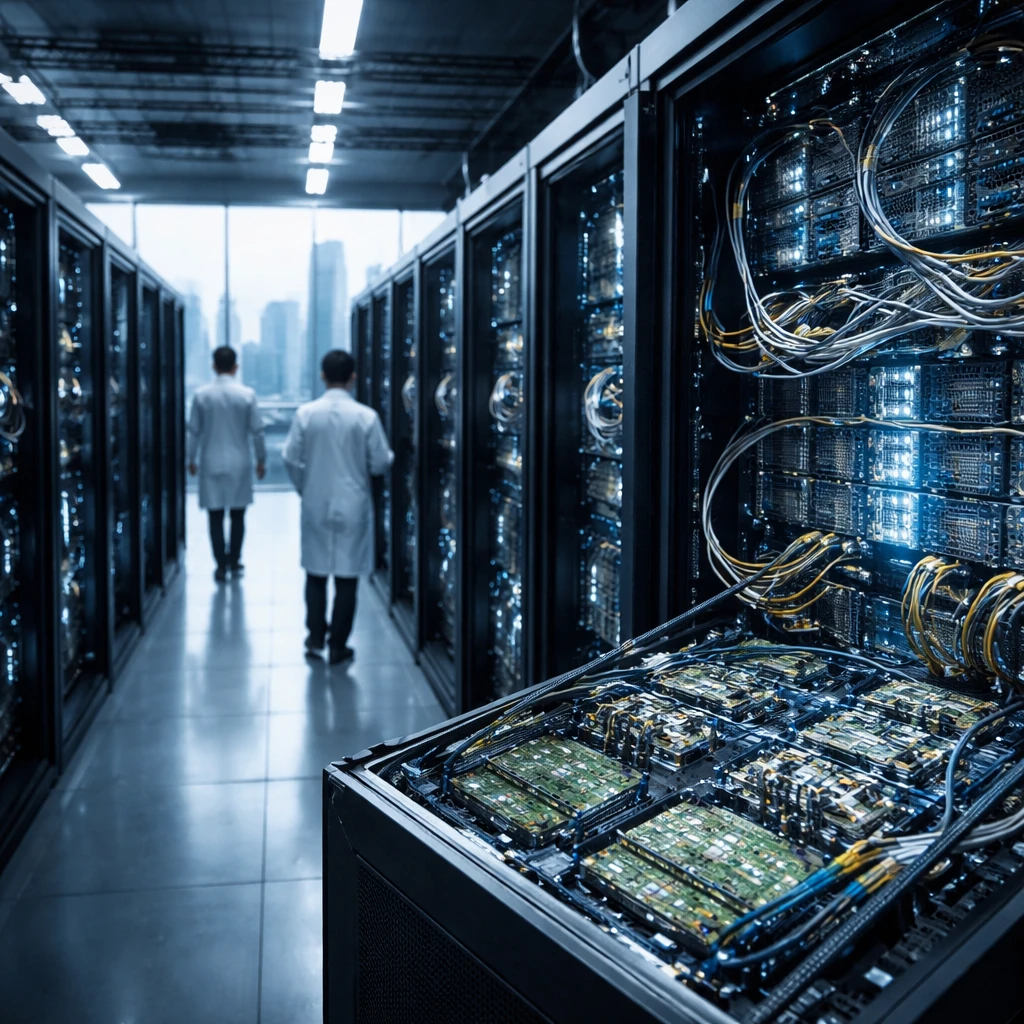
China has reclaimed the top slot on the TOP500 list of the world’s fastest supercomputers with a system called LineShine located at the National Supercomputing Centre in Shenzhen, according to the June 2026 edition of the biannual ranking. The system, which uses domestically designed chips, represents China’s first entry on the TOP500 in three years.
The placement comes amid intensifying competition between the United States and China in advanced computing. The ranking was published shortly after U.S. President Donald Trump on Monday signed an executive order intended to boost American leadership in quantum computing.
LineShine displaced the previous titleholder, El Capitan, a machine at Lawrence Livermore National Laboratory that the U.S. government uses to develop and maintain its nuclear weapons stockpile. But analysts and technology experts who reviewed the results cautioned that the TOP500 result does not necessarily indicate that China now possesses the most capable systems for AI workloads.
For many years, TOP500 has measured performance on benchmark tests tailored to classical high-performance computing (HPC) tasks, such as large-scale simulations of physical systems. To qualify for the list, operators run a set of prescribed benchmarks that reflect that traditional scientific and engineering workload profile. Historically, the supercomputers that populated the TOP500 were assembled from many linked machines to undertake problems like atom-level simulations and were largely the province of national laboratories and universities.
In recent years that landscape has shifted. Major cloud providers including Microsoft, Amazon.com and Alphabet’s Google have constructed very large compute systems designed specifically for AI. Those systems are often optimized for machine learning workloads rather than the HPC benchmarks used for TOP500 rankings, and most of the hyperscalers do not submit their AI-optimized systems for TOP500 consideration. Jimmy Goodrich, a senior fellow at the University of California’s Institute for Global Conflict and Cooperation, put the case succinctly: "If the hyperscalers submitted their systems, this 'world's fastest' would not crack the top five."
One academic study cited by experts found that xAI’s Colossus system was likely already more powerful than El Capitan, underscoring the point that systems built for AI can outperform traditional HPC machines on AI-style tasks even if they are not reflected at the top of TOP500.
LineShine itself did not top a benchmark intended to emulate AI-style workloads; it ranked fourth on a test designed to better simulate AI computing. Observers note that the composition of TOP500 and the criteria used to compile it mean that the list can highlight advances in classical HPC without capturing the leading edge in AI compute platforms.
Experts also interpreted China’s submission as a statement about domestic chip design progress. China previously appeared at the top of the TOP500 in 2010 and alternated the lead with the United States and Japan until 2023, when Chinese entries ceased following years of export controls on chips and related computing technologies introduced under prior U.S. administrations.
Addison Snell, CEO of Intersect360 Research, said he was unsurprised that LineShine achieved the number one ranking but was struck by the fact China chose to submit the system and pursue recognition: "I’m not surprised it’s the number one system. What I’m surprised by is that they submitted it and want recognition for it," he said.
Documentation released with the TOP500 results indicates that LineShine does not include advanced AI chips. Observers attribute that absence to the continued applicability of U.S. export controls to the tools and components required to produce leading AI accelerators. Commenting on the broader optics, Goodrich added: "China is hoping to convince the world export controls are useless by hoping we ignore the details."
The National Supercomputing Centre in Shenzhen did not immediately respond to a request for comment about the TOP500 placement or technical details shared with the ranking.
Summary - The LineShine system at China’s National Supercomputing Centre in Shenzhen has reclaimed the top position on the TOP500 list using domestically designed chips, marking China’s first appearance on the list in three years. While the ranking underscores progress in chip design and national HPC capability, experts caution that the TOP500 methodology and non-submission by AI-optimized hyperscaler systems mean the list is not a definitive measure of global AI compute leadership.