
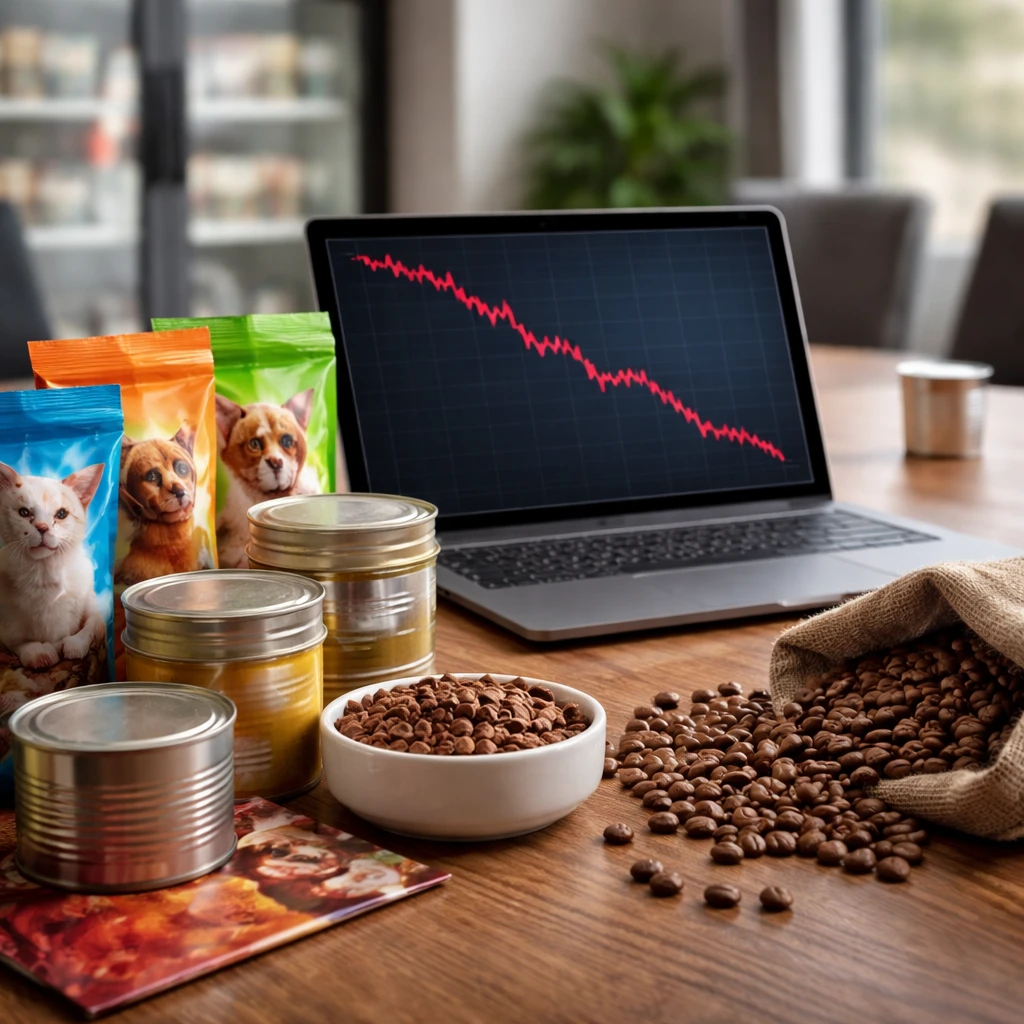
Bank of America on Monday downgraded Nestle to Neutral from Buy and cut the bank's price target to 89 Swiss francs from 94, flagging mounting challenges in the company’s North America Petcare business and a reduced tailwind from lower coffee and cocoa costs.
Shares of Nestle slipped 1.4% in Switzerland on the news.
Petcare under pressure
North America Petcare represents Nestle’s largest category/region segment, contributing roughly 13% of group sales. BofA analysts, led by Nicolas Ceron, report that Nestle has been losing market share in both cat and dog food categories, with losses in dog food appearing to be structural rather than cyclical.
The analysts attribute this shift to evolving consumer preferences - "the consumer shift toward fresh products" - which now drives all of the category’s growth despite fresh formats comprising only about 10% of the market. After a recent product launch from Colgate, the bank notes that "all major Petcare competitors bar Nestle have a fresh offering."
BofA estimates that for Nestle to close this gap and push Petcare volume growth from the current 2.5% nearer to a 3-4% range, the company would need to invest in a segment that carries materially higher supply-chain costs. The U.S. refrigerated pet food leader Freshpet is highlighted as operating with margins roughly 1,000 basis points below those of Nestle Petcare, underscoring the cost premium associated with fresh formats.
Within North America specifically, dog food is identified as the weak spot. BofA’s estimates show volume and mix growth in dog food running at negative 0.5%.
Commodities and margin impact
Compounding the pressure on margins, the bank points to sharp rebounds in cocoa and coffee prices since it reinstated coverage of Nestle in April. Coffee is reported up about 15% and cocoa nearly 70% over that period. At current spot prices, BofA calculates that the gross margin benefit from lower input costs in 2026-27 has narrowed to roughly 240 basis points, down from approximately 370 basis points in April.
As a consequence of these dynamics, BofA reduced its 2027 operating margin forecast by 20 basis points and trimmed its 2027 and 2028 EPS estimates by 1% and 2%, respectively.
Valuation and long-term assumptions
The bank’s price target is derived from a discounted cash flow model that retains an unchanged 3.9% weighted average cost of capital but lowers the long-term growth rate to -1.0% to reflect what it describes as "lower growth potential in NA Petcare." Nestle is trading at 14.6 times 2026 EV/EBIT, a 3% premium to European Food/Household & Personal Care peers, which the analysts say reasonably reflects a similar projected EBIT growth rate through 2028.
Implications for investors and sectors
- Petcare: Market-share declines and higher-cost fresh formats are pressuring volume and margins.
- Commodities: Rising coffee and cocoa prices have reduced the prior margin tailwind expected for 2026-27.
- Consumer staples and food industry valuations: Nestle’s multiple shows a modest premium to peers amid revised profit expectations.