
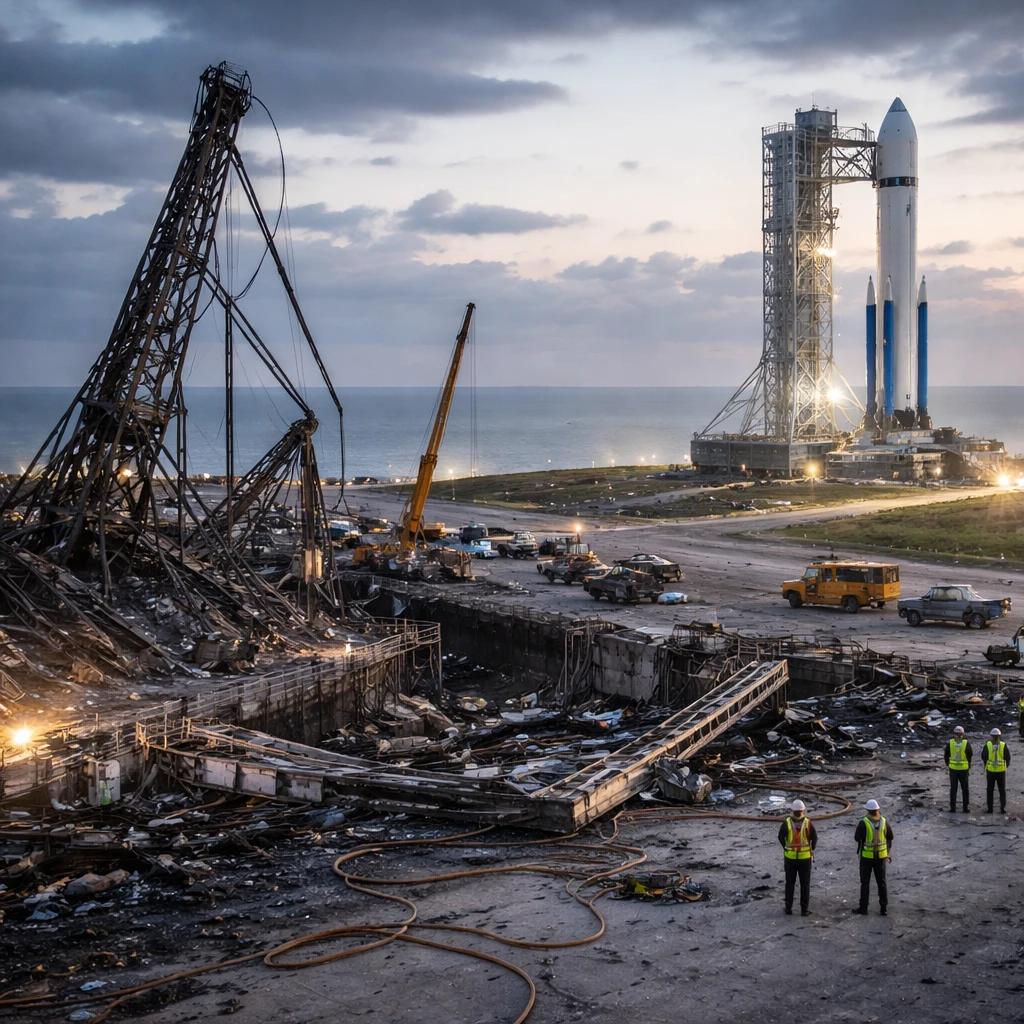
Blue Origin has announced a change in its launch architecture following the May hot-fire test that destroyed key equipment at its Florida launch site. Rather than rebuild the damaged pad, the company said it will transition to a horizontal/vertical hybrid system and leverage infrastructure already developed for a larger version of the New Glenn rocket, known as the "9x4." Blue Origin indicated it aims to resume flight operations before year-end.
In a public note on the company's website, Chief Executive Dave Limp made clear the firm will "not rebuild the same pad." He added: "We take our responsibility as a launch provider very seriously, and we are committed to returning to flight with the reliability our mission demands." Limp also posted on X that the revised configuration "has the added benefit of increasing our flight cadence as well."
The May incident occurred during a hot-fire test at Blue Origin's Florida launch complex. The explosion damaged and destroyed multiple pieces of ground infrastructure, including the lightning tower, the transporter-erector, and hydraulic cylinders. Some reconstruction work at the site is underway even as the company pursues an alternative launch approach.
Blue Origin said it is continuing its investigation into the cause of the failure. According to early findings cited by the company, the aft section of the first stage of the New Glenn rocket is a possible source of the anomaly. Beyond the technical probe, the mishap has had concrete programmatic impacts on a number of stakeholders.
Blue Origin is a partner on NASA's Artemis program and had been selected to launch an uncrewed Blue Moon lander on New Glenn later this year. Commercial customers are also affected: Amazon and AST SpaceMobile rely on Blue Origin for launches of their internet satellite constellations. The explosion took place days before Blue Origin was scheduled to launch Amazon's Low Earth Orbit (LEO) satellites.
Key points
- Blue Origin will move to a horizontal/vertical hybrid launch configuration and use infrastructure developed for the New Glenn 9x4 variant rather than rebuilding the damaged pad.
- The company expects to return to flight before year-end while reconstruction and investigation work continues.
- Multiple stakeholders are affected, including NASA's Artemis program and commercial customers such as Amazon and AST SpaceMobile, which depend on Blue Origin for satellite launches.
Risks and uncertainties
- The investigation is ongoing; early findings point to the aft section of the first stage as a possible source of the failure, but a definitive cause has not been confirmed.
- Operational timelines for return-to-flight and customer missions remain uncertain pending the outcome of technical reviews and implementation of the new launch configuration.
- Reconstruction of damaged ground equipment is in progress, and further damage or delays could affect planned manifest schedules for both government and commercial launches.
The company has positioned the shift in launch architecture as a way to maintain safety and to improve flight cadence, but it is still working through the technical and logistical consequences of the May explosion. Blue Origin's decision not to rebuild the same pad and to use the 9x4-derived infrastructure represents a substantive operational change while the investigation and recovery continue.