
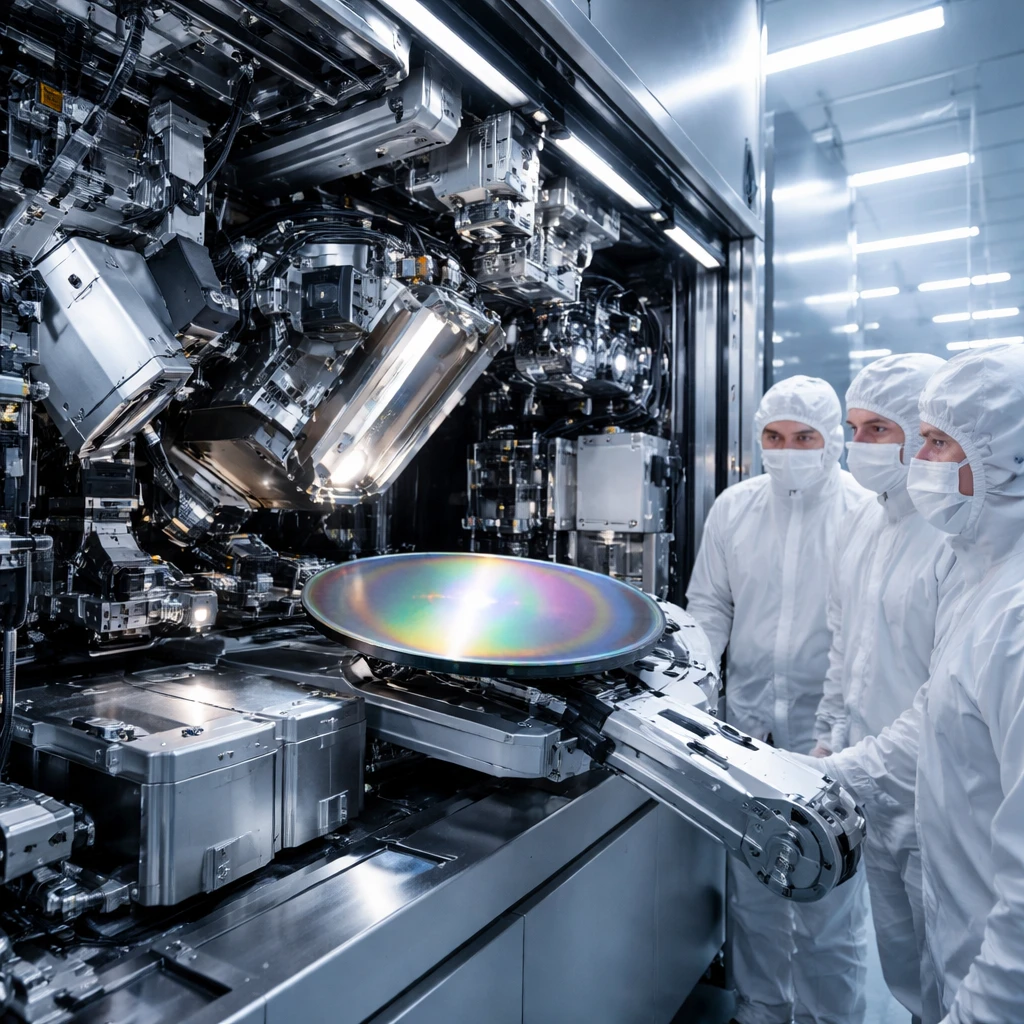
Bernstein has named ASML its top stock pick for Q3 2026, giving the Dutch lithography equipment maker an Outperform rating and a price target of €2,500. The brokerage's recommendation rests on what it sees as clear revenue visibility and scope for profit margin improvement tied to the company’s unique position in semiconductor equipment.
The research note positions ASML at the center of accelerating wafer fabrication equipment investment that is being driven by artificial intelligence-related demand for advanced chips. ASML is the primary supplier of both extreme ultraviolet (EUV) and deep ultraviolet (DUV) lithography systems, machines the firm says are gaining share as chipmakers layer in more EUV steps.
Bernstein observes that lithography intensity - the portion of wafer processing that uses more advanced lithography - is climbing. For DRAM, the share of EUV layers is rising from roughly 20% toward nearly 30% as production shifts to more EUV layers. For advanced logic chips, EUV intensity is already above 30%. The firm also expects High-NA EUV technology to be gradually adopted by virtually all leading-edge producers in both DRAM and logic manufacturing by 2030.
A central element of Bernstein’s bullish case is ASML’s pricing power and the associated potential for EUV margin expansion. The note points to two mechanisms that could lift profitability: first, a 20% increase in EUV system prices over two years tied to the transition from 3800E models to F models; second, the option for like-for-like price increases that would allow ASML to capture more value across the supply chain. Bernstein calculates that price moves alone could push EUV margins into the mid-60% range, with room for further gains thereafter.
Bernstein also highlights capacity constraints as supporting the pricing narrative. According to the firm, ASML’s capacity to produce EUV machines is near fully booked through the end of 2027. The company’s own chief financial officer has indicated there is room to raise prices for some categories of equipment, reinforcing the view that supply tightness and backlog create leverage for margin improvement.
The research note addresses geopolitical concerns, particularly around China, and concludes those worries are overstated in the context of ASML. In DRAM production, Bernstein points out that the EUV-to-DUV attachment ratio is about 1:1, meaning DUV demand scales with DRAM capital spending. While there are reports that China is developing domestic DUV systems, Bernstein contends these tools will not match ASML's offerings in the near term. ASML’s exposure to China has already declined, with China accounting for roughly 16% of the company’s revenue in the first half of the year - the lowest share among wafer fabrication equipment peers.
The note also refers to industry developments that reinforce ASML’s strategic position. Japanese equipment makers have announced price increases, which Bernstein views as a signal ASML could follow suit. Separately, reports indicate that Elon Musk will attend a company conference to discuss Terafab, a joint venture aimed at producing advanced chips.
Summary
Bernstein names ASML its top Q3 2026 investment idea, highlighting rising lithography intensity, EUV capacity tightness and price increases as drivers of revenue visibility and margin expansion. The firm awards an Outperform rating and a €2,500 target price.
Key points
- Bernstein rates ASML Outperform with a €2,500 target, citing strong growth visibility from AI-driven wafer fab spending and rising EUV adoption.
- Rising lithography intensity is reported - DRAM’s EUV share is moving from about 20% to nearly 30%, while advanced logic remains above 30% - and High-NA EUV is expected to be adopted broadly by 2030.
- Price increases - including a cited 20% EUV price rise over two years with model migration - and like-for-like hikes could push EUV margins into the mid-60% range; ASML’s EUV production capacity is near fully booked through the end of 2027.
Risks and uncertainties
- Geopolitical and regional risk - China developments in DUV tooling are noted, and while Bernstein believes Chinese tools will not be competitive soon, the emergence of viable competitors would alter demand dynamics. This impacts the semiconductor capital equipment sector.
- Technology adoption timing - Bernstein expects High-NA EUV to be broadly adopted by 2030, but the pace of adoption remains a variable that affects ASML’s near-term equipment mix and pricing power. This impacts chipmakers and equipment suppliers.
- Execution on pricing and capacity - the bullish margin case depends on price increases and near-term capacity constraints; if these factors change, margin expansion could be more limited. This affects equipment manufacturers and the wider semiconductor supply chain.