
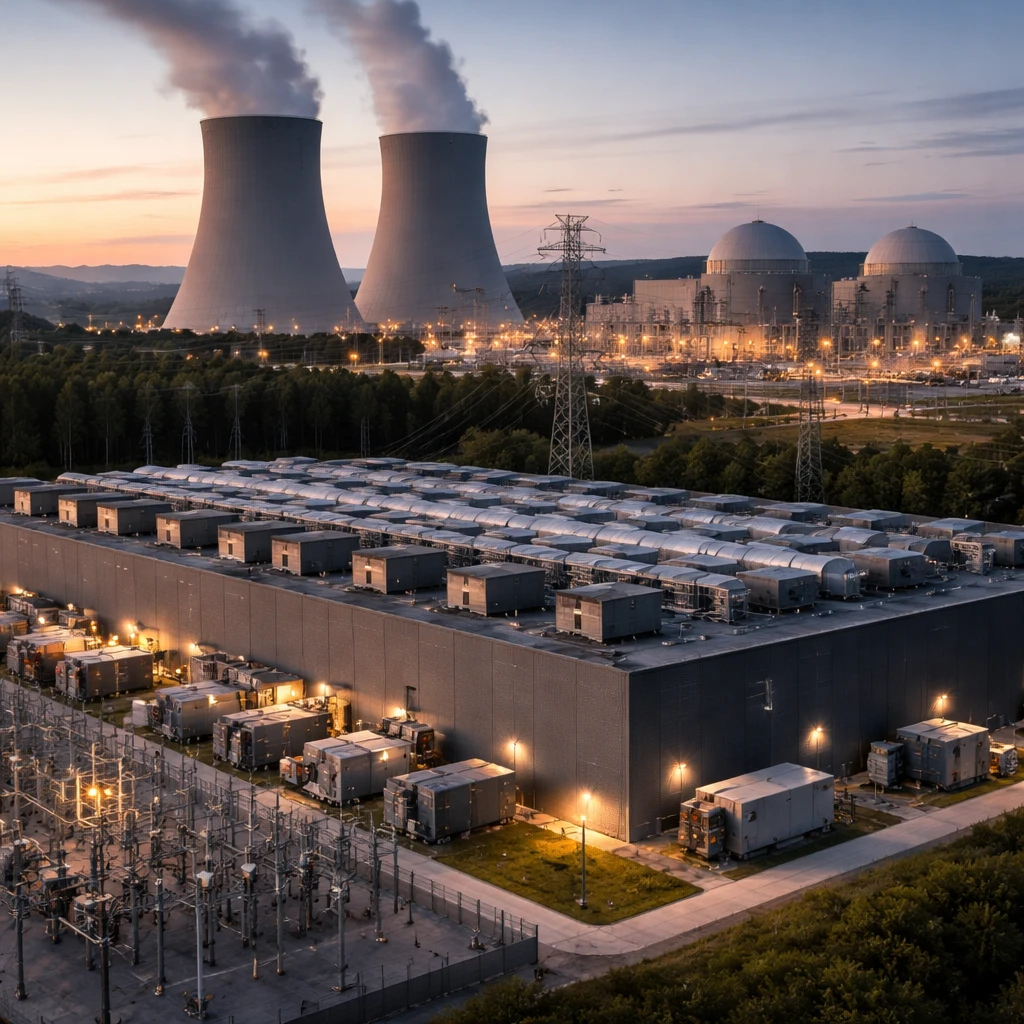
Barclays' technology team has identified a group of nuclear energy companies it believes are well positioned to play a central role in the buildout of AI infrastructure. The bank's analysts estimate that annual AI infrastructure spending by Western hyperscalers and AI research labs could top $1 trillion before peaking in 2028, a figure the firm says is more than $300 billion above current consensus estimates.
That anticipated surge in spending on data centers and AI compute is prompting greater attention to dependable, round-the-clock power sources. Barclays compiled a list of more than 400 companies it considers necessary for the expansion of digital and power infrastructure, and nuclear generators along with uranium producers emerged as pivotal providers of baseload electricity required by AI facilities.
Key companies highlighted by Barclays
The report calls out a set of nuclear operators and fuel-supply companies by name. Below are the firms Barclays singled out, along with the company statements and developments included in the bank's overview.
-
Southern Company (SO) - Southern operates a number of nuclear plants through its Southern Nuclear unit, including Vogtle Units 3 and 4, which the report notes are the first new reactors completed in the United States in decades. Southern Company also reported first-quarter adjusted earnings of $1.32 per share, beating consensus estimates. Barclays highlighted the company’s results were supported by higher customer usage, including a 42% increase in demand from data centers. Following those results, Mizuho raised its price target on Southern Company while Jefferies lowered its target after revising its valuation multiple.
-
Constellation (CEG) - Constellation is described as the owner-operator of the largest U.S. nuclear fleet, supplying over 180 terawatt-hours of carbon-free electricity annually to support grid reliability and data center operations. The bank noted Constellation recently announced a long-term nuclear power purchase agreement to supply Walmart with emissions-free electricity from its Dresden Clean Energy Center. Barclays also recorded that Bernstein initiated coverage on Constellation with an Outperform rating.
-
Duke Energy (DUK) - Duke operates six nuclear plants in the Carolinas and is advancing the BWRX-300 small modular reactor design, which Barclays references as a potential scalable solution for future infrastructure needs. Duke reported first-quarter adjusted earnings of $1.93 per share and revenue of $9.18 billion, surpassing analyst expectations. The company also secured a Department of Energy grant of up to $61.8 million to support projects at its coal-fired power plants.
-
NextEra Energy (NEE) - NextEra operates one of the nation's larger nuclear fleets while also running an extensive solar and storage business, providing diversified clean generation capacity. Barclays reported that NextEra filed financial statements with the SEC related to its pending acquisition of Dominion Energy. The bank noted a subsidiary of NextEra completed a $3.75 billion debt offering of junior subordinated debentures.
-
Dominion Energy (D) - Dominion maintains a fleet of regulated nuclear stations across Virginia, South Carolina and Connecticut, supplying stable baseload power in its service areas. Dominion announced the sale of $1.5 billion in junior subordinated notes. In connection with its pending merger with NextEra, Barclays recorded that Jefferies upgraded Dominion to Buy while Seaport Global Securities downgraded the stock to Neutral.
-
Entergy (ETR) - Entergy operates five nuclear units in the Southeast U.S. and, after exiting merchant nuclear operations, now focuses on regulated utility services. Barclays noted Entergy recently raised roughly $672 million in cash proceeds after completing settlements of forward sale agreements. The bank also documented that analyst coverage moved, with BMO Capital lowering its price target while Truist and Jefferies maintained Buy ratings.
-
Public Service Enterprise Group (PEG) - PSEG operates the Hope Creek and Salem nuclear units, which deliver continuous baseload power for New Jersey’s grid. Barclays recorded that Public Service Enterprise Group reported first-quarter results that exceeded both earnings and revenue forecasts.
-
Cameco (CCJ) - Cameco, which conducts uranium production and holds a 49% stake in Westinghouse, is represented across mining and reactor technology segments of the nuclear fuel cycle. Barclays included Cameco’s announcement of an agreement to increase its stake in the Cigar Lake uranium mine and noted the company referenced a conditional commitment from the U.S. Department of Energy for a loan package of up to $17.5 billion to finance new reactors from Westinghouse.
-
NexGen Energy (NXE) - NexGen is developing the Rook I uranium project and holds a 31.00% stake in IsoEnergy’s uranium portfolio, expanding exposure to fuel supply. Barclays recorded that NexGen missed first-quarter earnings-per-share expectations and announced the appointment of Ryan Podrasky as its new chief financial officer.
-
Talen Energy (TLN) - Talen operates the Susquehanna nuclear plant and co-locates data centers for direct power access, creating integrated infrastructure solutions. Barclays noted Talen reported strong first-quarter financial performance, including EPS of $1.33 and revenue of $1.13 billion, and that the company completed debt refinancing transactions expected to produce annual savings.
Additional names identified
Barclays also listed a number of other firms playing roles in the AI infrastructure buildout and nuclear ecosystem, including BWX Technologies, Oklo, NuScale Power, Evergy, Fluor, Quanta Services, Amentum Holdings, WESCO International, Xcel Energy and Vistra. The bank framed these companies as part of a broader group of more than 400 entities that support digital and power infrastructure expansion.
What Barclays’ view implies
Barclays’ analysis places nuclear operators and uranium producers at the center of conversations about reliable baseload power for 24/7 AI computing environments. The bank’s spending projection for Western hyperscalers and AI research labs is a central element of its rationale: annual AI infrastructure spending could top $1 trillion before a peak in 2028, which Barclays says would exceed prevailing consensus estimates by over $300 billion. That projection underpins the bank’s assessment of the strategic importance of companies that supply continuous electrical generation and fuel.
Note on coverage: This article reflects the companies and disclosures included in Barclays’ report and the company announcements cited. It does not add information beyond those items recorded by Barclays or the companies themselves.