
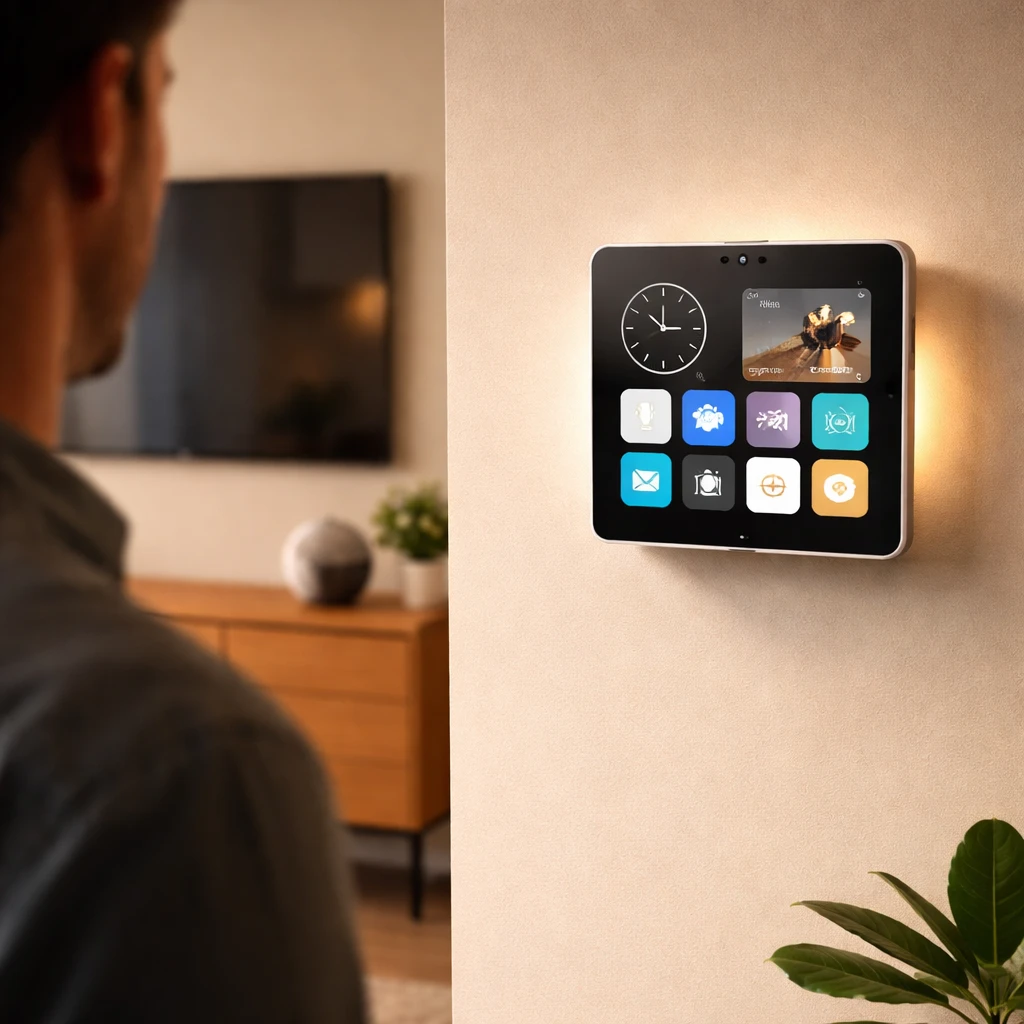
Apple is preparing an expanded presence in the home with a compact, AI-driven smart hub intended to act as a central control point for household tasks and communications. The primary product in the company's near-term plan is a roughly 7-inch square display that can be mounted on a wall or placed on a desk.
The display runs a bespoke operating system that blends aspects of tvOS, watchOS, and iOS. Its interface is described as using a familiar grid of apps, interactive widgets, and customizable clock faces that resemble those on the Apple Watch. The combination of those UI elements is intended to create a tidy, recognizable experience on a small, fixed screen.
What distinguishes the device from many existing smart displays is its on-board camera and sensing capabilities. The unit uses facial recognition to determine who is looking at the screen and spatial sensing to measure the viewer's distance. The system then adjusts in real time, resizing text and modifying the user interface to match the viewer's position. It also surfaces personalized content such as private notes and individual calendar items relevant to the identified person.
Functionally, the display is pitched as more than an interface experiment. It is meant to operate as a household manager, handling FaceTime video calls, functioning as a home intercom across Apple devices, monitoring security, and providing direct control over smart home hardware like lights, locks, and speakers.
To support the launch of the display, Apple plans hardware updates for other home devices, specifically the Apple TV set-top box and the HomePod mini. The company's previous home hardware has not matched the sales scale of its wearables business, but this AI-focused approach is positioned to compete directly with existing smart displays from other major technology firms.
The initial three-device lineup is characterized as only the first phase. These Siri AI-powered products are described as precursors to at least two more advanced devices. Foremost among the next wave is a premium home hub that incorporates a motorized, robotic limb. That mechanism would allow the display to swivel and tilt, enabling it to track people as they move within a room so the screen can face and interact with them during conversations or video calls.
The description of the roadmap emphasizes an iterative hardware strategy: an immediate, compact smart display supported by refreshed set-top and speaker hardware, followed by more experimental, robotics-enabled equipment. The plan places Apple squarely in competition with established smart display offerings while moving its home ambitions toward more mobile, physically interactive devices.
Summary
Apple is developing a 7-inch square smart display that personalizes content via facial recognition and spatial sensing, serves as a home management hub, and is supported by refreshed Apple TV and HomePod mini hardware. The initial trio of devices will lead into at least two more advanced Siri AI-enabled products, including a premium robotic hub with a motorized limb that can track and face users.
Key points
- The primary new product is a 7-inch square wall- or desk-mounted smart display running a custom OS that mixes tvOS, watchOS, and iOS interface elements.
- The device includes facial recognition and spatial sensing to resize text, adjust the UI in real time, and surface personalized content for identified users; it also manages FaceTime calls, intercom duties, security monitoring, and direct smart home control.
- Apple plans hardware refreshes for the Apple TV set-top box and HomePod mini to support the initial rollout; this three-device phase precedes at least two more advanced Siri AI-powered devices, the most notable being a premium robotic hub with a motorized limb for physical tracking.
Sectors and markets impacted
- Consumer electronics and smart home hardware markets, as the new products compete with existing smart displays.
- Home automation and security markets, given the hub's role in controlling lights, locks, speakers, and monitoring.
- Streaming and connected TV hardware, with planned Apple TV refreshes part of the strategy.
Risks and uncertainties
- Previous Apple home hardware has produced modest sales compared with its wearables line, indicating uncertain consumer uptake for new home devices - this affects expectations in consumer electronics and retail channels.
- The plan includes development of more experimental, robotics-enabled products; the eventual performance and consumer acceptance of such advanced devices are uncertain as they remain future phases.
- Competition from established smart display vendors is explicit; the new lineup directly targets competing devices, which creates execution and market share risk in the smart home sector.