
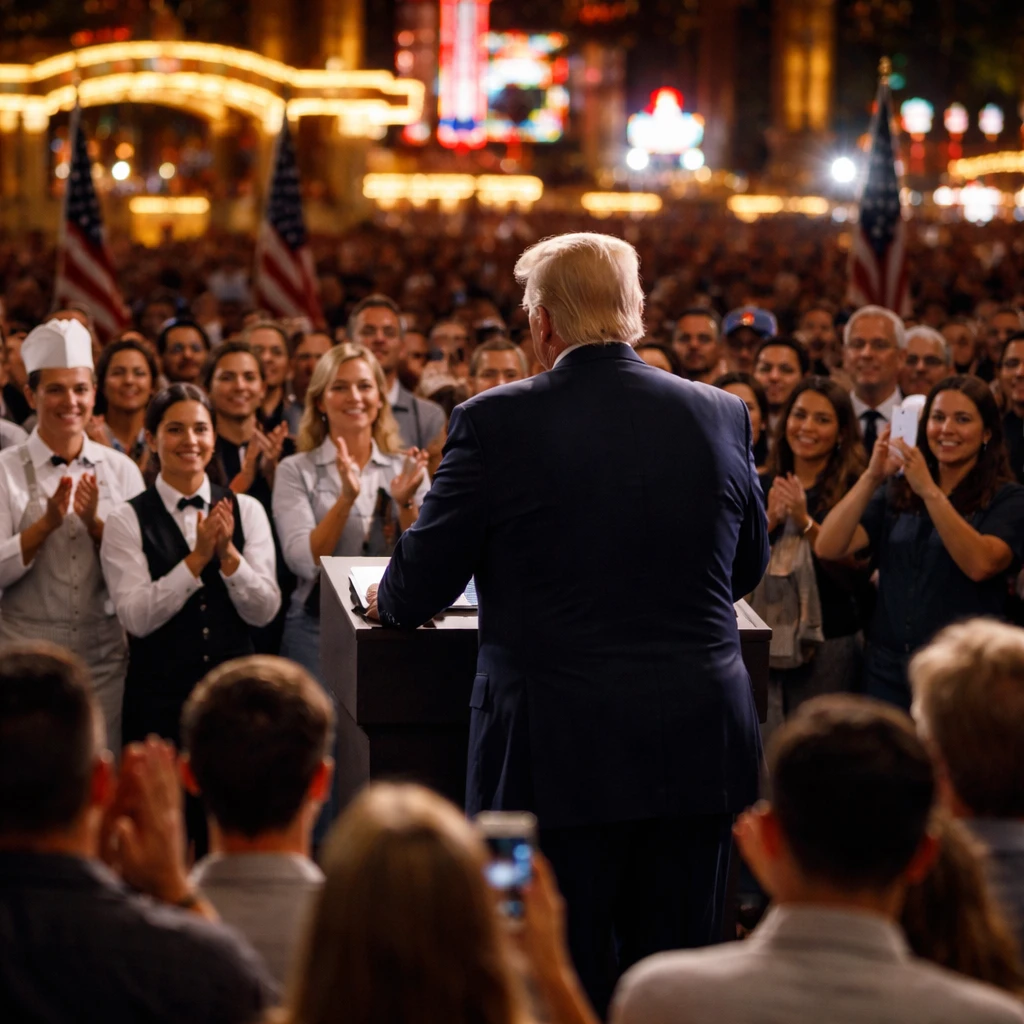
President Trump is scheduled to visit Las Vegas on Wednesday to promote his administration's tax-cut measures and to draw contrasts with Democratic opponents, as Republican leaders work to hold on to congressional majorities in November's midterm elections.
The trip reflects a stepped-up political effort by the White House at a time when Republicans face voter unease over the state of the economy and developments in the Iran war, which entered its sixth month this week. Administration activity has increasingly blended official duties with campaign-style events, with recent stops in Michigan and Georgia featuring praise for Republican candidates and criticism of Democrats.
In Las Vegas, the president is expected to join Republican congressional candidate Marty O'Donnell in a district represented by Democratic Representative Susie Lee, one of the battlegrounds drawing close attention. White House officials said the focus of the visit will be provisions included in last year's Republican spending package that temporarily eliminate certain taxes for many Americans.
Those provisions include measures that remove taxes on tips, on overtime pay, and on Social Security income for a large group of recipients. White House spokeswoman Liz Huston issued a statement saying: "By passing no tax on tips, no tax on Social Security, and no tax on overtime, President Trump and Republicans guaranteed Americans receive bigger paychecks and keep more of their hard-earned money."
Trump has repeatedly singled out Las Vegas' service-sector employees - a pivotal voting group in Nevada - as instrumental to the inclusion of the temporary "no tax on tips" measure.
Marty O'Donnell, whose career includes composing the Mr. Clean jingle and music for the Halo video game, criticized his Democratic opponent for opposing what he described as Trump’s "One Big Beautiful Bill." In a social media post on Monday, O'Donnell wrote: "Nevadans see you for who you are -- someone so blinded by Trump Derangement Syndrome that you voted against putting more money in their pockets,"
Democrats opposed the legislation unanimously, arguing it amounted to a benefit for wealthier Americans at the cost of social safety net programs. They cited potential impacts on programs such as Medicaid and food assistance.
Representative Susie Lee, a four-term congresswoman, used a recent video to criticize the package, saying people are "working harder and their dollar is going less far," and she linked the law to broader cost-of-living pressures.
Democratic strategists have aimed to keep the Iran war and rising prices at the center of voters' attention heading into the midterms. A recent poll found that only one in three Americans support the military campaign, a data point that highlights the political challenge Republicans face as concerns about everyday costs remain the top issue for many voters.
Context for markets and voters
The Las Vegas visit underscores how tax policy, household budgets and geopolitical tensions are converging on the campaign trail. For local economies with large service sectors, the "no tax on tips" provision is an explicit targeting of a key workforce. At the same time, debate over the legislation’s trade-offs - tax relief versus impacts on social programs - is likely to resonate with voters focused on cost-of-living and public assistance programs.