
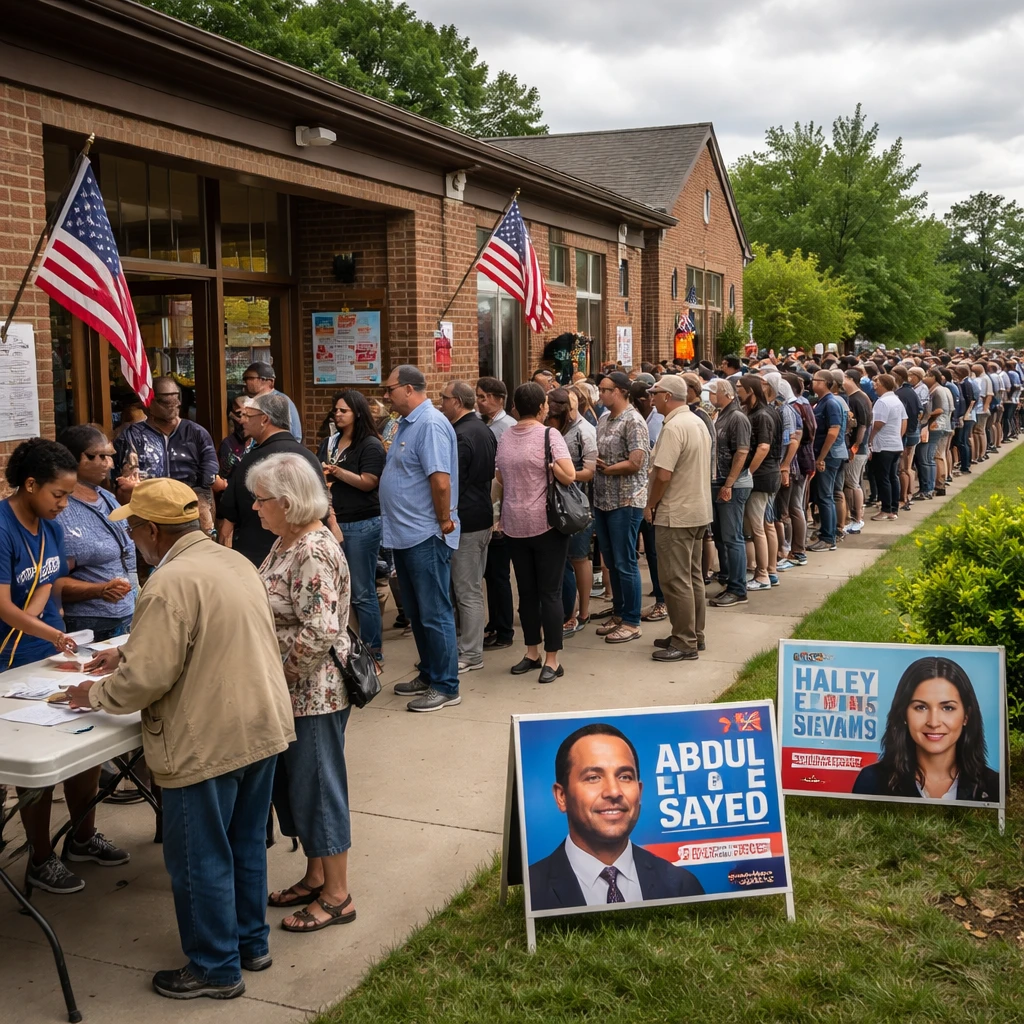
Michigan voters are casting ballots Tuesday in a high-stakes Democratic Senate primary that could influence who controls the U.S. Senate in November and help determine the Democratic Party’s posture on U.S. support for Israel. The contest matches Abdul El-Sayed, a progressive and former public health official, against U.S. Representative Haley Stevens, a moderate with significant backing from pro-Israel groups and party leaders.
The race centers not only on traditional electoral calculations but on a sharply contested question inside the Democratic coalition: whether the party should continue to defend current levels of U.S. military aid to Israel or move toward a posture that conditions or ends unconditional support. El-Sayed has called for ending unconditional U.S. military aid to Israel and has accused Israel of genocide; Stevens has been described as a longtime outspoken supporter of Israel and has attracted major pro-Israel financial backing.
Political operatives and strategists say the primary will offer a clear signal on which message Democratic voters find more persuasive: an anti-establishment campaign that challenges U.S. foreign policy and big money in politics, or a more conventional moderate appeal focused on electability and national security alliances. Frank Lowenstein, who served as a special envoy for Israeli-Palestinian negotiations in the Obama administration, described the primary as a bellwether for the party’s ideological future and a potential guide for how prospective 2028 presidential candidates calibrate their stances on Israel. "This will help inform them about how tough to be on Israel," he said. "It’s teed up to be a pretty clear choice."
Polling data cited ahead of the vote confirm the central role of the Israel question but also show competing dynamics at play. Reuters/Ipsos polling found Israel’s favorability among Democrats fell from 59% in 2018 to 22% in May. Recent aggregated polls put El-Sayed ahead on average by eight percentage points, though a Detroit News survey from early July showed Stevens leading by seven points.
Democratic strategists note that the contest is not solely a foreign policy referendum. Economic frustration and anti-establishment sentiment are prominent themes in El-Sayed’s campaign, which emphasizes reinvesting taxpayer dollars domestically rather than funding Israel’s campaign in Gaza. El-Sayed frames the issue as fiscal and social policy as much as moral: "Gaza and Israel is an affordability issue. I would rather spend our money on healthcare and schools and infrastructure here at home rather than bombing other people elsewhere," he told Reuters.
El-Sayed’s platform also includes progressive priorities such as universal healthcare, abolishing U.S. Immigration and Customs Enforcement, and reducing the influence of corporate money in politics. He has held rallies with high-profile progressive figures including Senator Bernie Sanders of Vermont and Representative Alexandria Ocasio-Cortez of New York. Observers note Michigan’s sizeable Arab-American communities as a potentially important constituency where opposition to Israel can be pronounced.
Stevens, by contrast, has emphasized her electability in a general election and the need to appeal to independents in a state many expect will be decided by narrow margins. Her campaign has drawn the backing of major Democratic figures, including Senate Majority Leader Chuck Schumer and Michigan Governor Gretchen Whitmer. Stevens has also received substantial support from outside pro-Israel organizations, including more than $30 million from the main super PAC associated with the American Israel Public Affairs Committee.
When asked about the influence of that spending, Stevens largely declined to elaborate in emailed responses but stated plainly: "No one influences my vote other than the people of Michigan." She has expressed criticism of Israeli Prime Minister Benjamin Netanyahu, including during a July debate when she said, "Mr. Netanyahu has not made us safer, has not brought us closer to peace. And he’s endangered Jews here in America and around the world."
Democratic strategist Karen Finney cautioned that either outcome poses lessons for party leaders: an El-Sayed victory would underscore the depth of voter anger and appetite for new leadership, while a Stevens victory would show that a more establishment, pro-Israel message can hold when framed around beating Republicans and addressing economic concerns. "Either way, Democratic leaders shouldn’t ignore the anger at the status quo fueling El-Sayed’s campaign or assume a Stevens win lets the party off the hook," Finney said.
Beyond the Senate contest, Michigan voters are joined on primary ballots by contests in Virginia and Washington State for Democratic U.S. House nominations. Several of those House primaries could determine whether Democrats retake the lower chamber; four of those races are identified as general election toss-ups.
The winner of the Michigan Senate primary will face former Republican Representative Mike Rogers in the general election. Rogers is a vocal supporter of Israel, and the state of Michigan was narrowly won by President Donald Trump in 2024, underscoring the strategic magnitude of the seat for control of the Senate.
Contextual note: The outcome in Michigan will be watched for the narrow electoral margins that often decide national control and for the degree to which Democratic voters prioritize foreign policy positions vis-a-vis domestic economic concerns.