
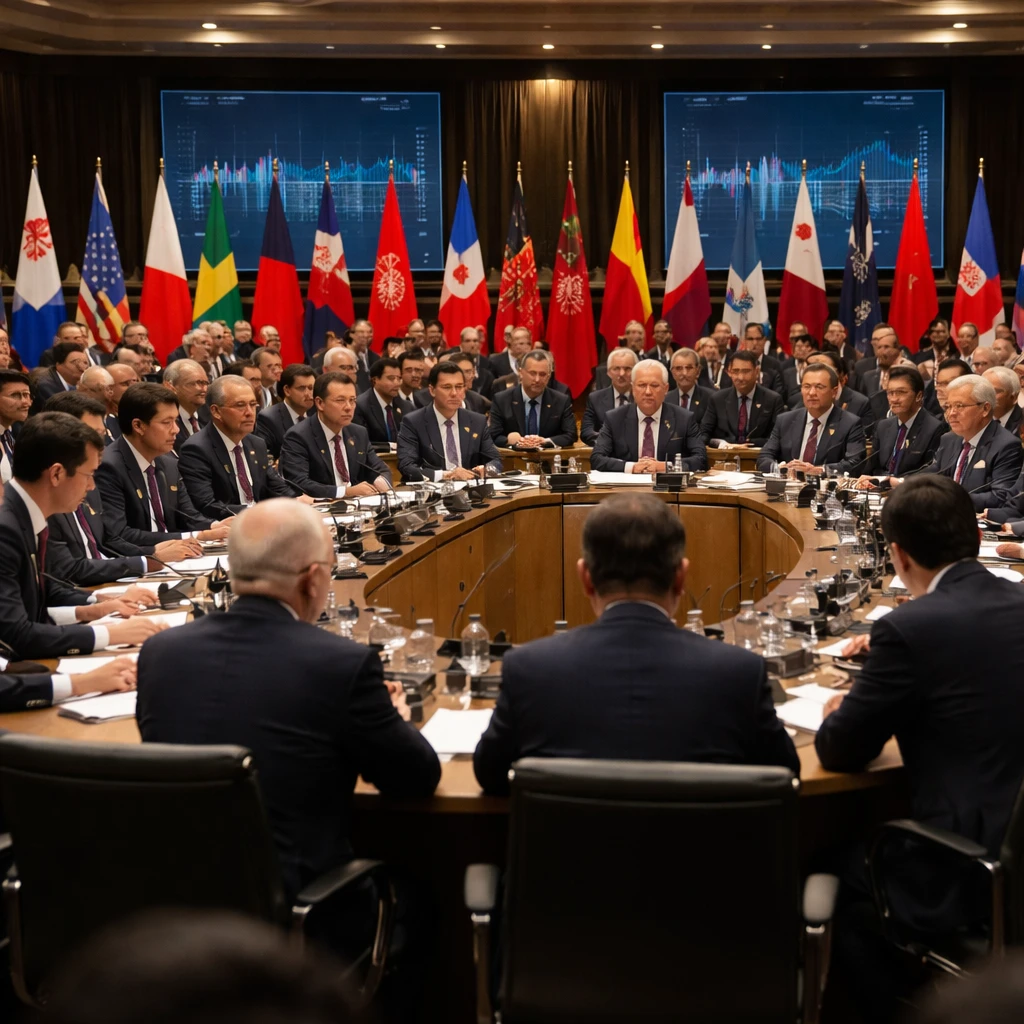
The U.S. pushed for G20 action on global trade and fiscal imbalances on Tuesday as world bond markets experienced a deepening sell-off, reviving concerns about rising debt burdens and inflation pressures.
Market turmoil intensified on Tuesday, underscored by Japan's 10-year government bond yield reaching 3% for the first time since 1996. Yields rose across major economies, including the United States, the euro zone, Germany and Britain. In the U.K., bond yields jumped 10 basis points after a public holiday, amid renewed concerns about attacks in the Middle East.
At the heart of the discussions, U.S. Treasury Secretary Scott Bessent told Reuters he planned to press G20 members to re-examine their terms of trade with China and to consider raising trade barriers on Chinese goods to push Beijing toward rebalancing its economy from exports toward domestic consumption. The U.S. case centers on a long-running view that China’s heavy export orientation is exerting pressure on trading partners.
China’s aggressive export strategy has been particularly evident in sectors such as electric vehicles and semiconductors. The country’s total exports expanded by 23.9% in July year-on-year, a surge that has strengthened calls within the European Union for tighter curbs on imports from China.
Despite U.S. pressure, the article says it remains uncertain whether the diverse G20 membership can reach consensus on a joint communique that would outline steps to reduce global imbalances. China has shown limited interest in longstanding appeals to reduce industrial subsidies and shift its growth model, while many measures indicate the yuan remains substantially undervalued. Meanwhile, the United States has not yet presented a concrete plan to address its large fiscal deficits, which economists cited in the article view as necessary to shrink its annual global trade deficit in excess of $1 trillion.
European voices at the meeting agreed that China is a central contributor to global imbalances but emphasized that the U.S. and Europe also bear responsibility for creating a more balanced global economy. European Economy Commissioner Valdis Dombrovskis summarized the assessment bluntly: "To put short the summary of this analysis, which we have been doing over the upscale couple of years, China would need to spend more, U.S. would need to spend less, and EU would need to invest more." He added that collective action by all economic blocs would increase the effectiveness of any global policy response and that China should view any measures as a growth agenda for itself as well.
Concrete data underscore the scale of the issue. China's goods trade surplus with the European Union reached c360.6 billion last year, representing a 15% increase on 2024, and has reportedly widened further this year as Chinese exports to the EU rose while imports declined.
Polish Finance Minister Andrzej Domanski voiced support for the U.S. position, noting the scale of China’s trade surplus with partners and pointing to European measures such as customs duties on e-commerce parcels, most originating from China. "We do know that Chinese currency is hugely undervalued, that China is supporting very actively subsidizing its exports and this is a problem for Europe as well," he said. "Many, many European countries have these high deficits with China, and definitely we need to take action."
The G20 talks also took up export curbs on critical minerals. Beijing's imposition of export restrictions on rare earths in April 2025, a measure described in the article as a response to U.S. tariffs, has affected companies beyond the United States. Japanese Finance Minister Satsuki Katayama told her counterparts she had argued that arbitrary export restrictions on critical minerals are damaging the global economy and should be withdrawn.
Negotiators reported that language on global imbalances in the draft communique proved particularly contentious. China resisted any wording that would single out "non-market economies" or deliver firm criticism of supply curbs on critical minerals. European delegations were also keen to include stronger language condemning Russia's war against Ukraine. Several European ministers expressed surprise and dismay at seeing Russian Finance Minister Anton Siluanov present at the G20 table when U.S. Treasury Secretary Bessent opened the meeting on Monday - the first in-person attendance by Russia at the forum since it invaded Ukraine in 2022, according to the report.
Officials described a complex negotiating environment in which concerns about market stability, trade policy levers and geopolitical tensions intersected. The interaction between rising bond yields and efforts to secure coordinated policy commitments to rebalance trade and fiscal positions highlighted the delicate balance that finance ministers and central bankers sought to strike during the G20 discussions.
As talks continued, the combination of higher global yields and disagreement over text in the communique underscored the challenges of forging a collective response to problems that participants saw as both structural and politically sensitive.