
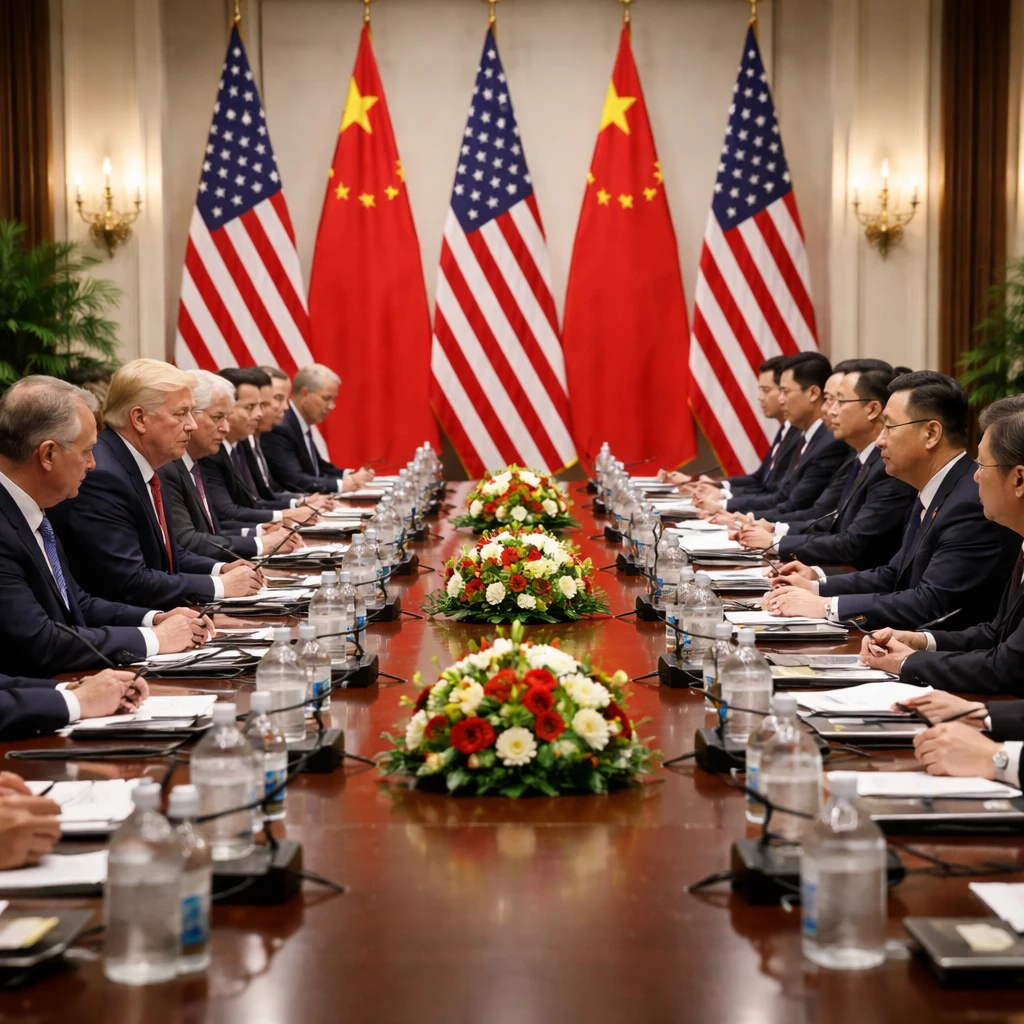
The diplomatic engagement between the United States and China has yielded several specific economic deliverables, largely focused on politically feasible "quick wins." A significant portion of these agreements involves the agricultural sector. Under the new terms, China has committed to purchasing at least $17 billion in US agricultural products every year through 2028. This follows a prior pledge made in October 2025 for 25 million metric tons of soybeans. Furthermore, trade in meat products saw movement as China renewed export licenses for more than 400 US beef processing plants and moved to resume certain poultry imports.
In the industrial and aviation sectors, President Trump identified the potential for significant orders involving up to 750 Boeing aircraft and engines. To facilitate ongoing commercial activity within non-sensitive industries, both nations are set to establish a new US-China Board of Trade. On the macroeconomic front, Treasury Secretary Scott Bessent noted that there are active explorations regarding mutual tariff reductions, which would initially target approximately $30 billion in non-critical trade goods.
The technology sector remains an area of significant uncertainty for market sentiment. While there were previous reports suggesting initial approvals for restricted AI chip sales to Chinese entities, Secretary Bessent clarified that no immediate updates regarding broader market access are available. Analysts observing the landscape noted that China appears to be prioritizing its own domestic semiconductor development at this time. However, a point of cooperation emerged regarding supply chain security; China has indicated it will address US concerns involving shortages in rare-earths and critical minerals.
Geopolitically, the summit saw an unexpected strengthening of alignment regarding Middle Eastern stability. US officials stated that both parties reached an explicit agreement that Iran must be prevented from possessing nuclear weapons and that the Strait of Hormuz must remain open to protect the continuous flow of energy. Chinese representatives expressed opposition toward any implementation of toll systems in this essential shipping lane and signaled a potential interest in increasing their procurement of US oil.
Despite these areas of cooperation, Taiwan continues to be a major source of tension. President Xi Jinping issued a warning regarding the serious consequences that could follow if the Taiwan issue is handled incorrectly. While President Trump maintained that US policy has not changed, he has implemented a freeze on a proposed $14 billion arms sale to Taiwan, utilizing the move as a bargaining tool in ongoing negotiations.
Key Economic and Market Impacts
- Agricultural and Food Commodities: The substantial commitments from China, including the $17 billion annual purchase agreement through 2028 and the soybean pledges, provide direct support to the US agricultural sector.
- Aerospace and Manufacturing: The potential for Boeing to secure orders for up to 750 aircraft and engines indicates a significant possible tailwind for the aviation industry.
- Energy and Shipping: Agreements regarding the Strait of Hormuz and China's interest in increasing US oil purchases could impact energy markets and maritime logistics stability.
Risks and Uncertainties
- Technology and Semiconductor Volatility: The lack of updates on broader market access for AI chips and China's focus on domestic development create ongoing uncertainty for the technology sector.
- Geopolitical Friction in Taiwan: The disagreement over Taiwan, including the freeze on a $14 billion arms sale, represents a primary point of instability that could affect broader diplomatic and economic relations.