
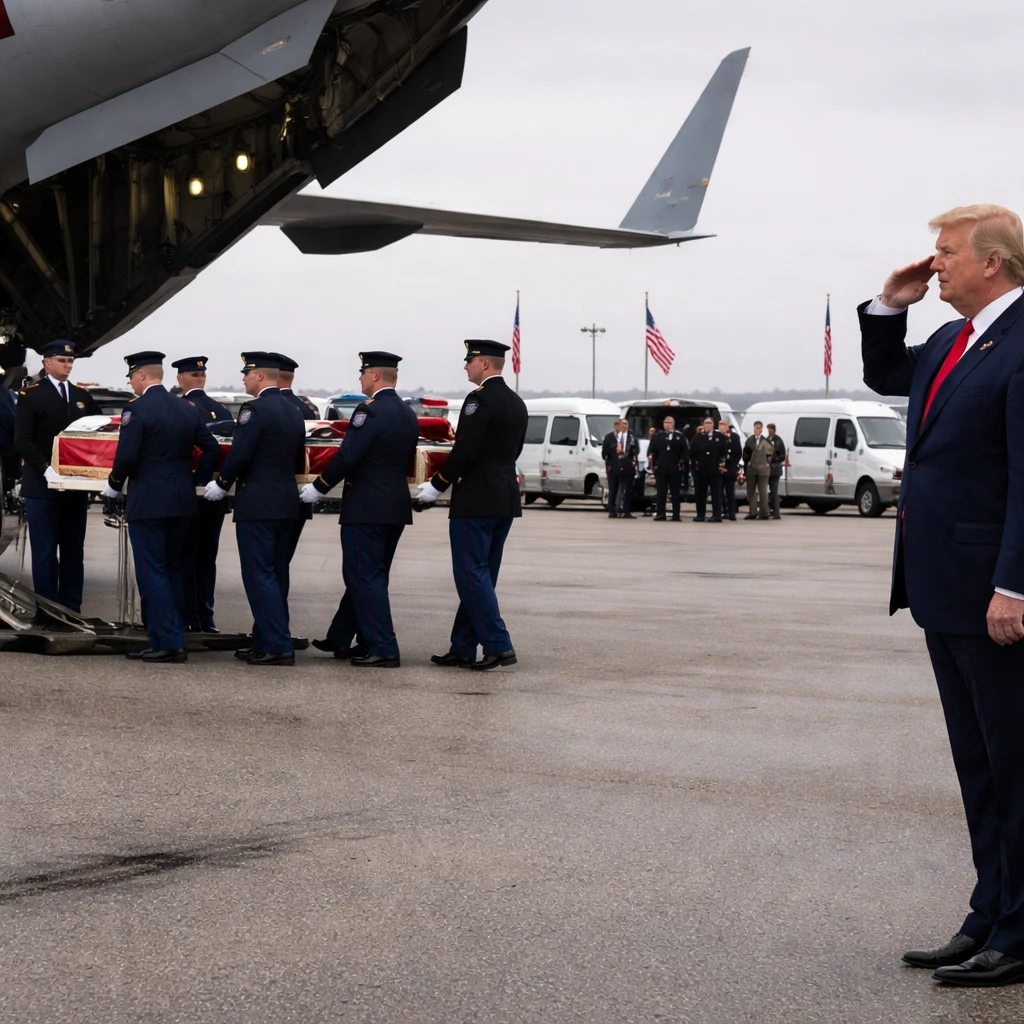
DOVER AIR FORCE BASE, Delaware, July 22 - President Donald Trump was present at a solemn transfer ceremony at Dover Air Force Base on Wednesday as four U.S. service members were brought back to American soil in flag-draped transfer cases following deadly Iranian attacks in the Middle East.
The ritual - formally described as a "dignified transfer" - was staged amid mounting scrutiny of the U.S.-Israeli war with Iran. Officials estimate the conflict has cost U.S. taxpayers at least $37.5 billion, has resulted in 18 U.S. service member deaths and has killed thousands of Iranians. Lawmakers from both Republican and Democratic parties have expressed concern about the trajectory of the war, which has pushed global oil prices higher and shows no sign of abating.
Trump, who has articulated varying objectives for the conflict since it began in February, stood near the flight line wearing a blue suit and a red tie. He stood at attention and saluted as military teams - each composed of seven service members - carried the transfer cases off the aircraft one by one. Family members, arriving in a convoy of vans, observed from a short distance as the flag-draped cases were moved and then placed into one of two waiting vans.
Before departing for the ceremony, the president said: "We’re going to honor them. For me it’s one of the hardest things to do as a president. But it has to be done." When asked what he would say to the families of the fallen, he added: "All I’m going to say is, we love you. We love your child, and that’s what they are to them. They’re their children. There’s no games, no nothing." Presidents, vice presidents and other dignitaries commonly attend such transfers at Dover, which is home to the largest U.S. military mortuary, during periods of conflict.
The four service members returned Wednesday include three who died when an Iranian missile struck their sleeping barracks at Muwaffaq Salti Air Base in Jordan on Friday: First Lieutenant Tyler James Feehan, 25; Sergeant Angel S. Rampersad, 28; and Private Isabella Gonzales, 19. All three were assigned to U.S. Army air defense brigades. The fourth service member, Sergeant Michael Emmanuel Swinton, 30, died on Sunday in a separate incident in Erbil, Iraq, during a controlled detonation of an attack drone.
An anonymous U.S. official said the number of U.S. troops injured in the conflict is now well over 500. The Pentagon reported on Monday that 100 service members have been injured since July 7 and that 96% of those injured have returned to duty.
The human toll is reflected in public sentiment. A recent opinion poll conducted this month found that four in five Americans expect the war to continue for an extended period, and roughly 37% of respondents approved of U.S. military strikes against Iran. The conflict has coincided with low presidential approval ratings for Trump, hovering near the lowest levels of his political career since the fighting began.
Republican strategists have warned that rising living costs have offset the electoral benefits of prior tax cuts. In particular, higher gasoline prices and broader cost-of-living pressures are identified as political risks for the president’s Republican Party heading into November’s midterm elections, where the party faces the possibility of losing its House majority and, potentially, control of the Senate.
Policy choices and public reaction to them are being closely watched not only for their political consequences but also for their market and economic implications. The conflict’s upward pressure on global oil prices and the associated impact on household energy costs are directly relevant to consumer spending and inflation dynamics. Those dynamics, in turn, can influence financial markets and electoral outcomes.
Wednesday’s ceremony at Dover was a stark reminder of the immediate human costs of the conflict and of the broader fiscal and economic consequences that have emerged as the war continues. Military honors at such transfers are intended to provide a measure of solemn closure for families while underscoring the gravity of decisions that have placed U.S. service members in harm’s way.