
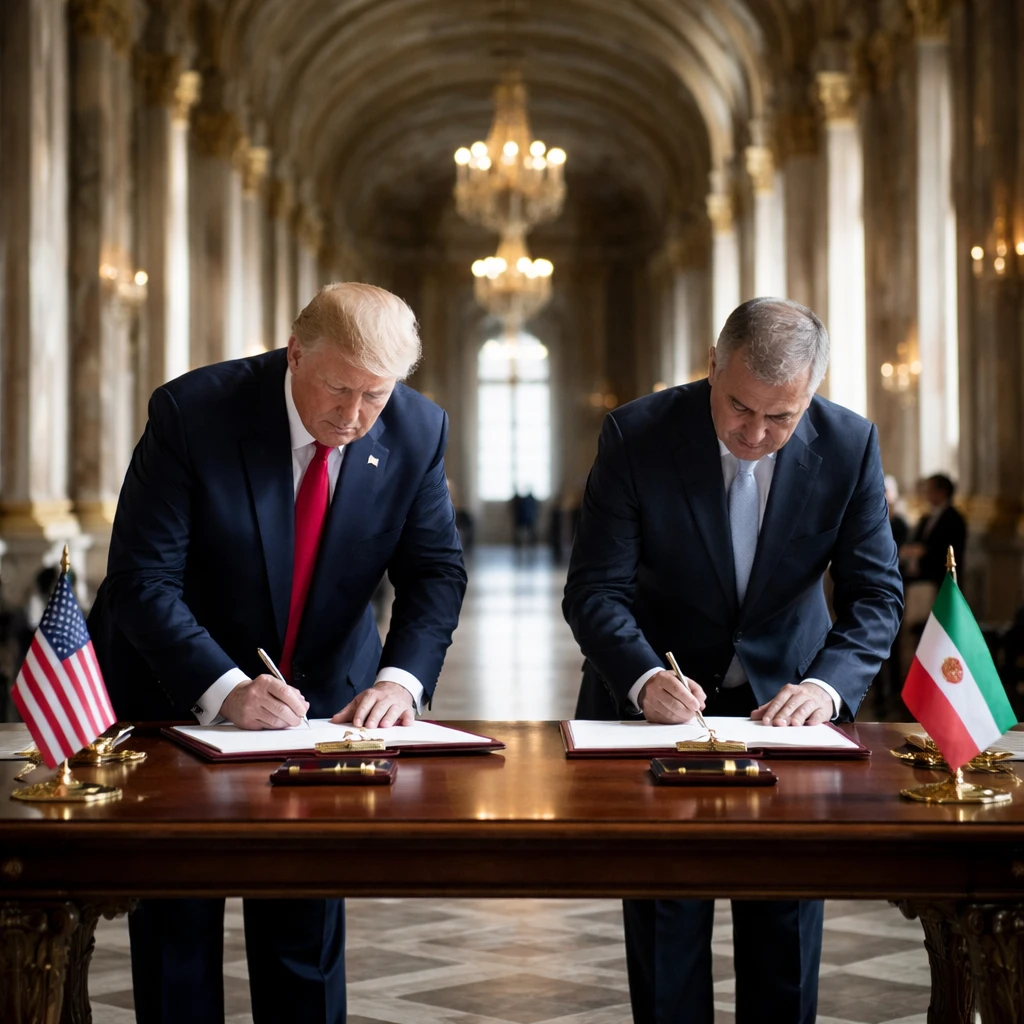
In a significant diplomatic development marking nearly four months of conflict, President Donald Trump and Iranian President Masoud Pezeshkian have signed a memorandum of understanding in Versailles, France. The agreement outlines critical conditions for de-escalation, including Iran's pledge to forgo nuclear weapons, the reopening of the Strait of Hormuz, and the lifting of U.S. sanctions. However, the arrangement serves only as a preliminary framework, paving the way for two months of intensive negotiations aimed at securing a permanent settlement. Both leaders have issued stern warnings regarding the fragility of the accord, emphasizing that any violation by the opposing party could instantly reignite hostilities.
The signing took place on Wednesday evening as President Trump departed the Palace of Versailles. When questioned by reporters regarding the status of the agreement, he provided a direct confirmation, stating that the document had just been signed at the historic location. According to White House officials cited by media outlets, Iranian President Pezesheshkian also affixed his signature to the memorandum. Additional reporting from CBS indicated that the signatures were applied remotely by both parties, underscoring the urgency and logistical constraints of the situation.
Key Terms and Immediate Conditions
Early reports from Wednesday shed light on the foundational elements of the memorandum. The core commitments require Iran to permanently abandon any pursuit of nuclear weaponry. Furthermore, the accord mandates the immediate cessation of all hostilities, extending to the conflict in Lebanon. A critical economic component of the deal involves the reopening of the Strait of Hormuz, a vital artery for global oil shipments, and the removal of existing U.S. sanctions on Tehran.
Despite the signing, the agreement is explicitly not a final peace treaty. Instead, it establishes a structured timeline for a two-month negotiation period. During this window, diplomatic efforts will intensify, with Iran's nuclear program remaining a primary focal point. An official signing ceremony was previously scheduled to take place in Switzerland on Friday, but current status of this event remains uncertain following the Versailles developments.
Risks, Warnings, and Market Implications
The atmosphere surrounding the agreement is tense, with both sides issuing conditional warnings that highlight the precarious nature of the ceasefire. President Trump cautioned that the arrangement is not permanent and warned that Washington retains the capability to resume attacks on Iran should Tehran fail to uphold its end of the bargain. Iranian officials echoed this stance, indicating a mutual distrust that complicates the path forward.
Specifically, Iranian authorities have declared that continued Israeli hostilities against Lebanon would automatically void the peace agreement. This conditional threat introduces a significant variable into regional stability, as any escalation in the northern theater could immediately unravel the diplomatic gains made in France.
From a macroeconomic perspective, the developments carry substantial implications for energy markets and industrial sectors. The reopening of the Strait of Hormuz directly targets oil supply chains, which are fundamental to the broader energy complex. Conversely, the lifting of sanctions on Iran suggests potential shifts in trade flows and commodity pricing for those sectors previously restricted by U.S. policy. However, the uncertainty surrounding the implementation of these terms and the two-month negotiation window creates a volatile environment. Investors in the energy sector, particularly those tracking crude oil and natural gas futures, face heightened risk as the geopolitical landscape remains fluid. The stability of industrial supply chains dependent on Middle Eastern transit routes will be closely monitored, with any breach of the ceasefire posing immediate risks to global trade and capital allocation.