
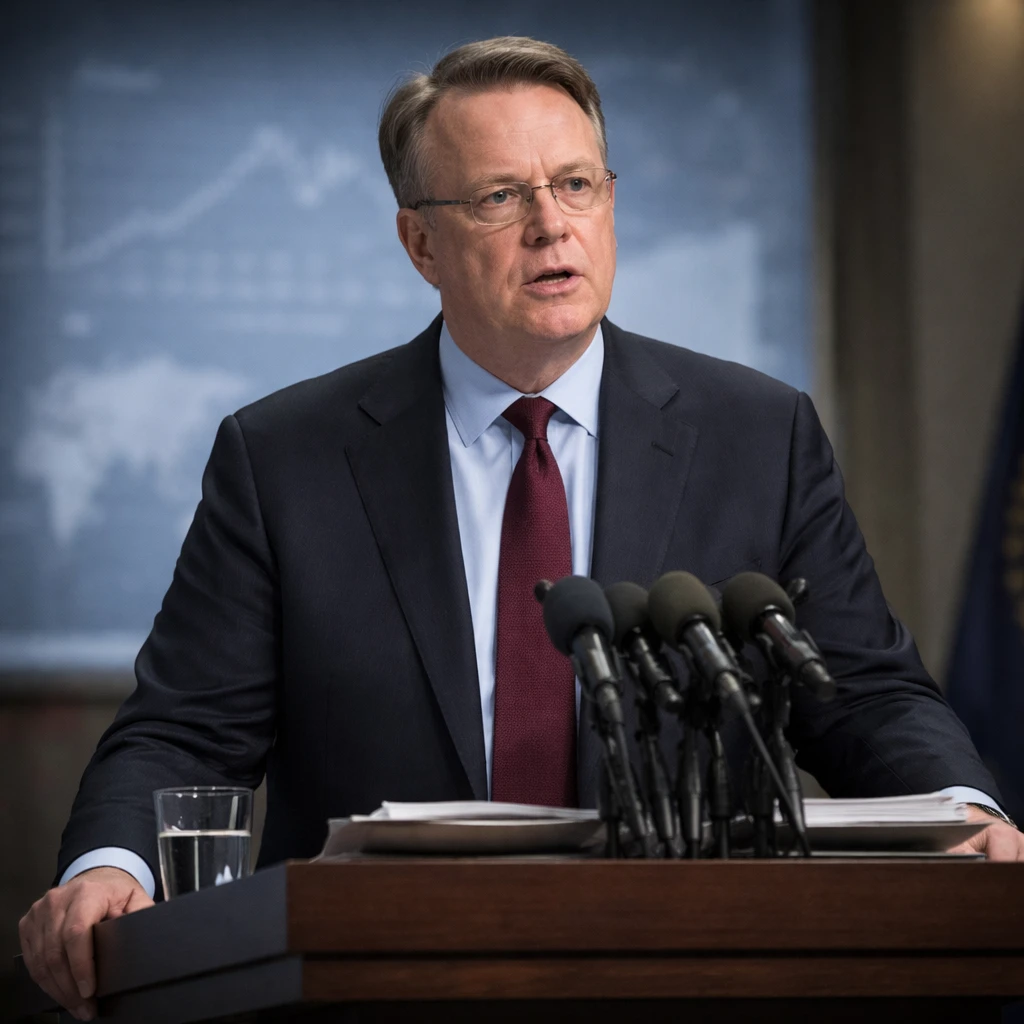
John Williams, president of the Federal Reserve Bank of New York, told Reuters in an interview published Monday that the central bank is prepared to raise interest rates if necessary to return inflation to its 2% target.
Williams said he anticipates inflation pressures will decline gradually if energy prices and trade tariffs have already peaked and if the economy remains robust. He noted that "some of the big drivers that pushed up inflation" over the last year and a half "will not be at play as much, and then some of the disinflationary forces that we've been seeing" should reassert themselves.
Speaking about his own projection, Williams said he expects inflation to fall in the second half of this year and to decline further next year. He described the current stance of interest rate policy as "well positioned" to return inflation to the 2% target.
Williams underlined the conditional nature of that outlook. He said, "if the economy is not on a trajectory that will bring inflation back down to 2% ... it would absolutely be appropriate to act to get us on a trajectory that does bring inflation back to 2%."
Inflation remains meaningfully above the Fed's goal. The article noted that inflation has remained above 2% for more than five years and that the Fed's preferred inflation measure rose 3.7% in June on a year-over-year basis.
Last week the Federal Open Market Committee left the federal funds target rate range unchanged at 3.50% to 3.75%. Williams said he "strongly ... supported the decision of the committee" to keep rates on hold.
The FOMC meeting produced three dissents, with the three officials who objected saying the central bank needs to raise short-term borrowing costs to bring inflation down. Cleveland Fed President Beth Hammack was quoted saying, "Inflation has remained stubbornly above 2% for more than five years, and I am not confident it will return to our objective on its own."
Williams said he will be watching core inflation data closely over the next several months to judge whether inflation is progressing toward 2% and is on a sustainable path to reach that objective by 2028.
He also highlighted the high degree of uncertainty in the economic outlook, especially around energy prices given renewed conflict in the Middle East. Williams said that when there is a resolution and shipping traffic resumes, improvement in inflation dynamics could come swiftly.
On the relationship between monetary policy and market moves, Williams stressed that the Fed will not set policy based on market levels, even as it closely monitors financial markets. The piece noted that long-term bond yields have risen amid investor concerns that inflation pressures may persist, and that futures traders have priced in a chance the Fed will raise rates by year end.
Williams also addressed recent volatility in artificial intelligence investments, saying such fluctuations are not surprising. He argued that leverage in the AI sector is not comparable to the leverage that contributed to the financial crisis two decades ago, adding, "Most of these businesses have very high earnings, so I'm not as worried about the financial stability from the leverage right now."
Throughout the interview Williams balanced a forecast that anticipates a gradual easing of inflation with a clear signal that the Fed stands ready to tighten policy if incoming data indicate inflation will not return to target on a sustained basis.
Key takeaways from Williams' interview:
- Williams said policy is prepared to tighten if needed to deliver 2% inflation.
- He expects inflation pressures to ebb if energy prices and tariffs have peaked and the economy holds up.
- The Fed will monitor core inflation data closely and will act if the economy diverges from a path toward 2% by 2028.
Market and sector context highlighted in the interview:
- Long-term bond yields have risen on investor concern over persistent inflation.
- Energy markets and shipping routes are closely tied to inflation uncertainty amid renewed Middle East conflict.
- Volatility in the AI sector was described as expected, with leverage levels not seen as a systemic financial-stability threat in the speaker's view.