
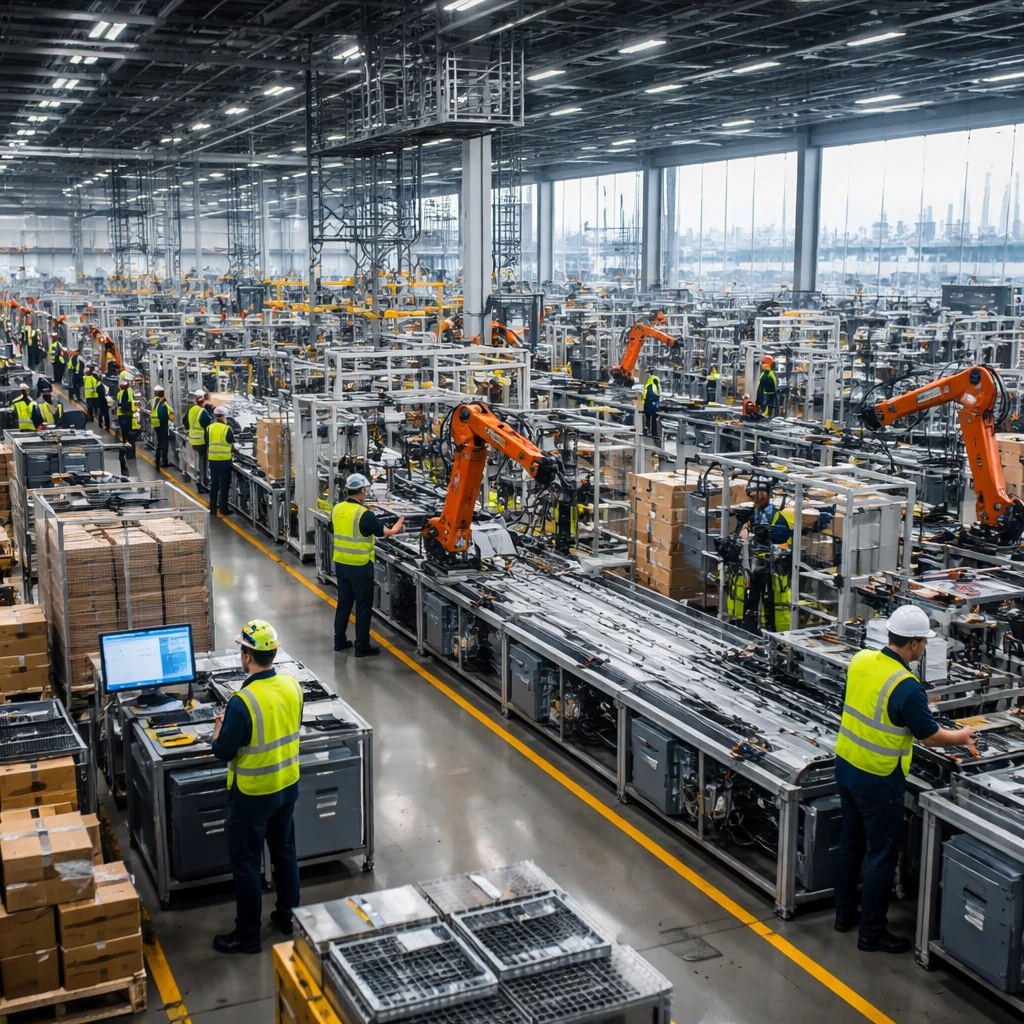
U.S. manufacturing activity accelerated in July to its most robust level in over four years as factories responded to strong order flows and rising backlogs, even as supply-chain frictions and elevated input costs persisted.
The Institute for Supply Management reported that its manufacturing purchasing managers index rose to 55.6 in July from 53.3 in June, reaching the highest reading since May 2022. Economists surveyed ahead of the release had anticipated a more modest increase to 54.0. The PMI remains above the 50 threshold that separates expansion from contraction.
Manufacturing accounts for roughly 9.4% of the overall economy. The sector has been buoyed in part by businesses moving to front-load orders to avoid higher prices and shortages tied to the U.S.-Israeli war with Iran. In addition, investment tied to an artificial intelligence buildout has supported activity in the technology segment, helping to offset headwinds from import tariffs.
Orders, employment and inventories
The ISM survey showed the new orders subindex climbed to 56.7 in July from 56.0 in June. Export orders also rose sharply and unfinished work accumulated, both factors that encouraged manufacturers to expand payrolls. The employment component of the survey rebounded to 52.8, its strongest level since August 2022, after a reading of 49.7 in June.
Business inventories remain unusually low, creating scope for additional production growth if demand persists. The Federal Reserve noted last month that overall factory output expanded at its fastest pace in four years during the second quarter. Separately, government figures showed business inventories have fallen for five consecutive quarters.
Supply constraints and input costs
Despite the stronger activity, manufacturers are contending with lengthening supplier lead times. The ISM supplier deliveries index rose to 58.9 in July from 57.4 in June; readings above 50 indicate slower deliveries. Longer delivery times are commonly associated with strong demand and likely helped push the headline PMI higher.
Inflationary pressures at the factory gate remained elevated, although the pace of increase moderated slightly. The survey's measure of prices paid for inputs eased to 71.1 from 73.0 in June. The report noted that the lower reading could reflect a retreat in oil prices in June amid a tentative ceasefire between the U.S. and Iran, though oil prices moved higher after the truce collapsed in July.
Policy backdrop and risks
The U.S. central bank last week left its benchmark overnight interest rate in the 3.50% to 3.75% range. Three members of the Federal Open Market Committee dissented from that decision, preferring a quarter-percentage-point increase. The ISM report highlighted that inflation risks are skewed to the upside because of the ongoing war in the Middle East, which has entered its sixth month.
Taken together, the data portray a manufacturing sector experiencing solid demand and employment gains while facing meaningful supply and price pressures. With inventories at low levels, production has room to rise further, but supply-chain constraints and geopolitical risks are likely to keep input costs elevated and complicate the outlook.
Data highlights
- ISM manufacturing PMI: 55.6 in July, up from 53.3 in June
- New orders index: 56.7 in July, up from 56.0
- Manufacturing employment index: 52.8 in July, up from 49.7
- Supplier deliveries index: 58.9 in July, up from 57.4
- Prices paid index: 71.1 in July, down from 73.0 in June
- Federal Reserve: factory production grew at fastest pace in four years in Q2
- Business inventories: declined for five straight quarters