
Economy June 24, 2026 02:05 PM

Judge Seeks Explanation for Tarp Obscuring Kennedy Center After Trump Name Removed

Federal court orders administration to report on purpose and status of tarp and scaffolding by July 31 following removal of former president's name

By Hana Yamamoto
Share
Twitter Reddit Facebook LinkedIn

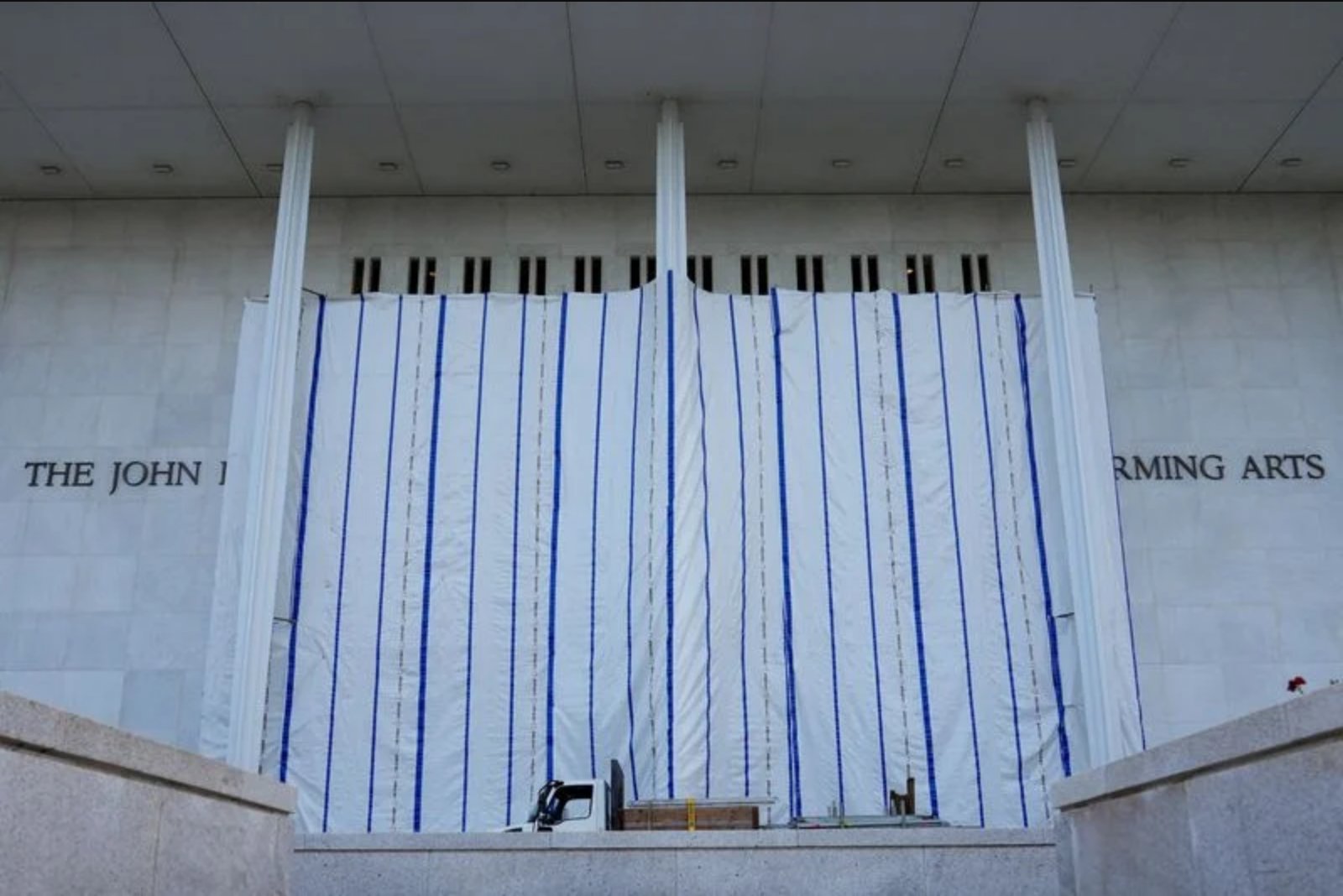
A U.S. district judge has directed the Trump administration to explain the installation of a tarp and scaffolding that now obscure the Kennedy Center's façade, after a court order required the removal of the former president's name. The administration must report the purpose and status of the covering by July 31, while legal proceedings continue in an appeals court.

Judge Seeks Explanation for Tarp Obscuring Kennedy Center After Trump Name Removed
Summarize with
ChatGPT Perplexity Claude Grok Gemini

Key Points

  • Judge Christopher Cooper ordered the administration to report by July 31 on the purpose and status of the tarp and scaffolding covering the Kennedy Center façade.
  • The tarp was installed as workers removed former President Trump's name following a court ruling that the renaming in December was unlawful; the administration has asked an appeals court to stay that order.
  • Representative Joyce Beatty, a Kennedy Center board member and plaintiff in the lawsuit, contends the covering obscures John F. Kennedy's name and called the action an act of petty defiance - sectors impacted include government/legal affairs, cultural institutions, and construction/renovation services.

A federal judge has ordered the Trump administration to provide a formal explanation for the placement of a tarp and scaffolding covering the façade of the Kennedy Center, after the president's name was removed from the building pursuant to a court order.

U.S. District Judge Christopher Cooper set a deadline of July 31 for the administration to report "the purpose and status of the tarp and scaffolding" now in place at the Washington theater complex. The covering was installed as workers removed former President Trump's name in a predawn operation earlier this month, following Cooper's finding that the administration had unlawfully added the name to the façade in December.

The action to obscure the building's exterior coincided with a lawsuit filed by Democratic Representative Joyce Beatty, who serves on the Kennedy Center's board. Last month, the same judge ordered the removal of Trump's name from the center's signage and barred plans to close the facility for two years of renovations scheduled to begin on July 4.

Representatives of the White House and the Kennedy Center did not immediately respond to requests for comment about the tarp or the court's directive.

Separately, the Trump administration has asked the U.S. Court of Appeals for the District of Columbia Circuit to put the district court's order on hold.

In filings before the appeals court, lawyers for Representative Beatty described the covering as a "semi-permanent tarp" that now conceals the name of the late President John F. Kennedy on the center's exterior. Beatty's legal team argued that the obstruction appears to be an effort by the administration "to frustrate the restoration of the status quo as it existed prior to the renaming."

Beatty herself called the obscuring of the façade an "act of petty defiance." The ongoing litigation and the district judge's requirement for a status report leave open the immediate question of the tarp's purpose and whether it will remain in place pending appellate review.

For now, the court-ordered timeline requires the administration to explain the tarp and scaffolding's purpose and current condition by the end of July while the appeals process continues.


Summary

Judge Christopher Cooper has ordered the Trump administration to explain why a tarp and scaffolding were placed over the Kennedy Center's façade following the removal of the former president's name, with a required report due by July 31. The action follows a court decision that the renaming was unlawful and comes amid an ongoing appeal seeking to stay the district court's order.

Risks

  • Uncertainty over the appeals court's response to the administration's request to stay the district court's order - this affects the legal sector and public institutions tied to the Kennedy Center.
  • Lack of immediate comment from the White House and Kennedy Center creates unresolved questions about the tarp's intended purpose and duration - this raises operational uncertainty for cultural and construction vendors involved with the site.
  • The presence of a "semi-permanent tarp" could delay restoration of the previous façade appearance pending legal developments, affecting public-facing operations and stakeholders in arts and venue management.

More from Economy

El Niño Seen Pushing Brazil’s Inflation Above Target, Central Bank Survey Finds Jun 24, 2026 Gilt Yields Slide to Three-Month Low as Global Bond Rally Follows Oil Price Drop Jun 24, 2026 U.S. Crude Stocks Fall to Levels Not Seen Since 1984, EIA Says Jun 24, 2026 Social Democrats Put Forward Sorin Grindeanu as PM Candidate as Romania Faces Government Deadlock Jun 24, 2026 Bulgaria Sets 2026 Deficit Target at 5.7%; Aims for EU 3% Ceiling by 2028 Jun 24, 2026