
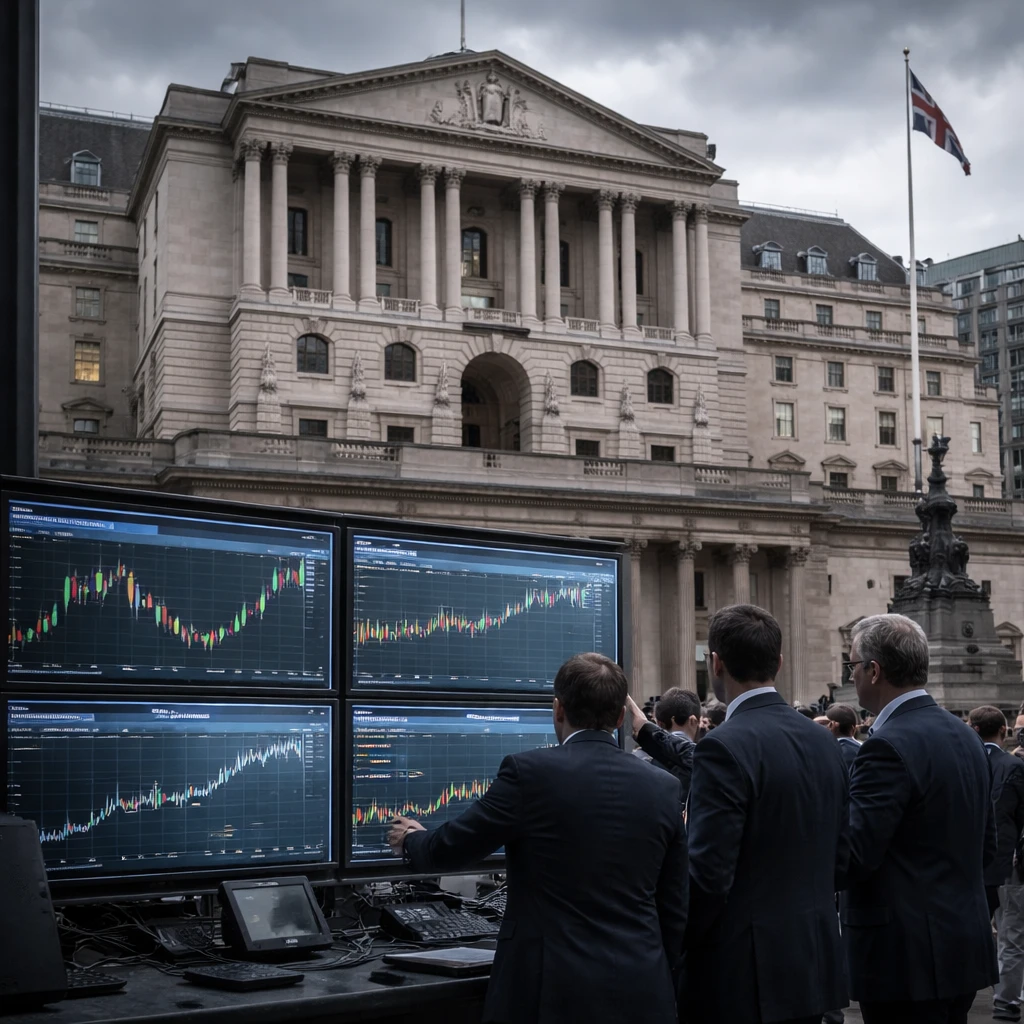
The Bank of England's Monetary Policy Committee (MPC) held the official Bank Rate at 3.75% on Thursday in a 6-3 vote, extending the pause in interest rate moves even as three members signalled they would have preferred a 25 basis-point increase to 4%.
Those voting for a hike were Catherine Mann, Megan Greene and the BoE's Chief Economist Huw Pill. The result differed from the split many market observers had anticipated, with the committee choosing a more cautious path under Governor Andrew Bailey's guidance.
Governor Bailey set out the case for pausing by stressing uncertainty in global conditions and comparatively milder domestic inflation pressures. "Holding Bank Rate is appropriate as global conditions look to be more uncertain and inflationary, while domestic conditions are on balance more benign as regards the prospects for inflation," he said.
The dissenters, led in part by Mann, pointed to geopolitical developments as the key reason for their preference for tighter policy. Mann said the breakdown of a tentative truce between the United States and Iran and the broadening of the conflict this month had altered the outlook. She described the situation as "this 'sporadic continuance' of the conflict that I hypothesised last month appears to be the state of play." That widening of tensions, the MPC members who favoured a hike argued, elevated risks to energy markets and therefore to the inflation outlook.
The BoE's central forecast, published alongside the decision, projects inflation climbing to 3.2% later this year from a 15-month low of 2.6% in June. Under the central scenario - which assumes energy prices follow market expectations and that there are only limited spillovers from high energy costs into pay and price-setting - inflation is expected to remain above the 2% target until early 2028, when it would dip back below 2%.
That projection incorporates market pricing that anticipates further BoE tightening in late 2026 and again in 2027, an outlook that contrasts with the majority view among economists polled that further tightening can be avoided.
Energy considerations were highlighted elsewhere in the policy discussion. The new UK government's measures to ease household bills were referenced as part of the domestic picture. Prime Minister Andy Burnham has prioritised cost-of-living measures, including plans to abolish a tax on household electricity bills. The BoE said removing that tax would reduce inflation by around a tenth of a percentage point, a small but tangible effect on price growth.
Monetary policy deliberations were also framed by recent moves at other central banks. The European Central Bank raised rates in June, while the U.S. Federal Reserve left policy unchanged at its latest meeting, though three members of the Federal Open Market Committee reported preferring a quarter-point increase. The Fed's chair was quoted as saying he had "no tolerance" for inflation.
Back at the BoE, committee members who urged a hike also flagged the risk of second-round effects from prolonged inflation. They noted that inflation has been above the 2% target for almost all of the past five years, which could raise the chance of wage-price dynamics becoming entrenched. Other MPC members, however, saw little evidence so far that those second-round effects were materialising and pointed to weaker labour market signals, including the slowest pace of private-sector pay growth since 2020.
Deputy Governor Clare Lombardelli commented that the absence of second-round effects to date was "informative but not conclusive," reflecting the committee's cautious weighing of competing signals.
Separately, the BoE revised upward its estimate of how much the reduction of its government bond holdings has affected market yields. The Bank judged that its quantitative tightening programme had added a "modest" 0.2-0.3 percentage points to gilt yields since 2022, an upward revision from a previous estimate of 0.15-0.25 percentage points. That reassessment comes ahead of the MPC's annual September vote on the pace of the balance-sheet reduction.
In 2025 the Bank slowed the pace at which it runs down its stock of government bonds to £70 billion a year from a previous £100 billion. Financial market participants polled by the BoE expect the MPC to slow the pace again in September to around £50 billion.
Exchange rate information published with the update showed $1 = 0.7521 pounds.
Summary
The Bank of England left Bank Rate at 3.75% in a 6-3 decision, as three policymakers - Mann, Greene and Pill - voted for a 4% rate amid concerns about renewed U.S.-Iran conflict and its potential impact on energy markets. Governor Bailey and the majority of the MPC maintained a wait-and-see stance to reduce the risk of inflation overshooting the 2% target. The BoE's central forecast expects inflation to rise to 3.2% later this year and remain above target until early 2028 under assumptions that energy prices follow market expectations and spillovers are limited.
Key points
- The MPC voted 6-3 to keep Bank Rate at 3.75%, with three members preferring a 25bp rise to 4%.
- BoE central projection sees inflation at 3.2% later this year and above target until early 2028, assuming energy prices move as markets expect and limited pay/price spillovers.
- Energy developments and a weaker labour market were central to the split in views; the government plan to remove a household electricity tax is expected to shave about 0.1 percentage point off inflation.
Risks and uncertainties
- Geopolitical escalation - Renewed U.S.-Iran tensions and disruption to oil exports through the Strait of Hormuz could push energy prices higher, increasing inflationary pressure and affecting energy-intensive sectors.
- Second-round inflation effects - Prolonged periods of inflation above target raise the possibility of wage-price feedback, which would have implications for labour costs and consumer prices.
- Market reaction to quantitative tightening - Changes in the estimated market impact of the BoE's balance-sheet reduction could influence gilt yields and funding costs across the financial sector.