
Economy April 4, 2026 10:47 AM

Administration Seeks Court Reversal to Restart White House Ballroom Work, Citing Security Concerns

Emergency appeal filed to lift judge's construction stop amid dispute over congressional approval and preservation challenge

By Nina Shah

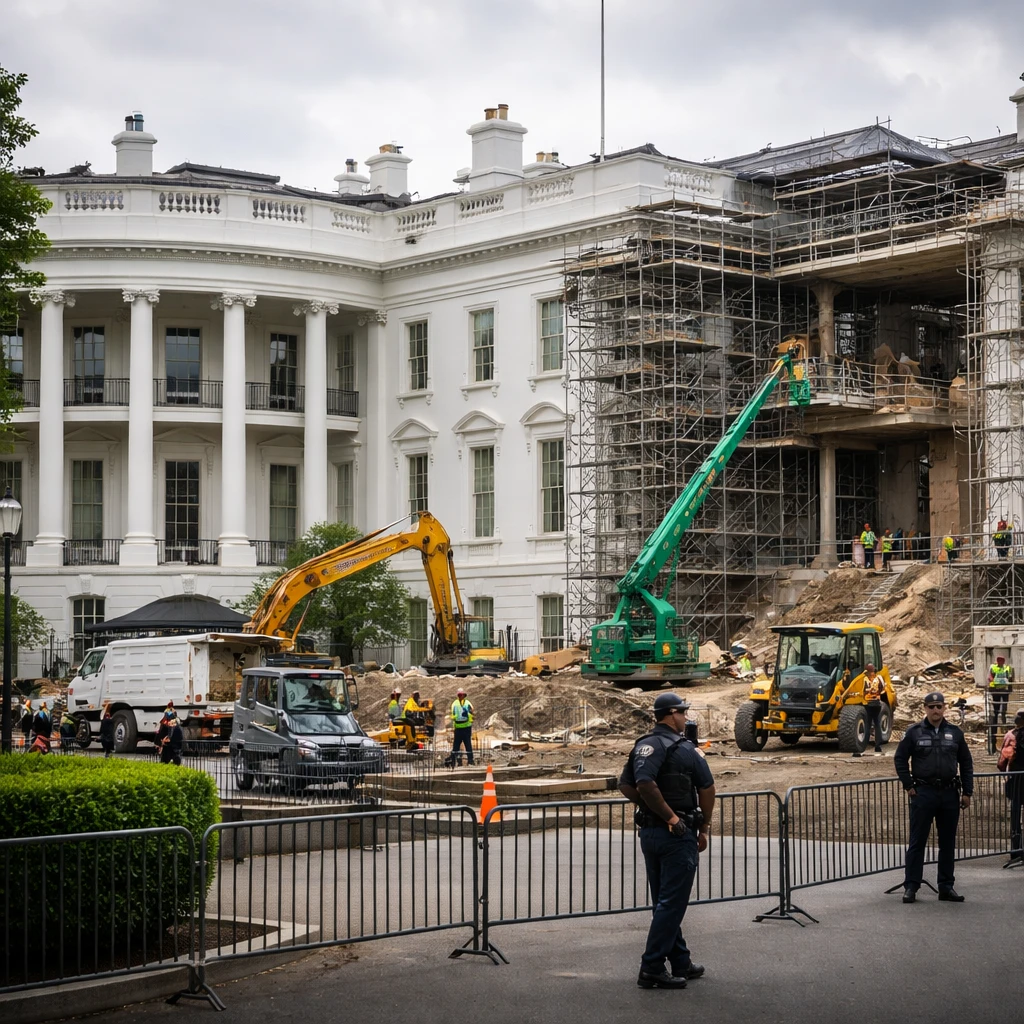
The administration has asked the U.S. Court of Appeals for the District of Columbia to allow construction on a planned White House ballroom to resume, arguing that a recent judicial halt exposes the presidential residence to security vulnerabilities. The filing follows a federal judge's order to pause the $400 million project while a preservation group pursues a legal challenge asserting the work requires congressional authorization.

Administration Seeks Court Reversal to Restart White House Ballroom Work, Citing Security Concerns

Key Points

  • The administration filed an emergency motion on Friday with the U.S. Court of Appeals for the District of Columbia asking to resume construction on a White House ballroom, citing security risks to the president, family and staff - sectors affected include government operations and security-related services.
  • U.S. District Judge Richard Leon ordered construction stopped earlier this week while the National Trust for Historic Preservation's lawsuit proceeds; the plaintiffs argue the $400 million project requires congressional approval - legal and construction sectors are directly impacted.
  • The administration disputes the legal claims as "legally baseless" and questioned the plaintiffs' standing, and it has a 14-day window to appeal the district court's halt - this introduces regulatory and procedural uncertainty that affects contractors and planning for landmark renovation projects.

The administration filed an emergency motion on Friday with the U.S. Court of Appeals for the District of Columbia seeking to lift a court-ordered stop on construction of a new White House ballroom. In the appeal, officials argued that the suspension of work leaves the presidential residence "open and exposed," creating potential national security threats to the president, members of his family and staff.

The request to restart construction comes after U.S. District Judge Richard Leon earlier this week issued an order halting the project while a lawsuit moves forward. The legal action was brought by the National Trust for Historic Preservation, which contends that the $400 million ballroom undertaking requires approval from Congress.

In its filing, the administration rejected the preservation group's claims as "legally baseless," asserting that the president possesses full authority to carry out renovations at the White House. The filing also questioned whether the plaintiffs have the legal standing necessary to maintain the suit.

Judge Leon, who put the construction on hold, provided the administration with a 14-day period during which it may appeal his ruling.

The contested ballroom project follows demolition work on the historic East Wing, which was originally constructed in 1902 and later expanded under President Franklin D. Roosevelt. The ballroom is part of broader plans by the president to rework prominent Washington landmarks.


Context and legal posture

The current procedural posture places the project in a period of legal uncertainty. With a temporary injunction in place, the administration is pursuing appellate relief to argue both the immediacy of security concerns and the legal authority to proceed without congressional sign-off, while the preservation group continues its challenge on statutory grounds.

Operational and security claim

The administration framed the pause as creating tangible security exposures for the White House compound and its occupants. That assertion forms a central part of the emergency appeal to the court of appeals.


Key parties

  • Administration - filed the emergency motion and argues for authority to renovate the White House.
  • U.S. District Judge Richard Leon - issued the order halting construction and allowed a 14-day appeal window.
  • National Trust for Historic Preservation - brought the lawsuit arguing congressional approval is required for the $400 million project.

Risks

  • Security risk cited by the administration arising from the temporary halt to construction, which the filing says could expose the White House and occupants - this impacts government operations and security planning.
  • Legal uncertainty while the preservation lawsuit proceeds, including the district court's injunction and the appellate process during the 14-day appeal window - this affects the construction sector and firms contracted for the project.
  • Regulatory and approval risk asserted by the plaintiffs that the $400 million project may require congressional approval, creating potential hurdles for the renovation plan - this raises uncertainty for project financing and the broader market for landmark redevelopment.

More from Economy

Market Resilience Amidst Sector Shifts: Dow and Russell 2000 Reach New Heights Jun 4, 2026 Australian house price momentum to slow to four-year low as borrowing costs bite Jun 4, 2026 Kevin O’Leary Scales Back Utah Data Center Plan Amid Lawmaker Concerns Jun 4, 2026 Fed's Daly Says AI Could Exert Downward Pressure on Prices Over Several Years Jun 4, 2026 Putin Says Moscow Willing to Make Concessions if Kyiv Reciprocates Jun 4, 2026