
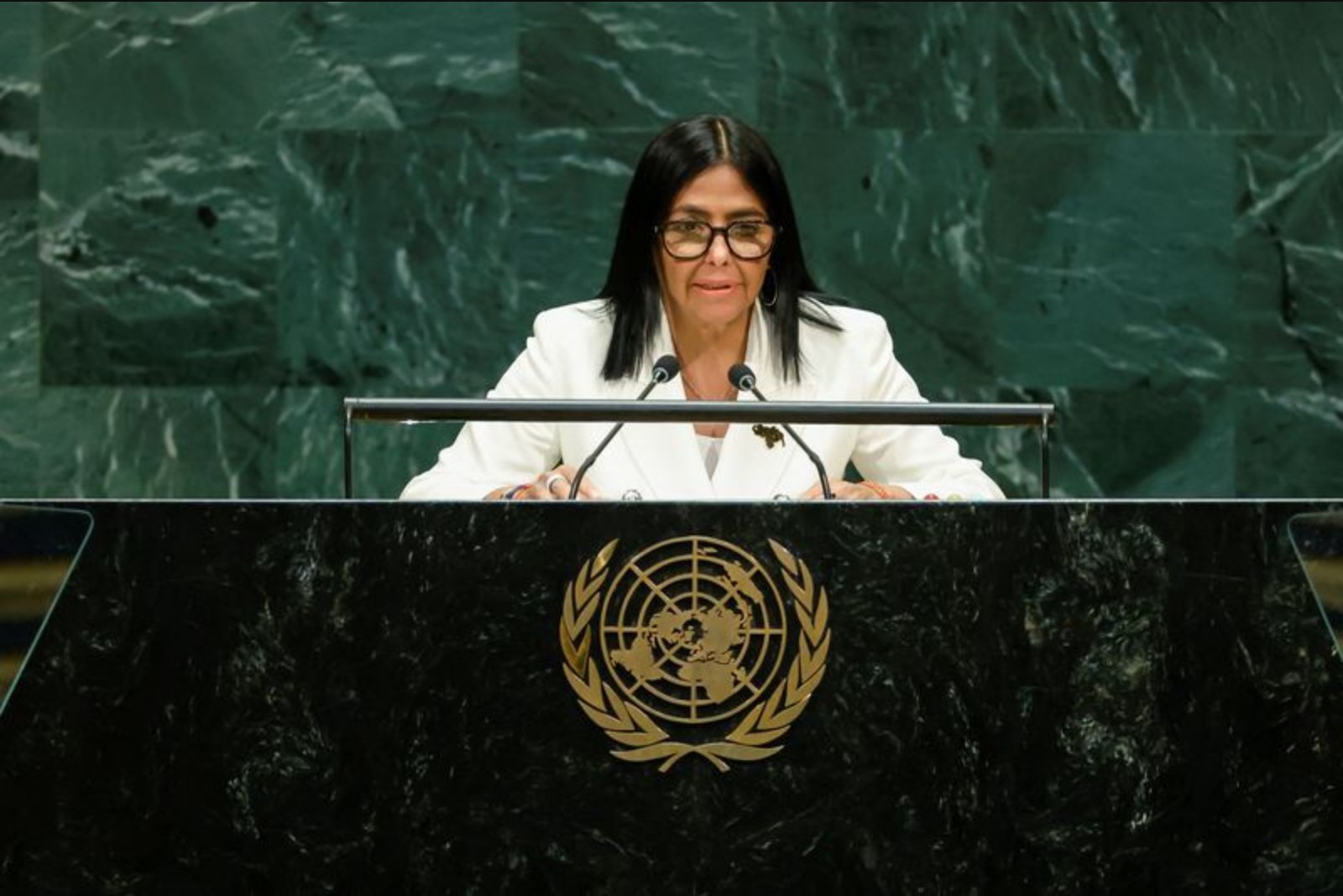
Venezuela’s interim president Delcy Rodriguez arrived in New York for the UN General Assembly with an agenda focused on securing business arrangements in debt restructuring, energy and mining, and on presenting a narrative of political transition. Rodriguez pledged at the UN that the South American OPEC member would hold elections as part of a move toward what she called "full democracy." She departed the city with photographs of herself alongside U.S. President Donald Trump, but with no announced, concrete deals.
The visit marked Rodriguez’s first trip to the United States since American forces captured then-President Nicolas Maduro in a January raid. The optics of her presence in New York and the optics of her interaction with senior U.S. officials highlighted Washington’s central role in shaping the trajectory of her administration, and also illustrated Venezuela’s need to cultivate new international relationships aligned with the U.S. agenda, analysts said.
Antonio De La Cruz, a Washington-based analyst, summarized the visit as one that produced visibility but limited tangible outcomes. He noted that while Rodriguez enjoyed a week of elevated attention, the trip failed to deliver the sort of disbursements, reconstruction funding or business contracts that would amount to a financial turnaround for Venezuela in New York. "Where are the disbursements, the reconstruction package or the business deals? They did not materialize on the scale that would have allowed New York to be portrayed as Venezuela’s great financial comeback," he said.
President Trump referenced the change in Venezuela during his UN address while Rodriguez listened. He used his speech to assert that the United States stood ready to employ its "unmatched military might," remarking "to the victor belong the spoils." Trump did not mention Rodriguez by name in that address, and there was no formal readout describing their brief pull-aside meeting.
Even as Rodriguez sought to show an open-door policy to potential investors and lenders, the trip exposed limits in diplomatic support and the absence of confirmed commercial outcomes. Leaders from leftist governments that had previously supported Maduro kept their distance. The Cuban delegation notably walked out of the UN hall when Trump turned to comments about Cuba; Rodriguez, by contrast, remained as Trump labeled Maduro an "outlaw dictator." Sources reported that officials from Caracas and Havana avoided each other during the meetings.
Rodriguez’s exchanges with other world leaders were occasionally awkward. When she crossed the assembly floor to greet Spanish Prime Minister Pedro Sanchez, he ended a phone call before formally rising to receive her; Sanchez later described the interaction as "normal." A source also told Reuters that the Russian delegation sought a meeting with Venezuela’s Foreign Minister Felix Plasencia to discuss Russia’s interests in Venezuelan oil projects.
Media and public attention also focused on whether multilateral lenders or private energy companies would commit funds or ventures. Ahead of the trip, sources had anticipated at least preliminary agreements with U.S. officials, multilateral banks, allied governments and energy and mining companies. By the time Rodriguez left New York, none of those hoped-for announcements had been made public.
The head of the Inter-American Development Bank said the institution was pursuing approval for a $2.5 billion bridge loan for Venezuela, but Reuters reported that some IDB board members opposed making the loan. No official backing for the loan was announced during the New York meetings.
Reports circulated that ExxonMobil had engaged in talks about a return to the Petromonagas development, a large project in which Russia’s state firm Roszarubezhneft holds partial ownership. Russia’s foreign ministry, its UN mission in New York and its embassy in Caracas did not immediately respond to requests for comment on those reports.
Outside the halls of the UN, demonstrations underscored domestic opposition to Rodriguez’s government. More than 50 protesters gathered with signs that criticized Rodriguez, including depictions of her in an orange jail-style jumpsuit. Signs reading "New Face, Same Regime" were reported, and demonstrators chanted that Rodriguez should join Maduro in the Brooklyn jail where he is being held pending trial.
Domestic political dynamics also surfaced in comments by regional leaders. Brazil’s President Luiz Inacio Lula da Silva told CNN that the United States treats Rodriguez as if Washington were her superior, and that in his position he would call elections. That comment echoed broader skepticism about whether Rodriguez’s visit produced the types of commitments needed to rapidly normalize Venezuela’s economic relationships.
Following Rodriguez’s meeting with President Trump, U.S. Secretary of State Marco Rubio said the two discussed restructuring Venezuela’s sovereign debt and that Washington pressed for political change - both complex and sensitive topics for Rodriguez’s administration. "For this project to be successful, it culminates in a free and fair election," Rubio said.
The lack of a concrete election timeline remained a central question at the conclusion of the trip. For months prior, Rodriguez had avoided providing clear signals about when elections would be held, and U.S. officials had cautioned that any process would take time to materialize. Analysts and Venezuelan opposition parties said the clock is now running for the administration to set a date. Experts cited in coverage said it would likely take at least 12 months to appoint reliable authorities and organize voting - a timeframe that would require extensive preparations.
Political maneuvering around potential candidates was also visible in media reports. Venezuelan opposition figure Maria Corina Machado, who has been suggested as a potential strong contender in a future election, was reported to have been prevented from returning to Venezuela from Panama while Rodriguez was visiting the United States.
On social media platform X, political analyst Nicmer Evans - a former supporter of late leftist President Hugo Chavez - suggested Rodriguez had accepted public humiliation in return for Trump withholding support for Machado. "There will be elections, but when the United States sees fit," Evans wrote.
Contextual takeaway - The trip delivered heightened visibility and a public signaling of alignment with U.S. interests, but it produced no confirmed financing or commercial agreements and left the timing of promised elections unresolved. The visit highlighted the dependence of Venezuela’s interim administration on U.S. backing and underscored the diplomatic complexity of re-engaging multilateral lenders and energy partners.