
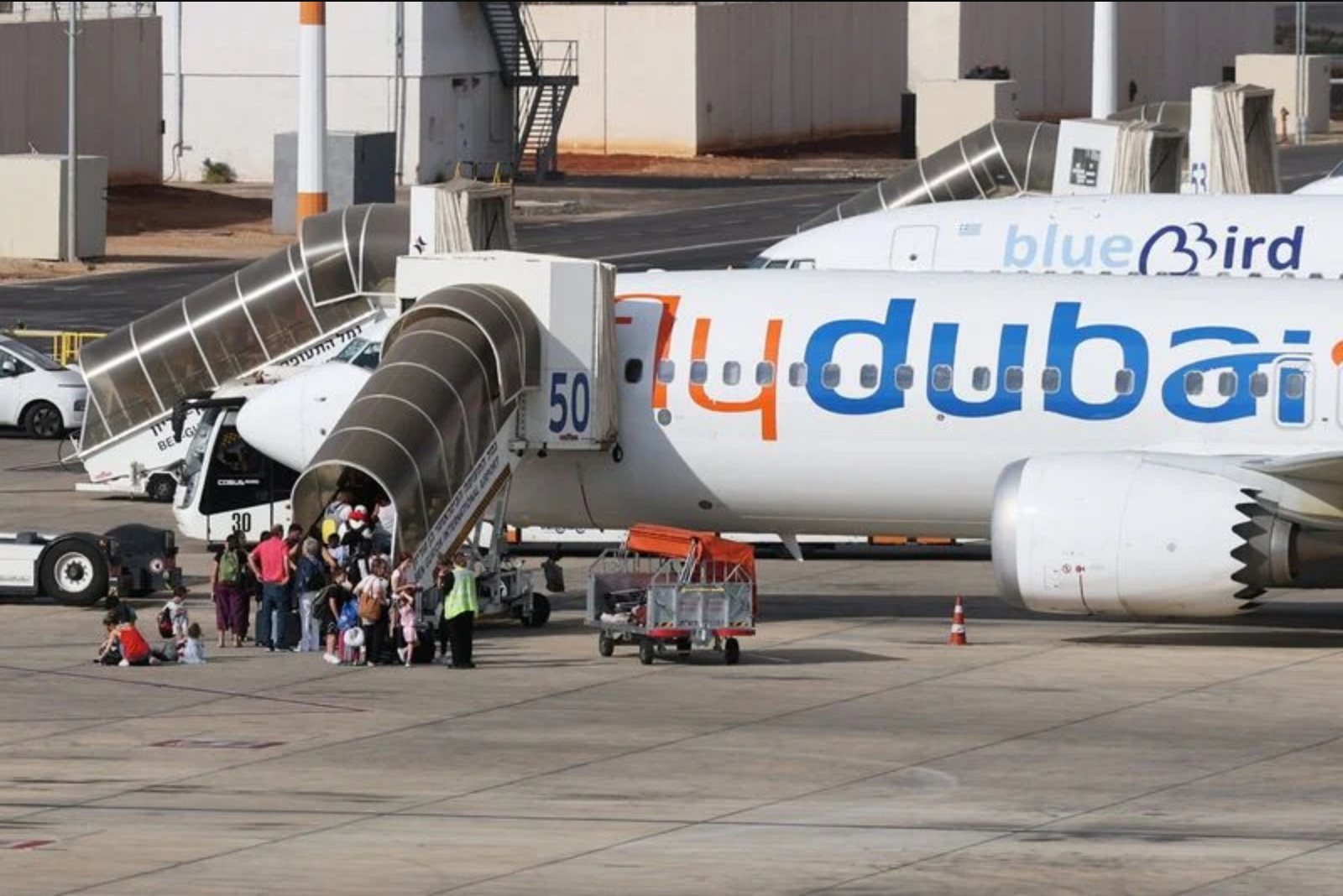
Israel announced plans to strengthen checks on pilots who operate flights into the country after a violent incident aboard a flydubai aircraft in which a co-pilot reportedly stabbed the pilot and attempted to crash the plane. The episode was brought under control when passengers assisted in subduing the co-pilot and other on-duty pilots employed by the airline on board later landed the aircraft safely in Saudi Arabia.
A spokesperson for the prime minister's office said authorities would institute more rigorous measures to verify the identities and backgrounds of pilots flying into Israel, applying the scrutiny to crews on both Israeli and foreign carriers.
"Every pilot that is going to be flying into Israel, we are going to know the pilots' identities, know who they are, and do some type of security check," Doron Spielman, a spokesperson for the prime minister's office, said. He added that the prime minister had instructed officials to "ramp up security" on flights to Israel operated by Israeli and non-Israeli carriers. Spielman said the aim was to ensure that security procedures are heightened for any pilot flying into Israel, even if they are not on Israeli airlines.
Israeli Prime Minister Benjamin Netanyahu identified the captain who was attacked as Indian national Captain Smit Machchhar. Netanyahu said that despite being "stabbed and seriously injured," Machchhar fought back and opened the cockpit door, allowing passengers and crew to overpower the attacker. The flight in question, FZ1073 from the United Arab Emirates to Israel, was carrying 174 people, almost all of whom were Israeli, Netanyahu said. Saudi authorities have arrested and interrogated the co-pilot.
Containment, uncertainty and operational questions
The dramatic nature of the event has raised questions about how pilots are screened and the breadth of security protocols that apply to flight crews. Government officials and aviation experts noted that while pilots already face extensive assessments, variations exist in how standards are implemented across jurisdictions and airlines.
Philip Baum, a visiting professor of aviation security at Coventry University in Britain, said pilots undergo "extensive background checks but also continuous medical and psychological assessments." He and other experts underlined that national authorities and airlines bear primary responsibility for carrying out checks and ensuring crew fitness for duty, in line with international standards that permit interpretation in local contexts.
Two pilots working in the Middle East, who were not employed by flydubai, told reporters that in their experience pilots are subject to the same security screenings as passengers and therefore would not be able to bring conventional weapons such as knives or firearms onto the cabin in the same way a passenger might. One industry consultant, Eric Schouten, head of aviation intelligence consultancy Dyami, said: "It's always the airline's responsibility. The airline has to do a proper vetting according to national guidelines on who is in the cockpit and every country does it differently."
The European Aviation Safety Agency (EASA) noted that the certification and safety oversight of flydubai are the responsibility of the UAE civil aviation authority. "This includes responsibility for ensuring that the operator meets the applicable requirements concerning its flight crews and their fitness to fly," EASA said.
Representatives of the UAE civil aviation regulator, the GCAA, did not respond to a request for comment on how its pilots are vetted.
What is known and what remains unclear
Officials and passengers have described chaotic scenes on board. Passengers reported seeing a man holding a knife while one of the pilots lay bloodied, but reporting has not established the exact nature of any weapon used. A pilot operating in the region but not for flydubai observed that crew sometimes have access to metal knives associated with meal service or to a crash axe carried in many cockpits; however, authorities have not confirmed the weapon used in this incident.
So far, no motive for the co-pilot's alleged actions has been provided. Israeli officials have emphasized the need for heightened vigilance among Israelis and Jewish travelers abroad, given concerns they could be targeted. Spielman said Israel already maintained some of the "toughest security checks" and that the measures would be made stricter following the event. "This is an opportunity for everyone to wake up. Israel has the most thorough security checks in the world, and they're there for a reason. They're there so that an incident like this doesn't take place," he said.
Operational and industry implications
The episode highlights the operational responsibility placed on airlines and national regulators to ensure crew fitness for duty. It also underscores the potential for authorities to impose additional screening measures at points of entry when a security incident calls existing protocols into question. How those tightened checks will be implemented in practice - whether through identity verification, additional background checks, psychological assessments, or other measures - has not yet been detailed by Israeli officials.
Passengers and industry observers will be watching how authorities reconcile the need for enhanced security with the operational realities of international flight operations, where crews from diverse jurisdictions operate to and from multiple countries under varying oversight regimes.
At this stage, authorities have confirmed the identity of the injured pilot and the arrest and interrogation of the co-pilot by Saudi officials. Beyond that, multiple aspects of the case remain unresolved, including the weapon used and the motive behind the attack.
This report presents the known facts as provided by officials, airline reports and passenger accounts; several elements of the incident remain under investigation and have not been resolved publicly.