
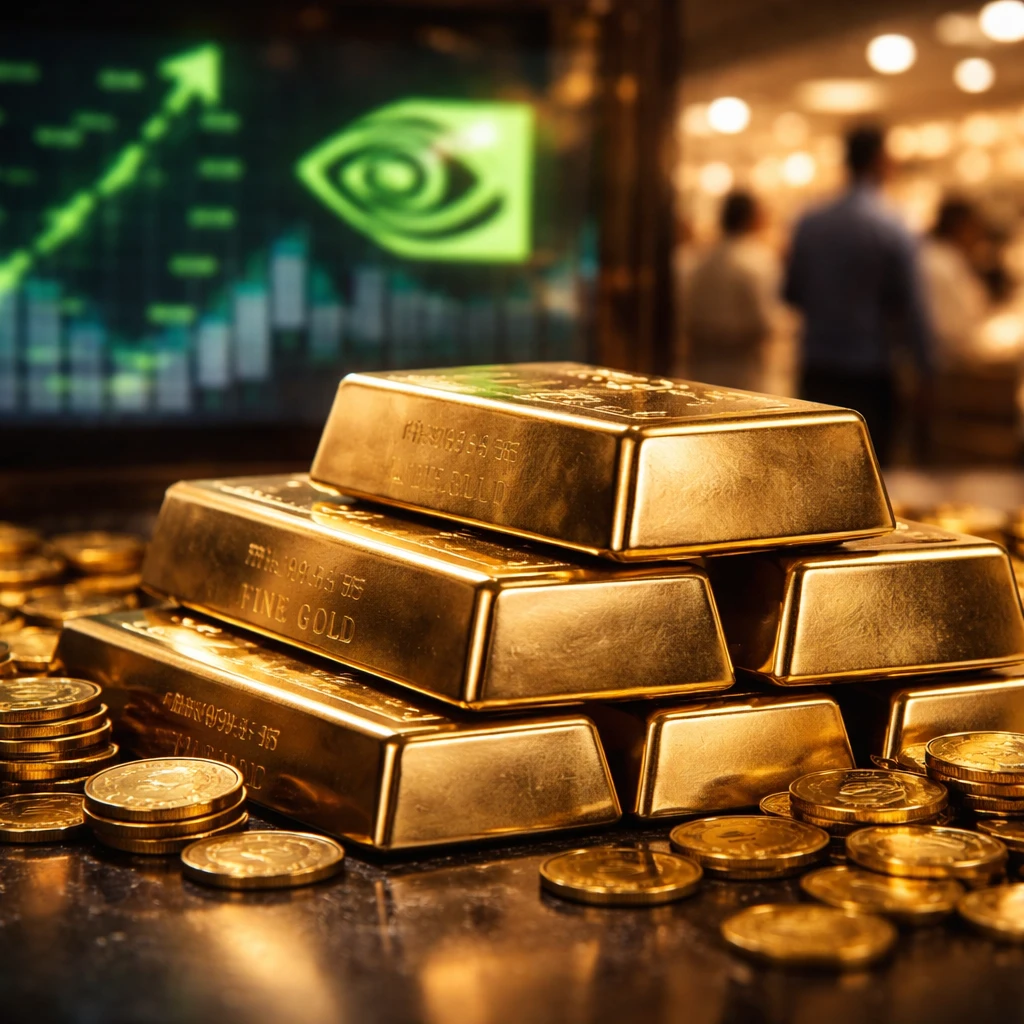
Summary: Spot gold advanced after a broad market uplift tied to Nvidia's reinstatement of Jensen Huang as president and chief executive. The precious metals complex saw gains across the board, supported by bargain buying and robust Chinese imports, but investors remain mindful of persistent inflation and the expectation of additional Federal Reserve rate increases.
At 20:31 ET (01:31 GMT), spot gold was trading up 0.9% at $3,668.93 an ounce. U.S. gold futures rose 0.4% to $3,667.25. Other precious metals also strengthened on the session: silver gained 1.2% to $43.6645 an ounce, platinum added 0.2% to $1,332.29, spot palladium climbed 1.3% to $909.61, and palladium futures increased 1.1% to $903.25. The U.S. Dollar Index eased 0.1% to 104.21.
Bullion pushed as much as 1% toward the $3,670 level following a 2.7% rise in the prior session. That two-day recovery has recouped a portion of last week’s near 9% selloff that took gold to its weakest levels in more than a year. The metal had also slipped beneath a roughly $4,000-an-ounce support level about two weeks earlier.
Equities catalyst
Market sentiment improved after Nvidia reinstated Jensen Huang as president and chief executive, less than two weeks after his departure amid controversy. The reversal - a move that involved government input - helped drive Wall Street to its strongest single-day performance since April 2025 and renewed interest in investments tied to artificial intelligence. That equity strength encouraged dip-buying in gold after recent heavy losses.
Earlier in the selloff, technology-stock weakness had triggered liquidations that included some gold positions, as investors sold assets to cover losses elsewhere. That dynamic added to downward pressure on bullion at the same time that persistent inflation and hawkish commentary from policymakers were weighing on prices.
Monetary policy and inflation
Monetary policy expectations continue to be a limiting factor for bullion. New York Fed President John Williams said on Monday that policymakers still had work to do to bring persistent inflation under control. Markets are pricing in the likelihood of another interest-rate increase at the Federal Reserve’s December meeting. Higher interest rates generally act as a headwind for gold because the metal does not offer interest income.
Demand fundamentals
Chinese buying has been a supportive feature of the market. Gold imports into China have reached a record $209 billion so far this year. The buying spree has also played a role in moderating China’s trade surplus with major partners, including the European Union.
ANZ analysts noted that gold had rallied as much as 4.3% amid the broader improvement in risk appetite. They highlighted that a decline in energy prices had raised hopes that inflation could be tamed in coming months, potentially easing pressure on the Fed to tighten further. ANZ also cited signs of bargain buying at the retail level, reporting that gold retailers in Shenzhen were reportedly crowded over the weekend, and that holdings in gold-backed exchange-traded funds had remained robust.
Market takeaway
The recent bounce in gold reflects a combination of improved risk sentiment after a major technology leadership development and persistent underlying demand from large buyers such as China, alongside retail interest in physical gold. Nevertheless, the trajectory for bullion remains sensitive to central bank messaging and the outlook for interest rates, which continue to shape investor positioning across both equities and fixed income.