
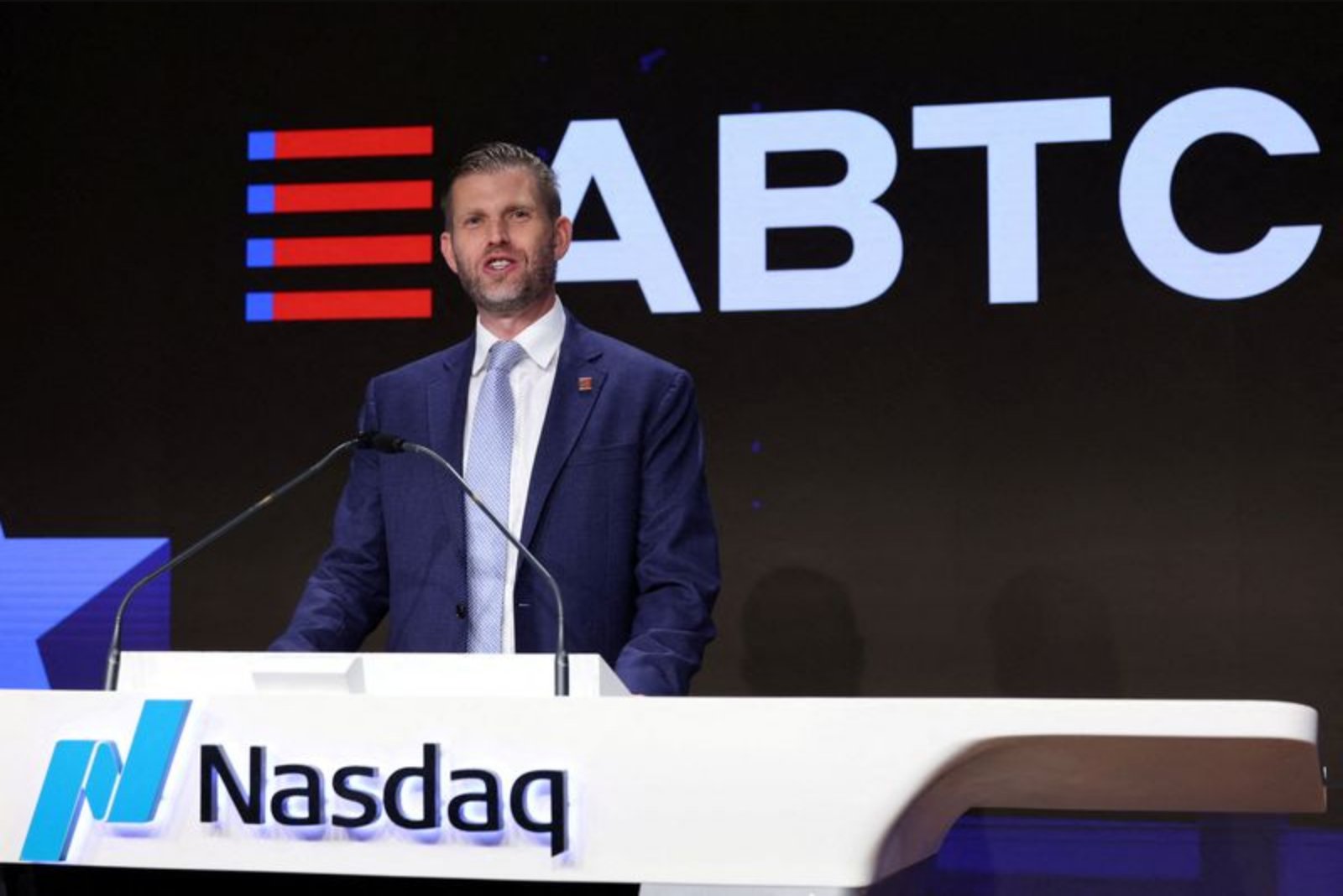
American Bitcoin, a Miami-based miner backed by two of U.S. President Donald Trump’s sons, posted a narrower net loss for the quarter ended March 31, supported by stronger mining revenue and improved operational efficiencies.
The company said net loss for the three months ended March 31 was $81.8 million, an improvement from a $100.6 million loss in the year-earlier period. Revenue for the quarter rose to $62.1 million, up from $12.3 million a year earlier, a jump the company attributed to better mining efficiencies at its Medicine Hat and Salt Creek facilities.
Operationally, American Bitcoin recorded its highest quarterly production on record, mining 817 Bitcoin in the first three months of 2026. In addition to mined output, the firm increased its strategic holdings by acquiring 803 Bitcoin through treasury purchases during the quarter.
These additions helped the company grow its strategic reserve to more than 7,000 Bitcoin as of March 31, compared with 5,401 Bitcoin at the end of 2025. The firm emphasized that its business remains closely tied to the market price of Bitcoin, which it noted had declined 7% so far this year.
CEO Mike Ho was quoted on the company’s forward approach: "Looking ahead, we will keep deploying incremental capacity when expected returns justify it and focus on compounding our Bitcoin reserve while preserving balance sheet flexibility." The statement underscores a measured stance on further expansion, balancing capacity additions with financial flexibility.
Key operational takeaways include the combination of higher production and strategic treasury purchases that boosted the company’s reserve, alongside notable revenue growth stemming from site-level efficiency gains. While revenue expanded materially year-over-year, the company continues to operate in an environment described as a bear crypto market, with a price headwind affecting results.
American Bitcoin's results illustrate how mining firms can partially offset adverse price movements through production gains and targeted accumulation of Bitcoin, while remaining attentive to balance-sheet considerations and the returns on incremental capacity.