
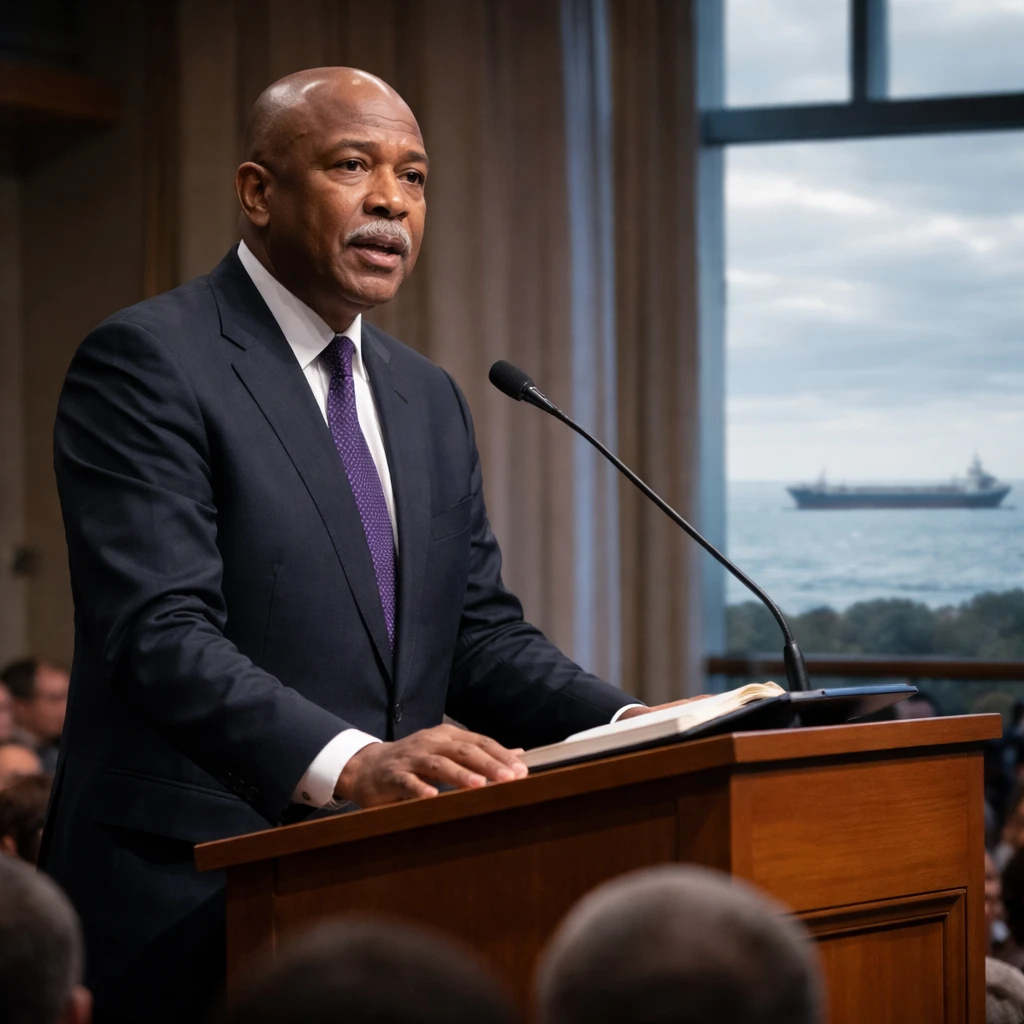
South Africa’s Reserve Bank said it will take a data-dependent approach to its next interest-rate decision as uncertainty stemming from the war in Iran clouds the near-term inflation outlook and the broader global economy.
Governor Lesetja Kganyago, speaking on Monday at Rhodes University, reiterated that the monetary policy committee paused at a policy rate of 6.75% at its March meeting in order to evaluate the economic consequences of the conflict.
The Middle East war has pushed oil prices sharply higher and effectively closed the Strait of Hormuz, a waterway the governor noted is a key artery for roughly a fifth of global oil and liquefied natural gas flows. Since the conflict began on February 28, Brent crude has risen by almost 60%, a jump that has pushed local diesel prices to record levels.
"We are experiencing the biggest jump in fuel price inflation in the history of inflation targeting," Kganyago said. He added that food-price pressures are an even greater concern, underlining the conflict's implications for both fertilizers and diesel - inputs he described as critical components of food supply chains.
Headline inflation increased to 3.1% in March, and Kganyago said it is expected to move higher in coming months as the effects of elevated energy and food costs feed through. He noted that the shock arrived at a time when the economy was moving toward the Reserve Bank's 3% inflation target, and that the process of disinflation will now take longer than previously anticipated.
Kganyago emphasized the committee's reluctance to lock in a predetermined path for policy. "As ever, we are not going to pre-commit to a path and give up optionality. We cannot offer certainty about our next steps," he told the audience. The bank's objective instead, he said, is to maximize clarity about the likely trajectory of inflation - specifically that the central bank remains focused on returning inflation to the 3% target.
Concluding his remarks, Kganyago reaffirmed the bank's commitment to its mandate: "Although we cannot do much about higher inflation right now, we are very committed to getting inflation back to 3%, just where we had it before the shock hit."
For now, the Reserve Bank's stance is to monitor incoming data closely and retain flexibility on policy choices until the full economic impact of the Iran war becomes clearer.
Summary
The central bank will await further data before altering its policy stance after holding rates at 6.75% in March. The Iran war has raised oil prices sharply, tightened shipping through the Strait of Hormuz, and driven local diesel prices to record levels, complicating efforts to return inflation to the 3% target.
Key points
- Policy rate held at 6.75% in March while officials assess the inflationary impact of the Iran war.
- Brent crude has climbed almost 60% since the war began on February 28, contributing to record local diesel prices and a sharp rise in fuel-price inflation.
- Inflation rose to 3.1% in March and is expected to increase in coming months; the central bank remains committed to bringing inflation back to the 3% target.
Risks and uncertainties
- Persistently higher energy prices could sustain elevated headline inflation, affecting household costs and sectors sensitive to fuel prices such as transportation and logistics.
- Food-price pressures linked to fertilizer and diesel disruptions could exacerbate inflation, with implications for agriculture and consumer food markets.
- Uncertainty over the duration and severity of the Middle East conflict limits the central bank's ability to commit to a fixed policy path, creating uncertainty for interest-rate-sensitive sectors.