
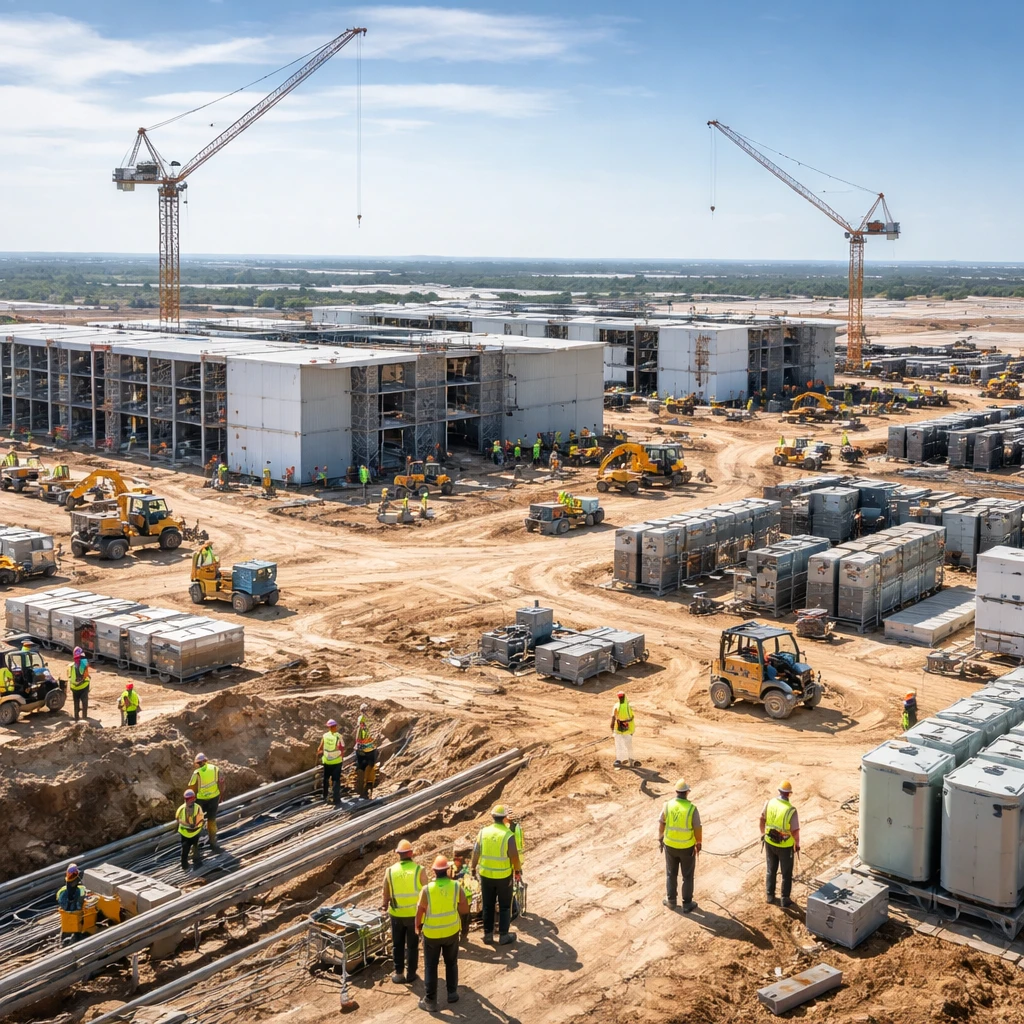
Jon Gray, president of Blackstone Inc., said the current rush to build artificial intelligence infrastructure is producing a marked increase in blue-collar employment as asset managers pour billions into data centers and supporting physical infrastructure.
Speaking on a panel at the Milken Institute Global Conference, Gray pointed to the rapid escalation in staffing tied to data-center projects. He said QTS, a data-center operator supported by Blackstone, is scaling up its field workforce from 10,000 people a year ago to 40,000 across job sites nationwide by the end of the year.
"This is a huge boom in blue collar employment, certainly over the next 5 years," Gray said, adding that the geographic distribution of these jobs may shift. "Where these jobs are, it may change - the middle of the country is where the bulk of this physical investment is happening."
Gray framed the pattern as a direct consequence of capital allocations to build out computing capacity and the physical facilities that support it. The expansion of on-site roles reflects the labor required for construction, electrical work, equipment installation and other hands-on tasks associated with data-center development.
At the same panel, participants discussed the broader labor-market implications of AI. A report from Boston Consulting Group cited during the discussion estimated that AI could eliminate as much as 15% of jobs over the next five years, while noting that an even larger share of positions will be reshaped by the technology.
Jenny Johnson, chief executive officer of Franklin Resources Inc., offered a complementary view on job creation tied to AI adoption. She suggested that new roles will arise as people learn to use AI and build applications around it, noting a current gap in user proficiency.
"None of us are that good at using these tools yet," Johnson said. "Once you get those tools in people's hands, we're going to find there's massive more things that we never understood we needed that we're suddenly not going to live without."
The remarks highlight a tension in the public conversation about AI: substantial near-term demand for physical labor connected to infrastructure spending, set against studies signaling potential displacement and widespread job transformation. Participants at the conference emphasized both the scale of immediate hiring tied to data-center construction and the uncertainty over how the broader labor market will evolve as AI tools proliferate.
Quick takeaways
- Significant blue-collar hiring is linked to AI-related data-center investments.
- QTS expects to increase its on-site workforce from 10,000 to 40,000 within a year.
- Research suggests AI could eliminate up to 15% of jobs over five years even as new roles emerge.