
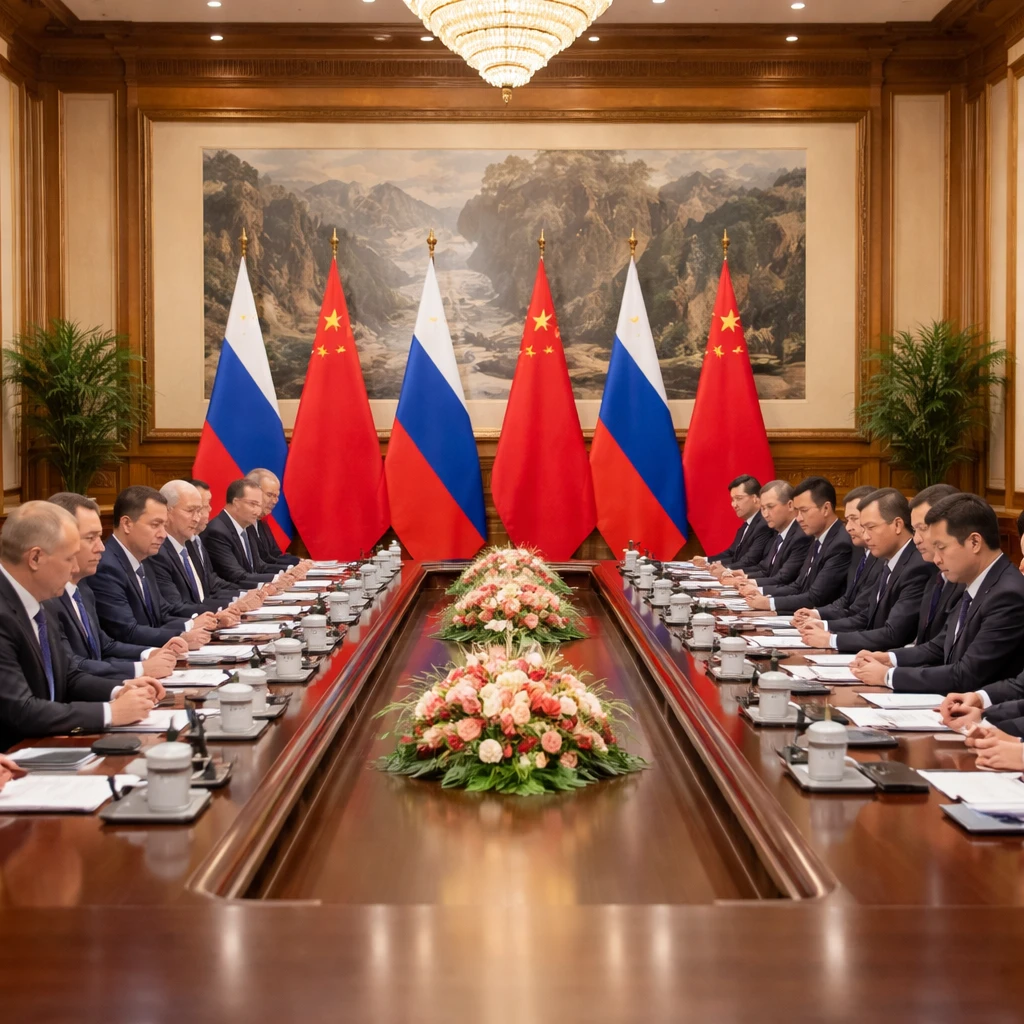
Russian President Vladimir Putin is scheduled to visit China for a state visit on May 19 and 20, the Kremlin said in a statement. The announcement described the trip as occurring at the formal invitation of Chinese President Xi Jinping and noted that the timing was chosen to align with the 25th anniversary of the Treaty on Good-Neighbourliness, Friendship and Cooperation.
The visit comes immediately after a bilateral summit in Beijing between President Xi and U.S. President Donald Trump, placing the Putin trip in a tightly packed sequence of meetings among global leaders.
The Kremlin said the treaty being marked was originally executed in 2001 by Mr. Putin and former Chinese President Jiang Zemin. That foundational agreement established a long-term strategic partnership between the two nations and set a legal basis for coordinated activity across multiple economic sectors.
According to the Kremlin statement, the forthcoming discussions will broaden that framework. Delegations plan to introduce new bilateral accords alongside a comprehensive joint statement intended to deepen the overall comprehensive partnership and strategic cooperation between Russia and China.
Officials indicated the agreements are designed to strengthen institutional links at a time when global trade alliances are evolving. The state visit will emphasize immediate commercial, financial, and industrial initiatives, reflecting a pragmatic component to the broader strategic agenda.
As part of the program, President Putin is due to hold separate meetings with Chinese Premier Li Qiang. Those sessions will review existing trade frameworks, examine customs data, and discuss cross-border economic cooperation.
The state visit schedule also includes an official ceremony to inaugurate the Russia-China Years of Education for 2026-2027. The multi-tiered talks are slated to address supply chain integration and development of investment corridors across the Eurasian continent.
Participants framed these priorities as responses to changing macroeconomic conditions, shifting industrial commodity demands, and mounting international regulatory pressures. The Kremlin emphasized that the visit will focus on both expanding political ties and advancing concrete economic initiatives.
Context and next steps
While the statement outlined the topics and ceremonial elements of the trip, it described the visit primarily in terms of its timing and its objectives: to mark the treaty anniversary, to finalize new bilateral measures and a joint declaration, and to press ahead with trade, customs and cross-border cooperation in areas of mutual commercial and industrial interest.