
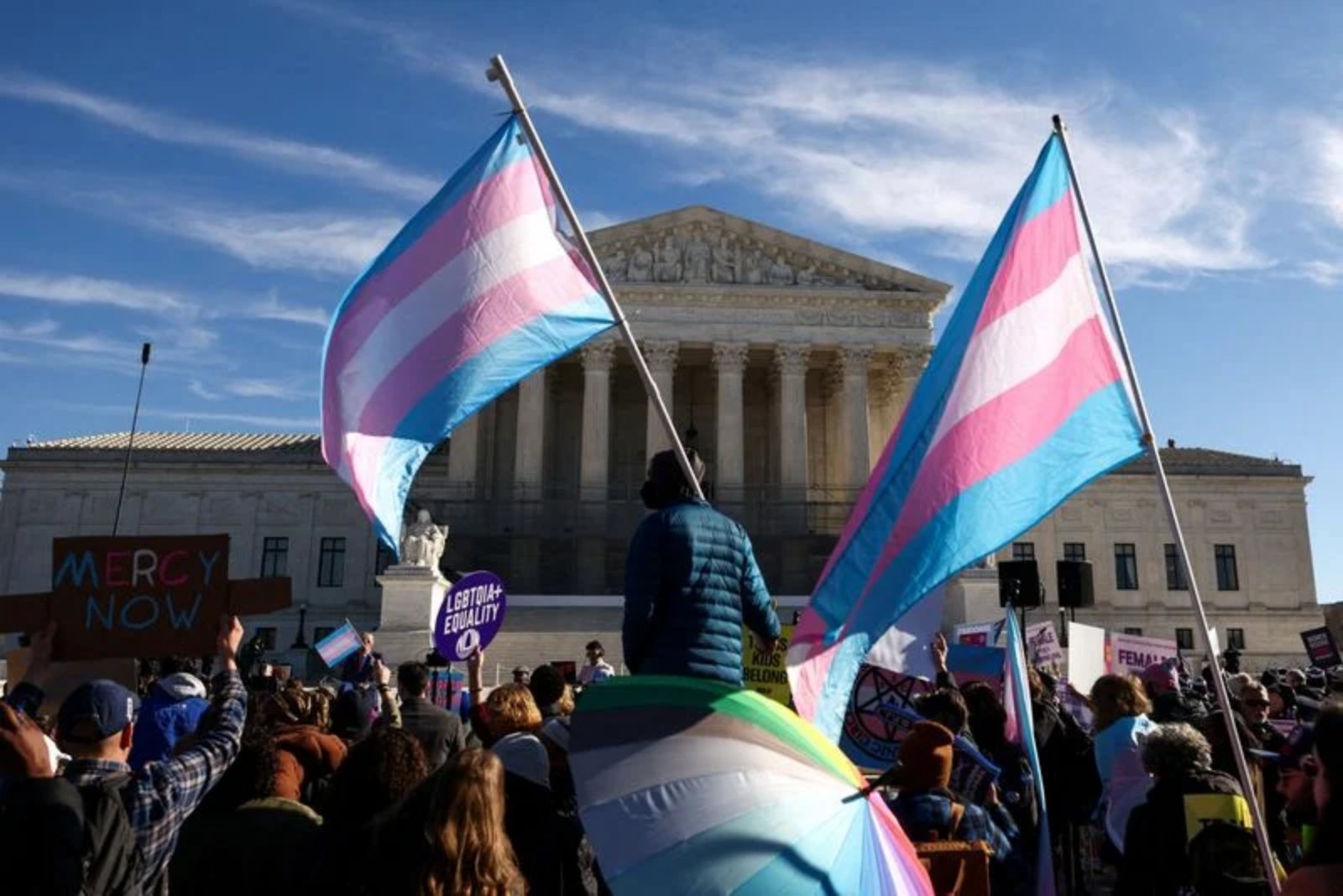
The Supreme Court is approaching the end of its current nine-month term and is preparing to hand down decisions in a cluster of high-profile cases that intersect with some of the most contested social and legal debates in the United States. While this term has included confrontations over tariffs, immigration and the removal of regulatory officials, the justices also have before them major questions on firearms law, the participation of transgender athletes in female sports, and immigration policies tied to the last presidential administration.
The court, which is expected to conclude the term around the end of this month, decides several matters that have broad public salience. Among the pending rulings are two major gun-related cases: one challenging a federal prohibition on firearm possession by "unlawful users" of controlled substances and another testing a Hawaii statute that limits the carrying of handguns on private property open to the public unless the property owner grants permission.
Gun rights and public-carry restrictions
In January oral arguments over the Hawaii law, the conservative justices signaled skepticism of the state's defense of a provision that requires a property owner’s "express authorization" to bring a handgun onto private property that is open to the public, such as most businesses. The Hawaii measure mirrors statutes in four other states. The court has in recent years taken an expansive view of the Second Amendment and moved American jurisprudence to the right on gun rights.
Gun control advocates see the Hawaii challenge as vulnerable. Hayley Lawrence, executive director of the Duke Center for Firearms Law, said she expects the state to lose and predicted the justices will rule against Hawaii’s defense. "It seems to me Hawaii is going to lose 6-3," Lawrence said. The court may also further elaborate on the framework it established in its 2022 decision in New York State Rifle & Pistol Association v. Bruen, which requires that firearms regulations be consistent with the nation’s historical tradition of gun regulation in order to pass constitutional muster.
Federal ban on firearm possession by drug users
A separate case argued in March centers on a provision of the Gun Control Act of 1968 that criminalizes firearm possession by anyone who is an "unlawful user" of a controlled substance. The statute lists categories of people barred from owning firearms, including felons and fugitives. The current challenge was brought by a Texas man who has acknowledged using marijuana several times a week and was prosecuted under the law. That same provision was invoked in charges brought against Hunter Biden in 2023; his father later pardoned him.
The Trump administration is defending the statute. University of Chicago law professor Darrell Miller observed that while the justices appear skeptical of the provision that prohibits unlawful drug users from possessing firearms, they are also wary of adopting an interpretation that would sweep too broadly and erode other components of the statute, such as the prohibition on firearm possession by felons. "The court is deciding a drug case but they have one eye on the felony possession statute," Miller said.
Transgender athletes and educational settings
Another set of cases asks whether state laws in Idaho and West Virginia that ban transgender athletes from female sports teams at public schools, including universities, are lawful. The Trump administration has backed those bans. During January arguments, conservative justices appeared inclined to uphold the statutes.
Public opinion polling cited during coverage of the litigation suggests a majority of Americans oppose transgender athletes competing on teams that align with their gender identity, particularly at the collegiate level. Advocates for the state laws point to that sentiment. William Bock, a sports law attorney who supports the Idaho and West Virginia measures, said there is widespread agreement on the issue: "There is vast consensus on this issue," he said. "Seventy to 80 percent of the public doesn’t understand why people are fighting about this."
Attorneys representing transgender plaintiffs expressed cautious optimism. Sasha Buchert of Lambda Legal, counsel for one of the plaintiffs challenging the bans, said she hoped the court would strike down the state laws and added that the arguments in this case "went much better" than in a 2024 dispute involving gender-affirming medical care for transgender minors. In that earlier case, the court’s conservative majority ruled 6-3 to uphold Tennessee’s ban on such care.
The litigation over transgender rights has unfolded across multiple fronts. Last year, while a legal challenge proceeded, the court permitted the Trump administration to enforce a ban on transgender people serving in the U.S. military. The administration has pursued other policies concerning transgender people, including rules limiting the use of gender identities on passports and restrictions on bathroom access for transgender federal employees.
At the same time, the court has continued to shape LGBT rights doctrine through discrete rulings. In 2020 the justices found that a federal law barring workplace discrimination extends to gay and transgender employees. This term the court issued an 8-1 decision in March rejecting a Colorado law that prohibited licensed psychotherapists from using so-called conversion therapy to change an LGBT minor’s sexual orientation or gender identity; the majority held that the prohibition unduly burdened First Amendment speech protections for a Christian counselor who challenged the ban. Separately, in March the justices blocked a set of California laws intended to restrict the sharing of information with parents about a public school student’s gender identity without the child’s consent, a result that advocates for the parents described as a victory.
Immigration and other pending matters
Immigration cases remain prominent on the court’s calendar. In the weeks ahead the justices are expected to issue rulings on two Trump-era policies: one challenging efforts to restrict birthright citizenship and another concerning the removal of Temporary Protected Status from hundreds of thousands of Haitian and Syrian immigrants. Oral arguments in those matters indicated that the court might reject the challenge on birthright citizenship while upholding the administration’s position on Temporary Protected Status; the same term the court ruled against the administration in a tariff dispute in February.
Other pending decisions include a religious rights case brought by a Rastafarian incarcerated man who sued Louisiana prison officials after they forcibly shaved him in violation of his religious beliefs, an action challenged under a federal law that guards incarcerated people against religious discrimination. The court also recently intervened in a death-penalty matter, leaving in place a judicial finding that a man convicted of a 1997 murder in Alabama was intellectually disabled and therefore ineligible for execution under one of the court’s precedents.
The cluster of cases before the justices underscores how the court’s docket this term has blended questions of administrative and executive power with fraught social issues that divide the country. With a conservative majority that has shifted legal doctrine rightward in recent years, observers are watching closely how the court will reconcile constitutional tests set in prior decisions with present-day disputes over firearms, gender identity and federal immigration policy.