
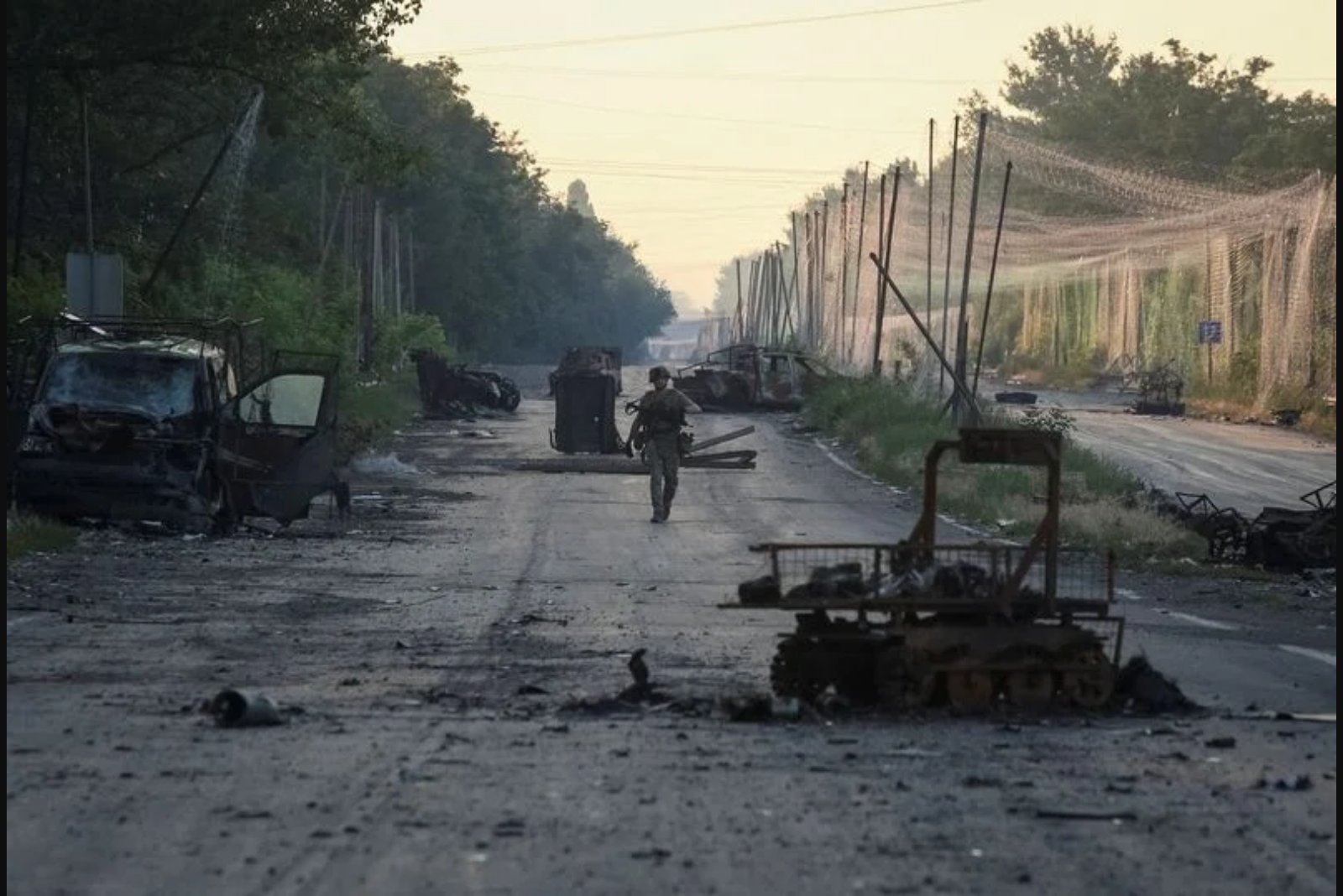
Russian units are steadily pressing into Kostiantynivka, the southernmost settlement of a four-town defensive line that Kyiv has relied on to hold back advances across the industrial heart of Donetsk. Senior Ukrainian commanders say small groups of Russian soldiers have started to infiltrate the city outskirts, and fighting is beginning to move into urban areas.
The push toward Kostiantynivka highlights a persistent Russian manpower advantage on some parts of a long, roughly 1,200-km front. At the same time, analysts note that Ukrainian mid-range drone strikes on logistical nodes have reduced some of Russia’s combat effectiveness, though not enough to stop attacks in every sector.
"The effect (of mid-range strikes) hasn’t been so great that it would have forced the Russians to suspend their offensive," said Emil Kastehelmi of the Black Bird conflict analysis team in Finland. "So even though Russia has been taking increasingly heavy losses in the rear, they are still able to continue their offensives, at least in certain sectors."
Kostiantynivka forms the southern anchor of the four-settlement defensive belt that has been central to Ukraine’s attempt to retain control of Donetsk, a heavily industrialised region in the east. Occupation of the city would give Russian forces a staging ground to continue a northward push along that axis, though any such advance would likely be protracted and costly, with the potential to resemble previous intense urban sieges.
President Vladimir Putin has said Russia must control all of Donetsk before the war ends. After more than four years of fighting, Ukraine still retains roughly a fifth of the region.
Claims by Moscow that Kostiantynivka was near capture were dismissed by senior officers of Ukraine’s 19th Army Corps as exaggerated. They said their troops have been able to target and eliminate small Russian groups that have entered the outskirts. Maj. Gen. Viktor Nikoliuk, head of Ukraine’s eastern operational command, told the national public broadcaster that, at the current level of manpower and materiel, Kostiantynivka could hold out.
Independent monitoring also suggests the current infiltrations have not yet produced "a rapid operational breakthrough." In a June 23 assessment the U.S.-based Institute for the Study of War judged the Russian incursions insufficient for such a breakthrough. Still, Ukrainian open-source analyst Ruslan Mykula, of the DeepState mapping group, said Russian pincer attempts to envelop the city are increasing the cost of defense and forcing difficult choices.
"A choice will have to be made: either raise the stakes or withdraw," Mykula said. "And right now, the situation is such that the stakes are rising with each passing day."
Kastehelmi added that the city’s fall "seems to be more of a question of time," underscoring the steady pressure being applied by Russian forces in that sector.
At the northern end of the same defensive belt, Russian troops are also exerting pressure, bringing the larger cities of Sloviansk and Kramatorsk within range of frequent air and drone attacks from positions roughly 15 km away. Those strikes, together with artillery fire and guided munitions, are battering the arteries that supply Ukrainian positions north from Kostiantynivka.
Troops operating along the embattled road north report sustained pressure on supply lines. Artillery, drones and guided bombs have repeatedly hit infrastructure along that route, complicating deliveries and evacuations. Military personnel described an environment where conventional transport has become too hazardous and improvised measures now dominate resupply.
On patrol with a unit known as the "Predator" rifle brigade, which is deployed under the National Police to secure the route against drones and remotely dropped mines, observers can see the improvisation and the risks. Anti-drone netting is draped across sections of the road, and strands of fibre-optic cable — used to guide first-person-view drones — lie caught across the mesh, glinting in the sun.
Ground robots have become the predominant method of moving food, water and medical supplies through the so-called "kill zone." Soldiers ferry equipment and personnel on quad bikes as convoys try to limit exposure. The route is reportedly too dangerous to evacuate casualties using standard vehicles, a reality summed up by one serviceman, 34-year-old Oleksandr Kosmin: "Everything happens on foot."
The human toll is not limited to fighters. Civilian life near the front is fraying as towns under threat empty. Druzhkivka, about 12 km north of Kostiantynivka, has seen residents leave as the fighting approaches. In one incident on a leafy street, a husband and wife were found dead inside a van struck by a Russian drone; white ribbons intended to mark the vehicle as civilian still fluttered on the roof.
From a police evacuation vehicle, 59-year-old Larysa Sereda said she was leaving because she was frightened by drone activity, but added that she intends to return: "Why am I leaving? Because I’m scared. Drones are flying. But I plan to return home. I don’t want to stay in some strange place. The war will end, and I’ll come home."
Even as Moscow presses on the ground, its wider war machine shows signs of strain tied to Ukrainian attacks on logistics and economic targets. Ukrainian strikes on supply lines to and from Crimea, and longer-range assaults on the oil sector, have contributed to mounting pressure in occupied areas. Authorities installed by Russia on the Black Sea peninsula have declared a state of emergency and suspended all fuel sales to individuals and businesses.
On the front, some observers describe Russian forces as overextended, with assaults sometimes executed by just one or two soldiers at forward positions. Mykula characterised many such attacks in this way, reflecting the thinness of forces in certain sectors even as operations continue.
Despite these constraints, officials aligned with Moscow in temporarily occupied parts of Donetsk maintain that the campaign to seize additional cities is ongoing. Denis Pushilin, the Kremlin-installed head of the region, said that the pace of operations is not the central issue: "Talking about whether this is happening slowly or quickly isn’t really the point," he said.
Meanwhile, hardline voices within Russia have called for abandoning a U.S.-backed peace process and escalating military action as Ukrainian strikes have reached deeper, including attacks that have struck Moscow itself. The combination of incremental territorial gains, mounting defensive costs for Kyiv, strained logistics, and civilian displacement means commanders on both sides face decisions that will shape the next phase of fighting around the fortress belt.