
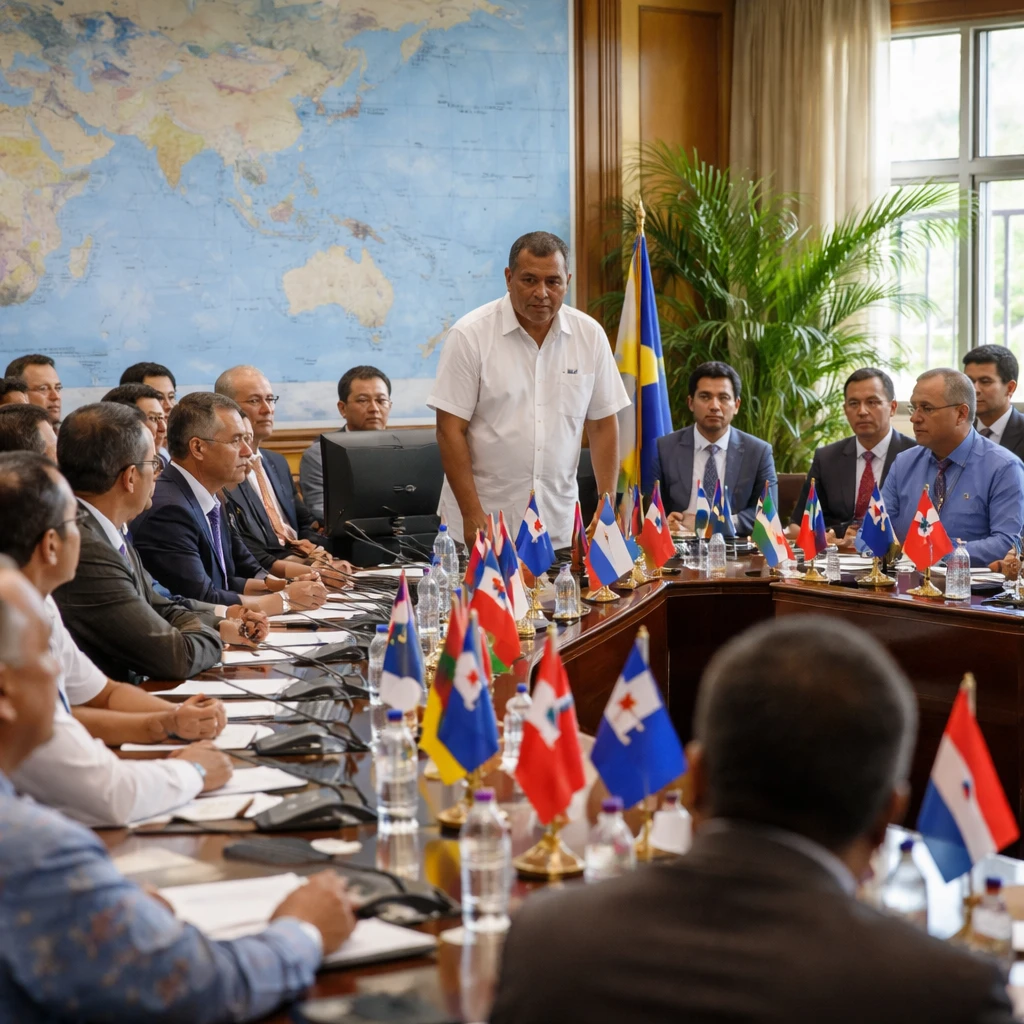
Pacific Island leaders raised worries about China’s July intercontinental ballistic missile (ICBM) test during their annual summit, though the gathering did not produce unanimous condemnation after the Republic of Nauru formally dissented, summit host Palau’s president said.
Palau President Surangel Whipps Jr. told reporters on Thursday that Beijing’s first known missile launch in the Pacific since September 2024 had flown over several island nations without sufficient advance notification. Reading from a prepared statement at the close of the Pacific Islands Forum, Whipps Jr. said leaders had urged states conducting ICBM tests to provide transparency and reassurance, including offering at least 24 hours advance notice in line with international practice.
"Leaders called on all states undertaking ICBM testing to ensure transparency and reassurance, including through the provision of advance notification of a test at least 24 hours in accordance with international practice," Whipps Jr. said. He added: "I might note that the Republic of Nauru has dissented."
Nauru, which has alternated diplomatic recognition between Beijing and Taipei in the past, re-established ties with China in 2024, a fact the summit record notes in explaining its formal dissent.
Australian Energy Minister Chris Bowen, who attended the summit alongside Prime Minister Anthony Albanese, defended the outcome on Friday, saying it was reasonable for the vast majority of Pacific countries to express a view even if one or two states disagreed. Speaking on ABC Radio, Bowen said: "It was perfectly reasonable for the vast majority of Pacific countries to express a view and for one or two to say that they have a different view." He added that "Unanimity is not necessary to express very strong views on behalf of the vast majority of the Pacific island states, which was very clear."
The leaders’ consensus followed an earlier meeting of the forum’s 18 foreign ministers, which failed to agree on a joint statement condemning the missile test despite both public and private expressions of concern from a number of leaders about the militarisation of the region.
Palau, one of three Pacific island nations that maintain official diplomatic ties with Taiwan, had lobbied the group to issue a formal condemnation of the test. Beijing responded on Thursday by accusing Palau of whipping up "hype" over the launch and warning that attempts to sway other Pacific nations were "malicious and will not succeed."
The summit was further unsettled by China’s objections to Taiwan’s participation, with Beijing arguing that the island was not qualified to attend. The statement at the meeting recalled that Beijing views Taiwan as its own territory and noted that Taiwan rejects that claim. Delegates also pointed to the reduced representation caused by five Pacific leaders opting to send lower-ranking ministers rather than attend in person.
Forum members agreed that the next Pacific Islands Forum leaders’ summit will be hosted by New Zealand in 2027.
Contextual note: The summit record reflects concerns about transparency in missile testing and diplomatic frictions connected to Taiwan’s attendance, as well as uneven participation by member states.