
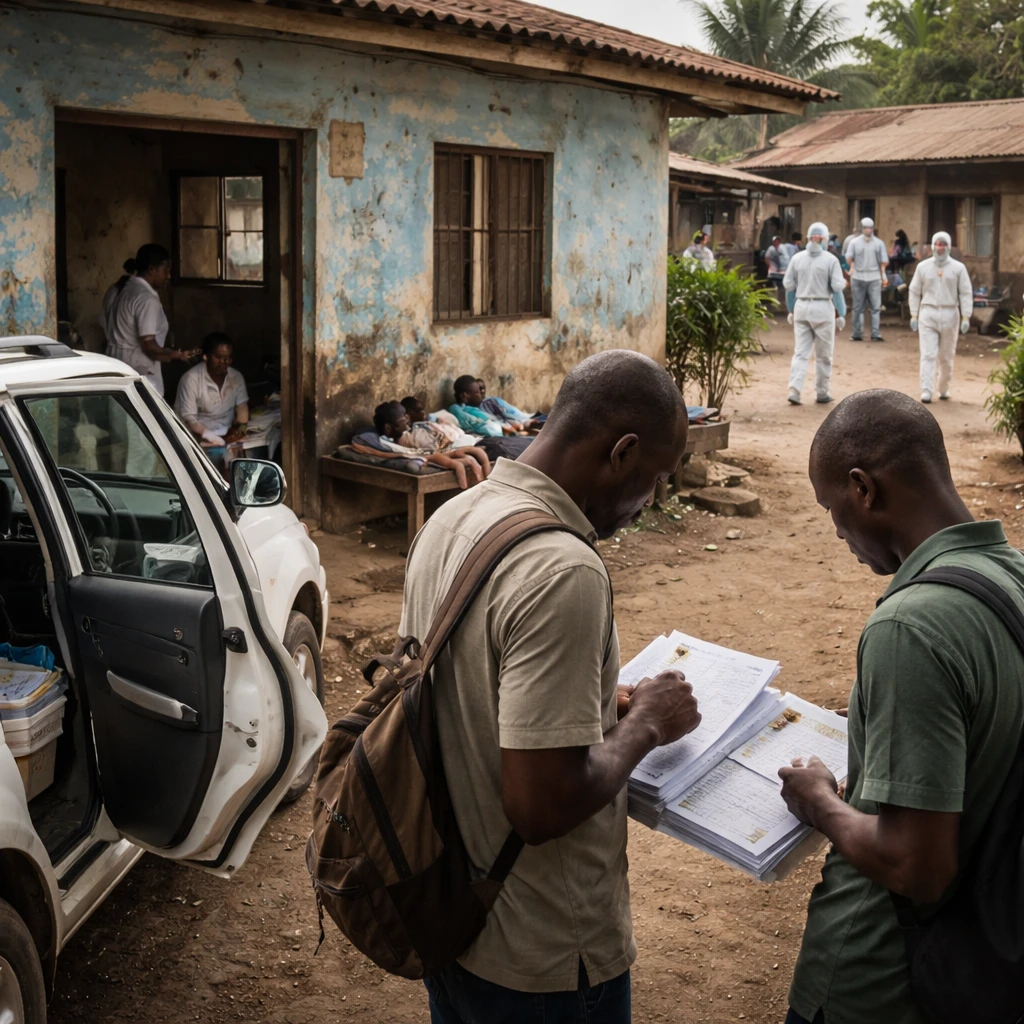
On many days in Bunia, eastern Democratic Republic of Congo, surveillance teams tasked with detecting and containing Ebola have fewer than five vehicles to call on. When Dr Moubarack Kano arrived at work one morning he found the four cars normally in circulation all in use. He climbed into his own white Subaru Forester with a colleague next to him, emergency alert forms stacked in the seat pockets and a rosary swinging from the rear-view mirror, and set off to visit clinics and households across the city.
The investigators move quickly across a zone that covers roughly 1 million people in 23 health districts. Their aim is to locate suspected cases, trace contacts and limit onward transmission of the Bundibugyo strain of Ebola - a strain that, according to health officials, has no known vaccine or treatment and can be difficult to detect because its early symptoms may appear milder than those of other forms.
Surveillance hampered by gaps at the front line
Kano and his colleague discovered that a shortage of vehicles was only one of several constraints. At clinic after clinic they inspected handwritten consultation registers and found entries that had not been reported to central surveillance authorities. Nurses and other frontline staff described late lab results, refusals by patients to undergo testing, and failures to raise alerts when cases should have been notified - each of which complicates the field teams' work to reconstruct transmission chains.
"We discover the disease only after it has already spread," Kano said. "We're just chasing it."
At a small health post named "Jesus is saviour," down an unpaved road with a faded blue exterior, the investigators paused to review recent entries. Several patients had been recorded as having typhoid fever - a condition whose initial symptoms can resemble those of Ebola. Kano said that nurses should normally call to report such cases so field teams can investigate and decide whether testing is needed. When he asked the nurse on duty whether she knew how to use the Ebola alert system, she acknowledged that she knew it existed but did not know the telephone number to call.
Reluctance to alert - and the reasons why
Elsewhere in Bunia's Nyakasanja neighbourhood, a register entry described a teenage patient whose older brother had tested positive and later died. When Kano asked whether an alert had been raised, the head nurse said it had not. The young man's address and phone number were not recorded; his whereabouts were unknown. "We'll have to wait until he comes back," Kano said. By his tally, there were a dozen other cases in facility records that he believed should have triggered alerts.
Health workers explained why clinics sometimes hold back on alerting authorities. "Health facilities don't always want to alert," Kano said. "When they do so, they risk losing a patient because the patient may be transferred elsewhere. For them, it is a loss of money." The cost of making phone calls is also an obstacle. "If people don't have phone credit, they don't call," said Dr Rachel Ulingisayi, who oversees the surveillance teams in Bunia.
Even when alerts are made, response capacity can be insufficient. Ulingisayi described an instance where a father telephoned to say his two children were ill; two days later he called again to report they had died. Delays in laboratory results and a shortage of staff to respond to alerts further slow the process of isolating and treating cases.
Families refusing testing and the limits of enforcement
At the Nyakasanja centre, two children lay in a single bed, treated with intravenous lines for fever and pain. Kano said the proper protocol would have been to transfer them immediately to a treatment centre for testing, isolation and care. Their mother refused, insisting she did not believe her children had Ebola. The surveillance team dispatched a psychologist to speak with the family.
The difficulties of persuading families, and of ensuring clinics follow reporting protocols, place heavy burdens on the 27 field investigators covering Bunia. Kano, who worked during the country's previous large-scale Ebola epidemic that killed more than 2,000 people between 2018 and 2020, said the current response has been hamstrung by weak planning, logistical bottlenecks and the recruitment of inexperienced staff. He contrasted the current situation with the past epidemic, when he said there had been time to investigate cases and to train surveillance personnel.
Operational and payment problems
Like many other health workers involved in the current response, Kano said he had not been paid since the outbreak was declared on May 15. Requests for comment sent by email to Congo's Ministry of Public Health and to the National Public Health Institute did not receive immediate replies. Officials have publicly acknowledged operational difficulties: Congolese Health Minister Samuel-Roger Kamba said this month that the government was working to address payment problems.
On the team's final call one afternoon, Kano visited a home where a 67-year-old man had died the previous day. Personnel in protective suits were on site, disinfecting and arranging for a safe burial while neighbours kept their distance. Kano began compiling a list of people who had been in contact with the deceased, but he said he feared the infection had likely already moved on beyond that immediate circle.
Scale of the outbreak and uncertainties
Government figures released on Sunday put the outbreak's toll at 3,200 infections and 1,405 deaths. The World Health Organization has cautioned that the true scale could be two to four times larger than reported data, suggesting substantial under-detection.
The combination of incomplete clinic reporting, refusals to test, delays in lab results, limited transport and staff shortages paint a picture of a surveillance system operating under severe strain. Field investigators continue to press clinics and families for cooperation, even as they confront gaps in resources and in the basic mechanics of reporting that are essential to containing the disease.
Reporting from Bunia for this dispatch involved direct visits to clinics and homes across the city and conversations with surveillance staff and health officials on the ground.