
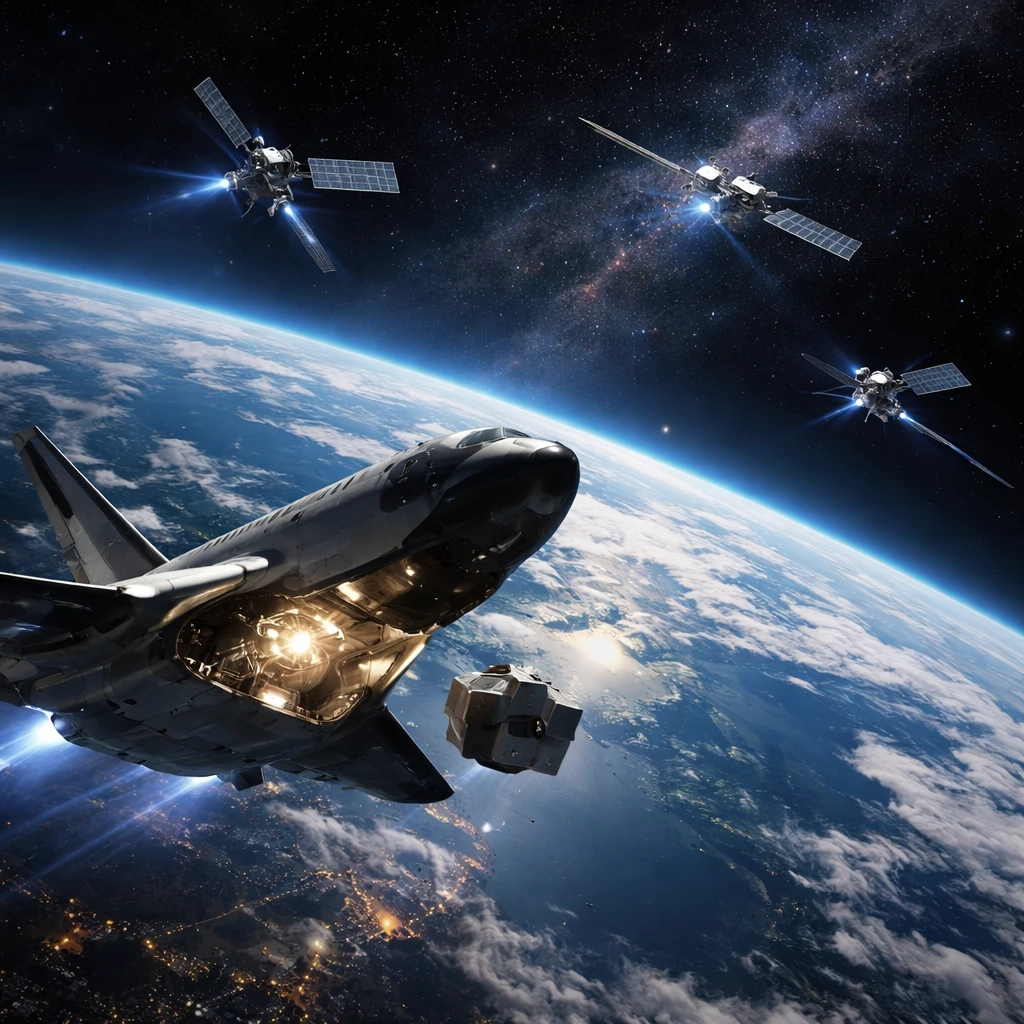
In recent months, activities by both Beijing and Washington have underlined how Earth’s orbit is evolving from a largely passive environment into an arena of potential military confrontation. In June, analysts at a U.S. space-tracking firm observed a covert Chinese unmanned spaceplane release a small satellite at an altitude of several hundred miles. The released object maneuvered around another Chinese spacecraft before circling back to the releasing vehicle, according to tracking data from LeoLabs.
Details about that small satellite and the broader mission remain limited. The Chinese craft that released it has been described as a spaceplane - a reusable, shuttle-like vehicle without a crew. The United States operates a comparable secretive unmanned spaceplane, which has likewise been used for a variety of classified tests and experiments. The existence and activity of both programs were highlighted in a Reuters review of documents, public space-tracking datasets and interviews with current and former military officials, underscoring how rapidly the field of military space operations is changing.
Researchers in China with ties to the military are pursuing technologies that could alter the mechanics of orbital competition. Patent-related filings, procurement notices and academic papers reviewed by Reuters point to work on satellites built to pursue and potentially capture other spacecraft, plus systems designed to extend fuel supplies while carrying out those maneuvers. Such capabilities would change the calculus of longevity and maneuverability in orbit because satellites typically operate within the limits of the fuel they carry at launch.
Beyond China, the United States and its allies are also testing new behaviors in orbit. Commercial tracking data show the first known U.S.-British joint military operation in space took place last September in the vicinity of a suspected Chinese intelligence satellite. In that operation, U.S. space forces using a base in Colorado directed a U.S. military satellite to fly close to a U.K. satellite while China’s Shiyan 12-01 passed some 83 kilometers beneath them, according to analysis by space intelligence firm Slingshot Aerospace.
Analysts with military backgrounds said the maneuver appeared to be a deliberate signal to Beijing, demonstrating allied unity and an ability to operate cooperatively in orbit. The operation was publicly announced by U.S. and British officials as a demonstration of allied capabilities and a statement that the partners would act to protect their national and military interests in space. Officials did not, however, detail how close their satellite came to the Chinese craft.
Much of what happens in orbit remains classified because of intelligence sensitivities. U.S. Space Command characterized the September mission as evidence of allied interoperability in space, while Britain’s defense ministry framed it as part of a set of advanced orbital operations intended to shield national interests. Officials from both governments declined to comment on whether the proximity of the joint allied maneuver to the Chinese satellite was intentional.
The U.S. Space Force has acknowledged that its own spaceplane is conducting a range of tests and experiments. Chinese state media has described the Chinese spaceplane as experimental and supporting peaceful uses of orbit, and labelled the Shiyan 12-01 mission as conducting space environment surveys. China’s foreign ministry said it was not familiar with the specific details of the allied operation and reiterated its opposition to weaponizing space while accusing Washington of fueling an arms race.
Why satellites matter
Satellites play a critical role in modern warfare by providing communications, navigation and intelligence services. Recent conflicts have illustrated how indispensable those capabilities are to contemporary military operations. Historically, satellites have been placed into fixed trajectories and relied upon passivity to avoid confrontation. That paradigm is changing as militaries view satellites not only as sensors and relays but also as active platforms capable of being targeted, moved or employed directly in conflict.
Experts warn that disrupting an adversary’s space capabilities could have crippling effects on terrestrial military operations. Everett Dolman, formerly a professor at the U.S. Air Force’s Air War College, told Reuters that space-enabled functions touch everything from surveillance to missile defense, and impairments could degrade broad military effectiveness.
Spaceplanes - because of their maneuverability and ability to release or retrieve payloads - could be perceived by opponents as potential “space fighters” or mobile weapons platforms. That is one reason military planners are increasingly focused on how satellites move and are supported in orbit, including technologies that permit refueling or capture.
Emerging capabilities and disclosed countermeasures
Western officials have detailed a range of threats that could be used to degrade or destroy space systems. Those include ground-based lasers, electronic jammers, cyberattacks and anti-satellite missiles. In orbit, maneuverable satellites - operated by nations including the United States, China and Russia - can approach and inspect other spacecraft and potentially be adapted to carry directed-energy weapons or kinetic projectiles.
U.S. defense leaders have argued that adopting a more assertive warfighting posture in space will be necessary to deter or, if needed, respond to attacks. General Stephen Whiting, head of U.S. Space Command, has emphasized the need to be prepared to threaten or strike hostile space assets alongside protecting friendly systems. He has publicly advocated for developing orbital interceptors and other offensive capabilities.
In June, the U.S. Space Force disclosed the deployment of a terrestrial electromagnetic weapon supplied by L3Harris Technologies intended to disable or disrupt adversary satellites. The move was an unusual public acknowledgment of a means to interfere with hostile space systems from Earth rather than by spacecraft-on-spacecraft actions.
Chinese experimentation and “hunter” concepts
China has been both increasing the number of satellites it launches and expanding the technical complexity of its missions. U.S. officials have described some Chinese behavior in orbit as resembling “dogfighting,” with multiple satellites coordinating movements in proximity. Chinese spacecraft have been observed capturing a defunct satellite and relocating it to a different orbit, demonstrating the ability to physically manipulate other objects in space.
Last year, U.S. Space Force officials described what was likely an on-orbit refueling attempt by Chinese forces. Refueling capability would be transformational because it allows a satellite to extend operations beyond its original fuel constraints. The ability to refuel in orbit could determine whether a satellite remains on the offensive - able to pursue targets - or becomes vulnerable to being tracked and neutralized.
Patent filings and technology-transfer notices examined by Reuters indicate Chinese institutions are working on software and hardware to support pursuit missions. One aerospace manufacturer known for advanced military aircraft reportedly obtained systems enabling satellites to autonomously compute fuel-efficient trajectories while following another spacecraft. The National University of Defense Technology published a technology-transfer notice describing a mature system capable of managing hundreds of satellites simultaneously for both defensive and operational tasks. Another university with close military ties has explored concepts for multiple satellites using nets to capture targets.
The institutions and the People’s Liberation Army did not respond to requests for comment on these programs. Chinese state-run media and official statements reiterate Beijing’s stated position opposing the weaponization of space while emphasizing the peaceful use of orbit. At the same time, China’s official military newspaper has framed control of space as integral to national security and military victory, in a 2022 editorial.
Allied signaling and strategic posture
Western military and space officials have framed recent allied orbital operations as both capability demonstration and deterrent signaling. Space experts with military experience, including personnel at space-tracking firms, suggested the U.S.-British maneuver last year was meant to show cohesion and to deter interference with allied satellites.
Lieutenant General Douglas Schiess, who was involved in the joint operation, has described the utility of operating close to another craft as a way to confirm whether an allied satellite is functioning correctly or to determine if an adversary is conducting unwarranted actions. He refrained from confirming whether a foreign satellite was in the immediate vicinity at the time of the operation.
Britain disclosed that the orbit mission was conducted alongside a maritime deployment to the Indo-Pacific region. Major General Paul Tedman, former U.K. Space Command chief, has said using space both to support terrestrial missions and to influence their outcomes is important. He characterized satellites increasingly as weapons systems that must be able to maneuver and fight in order to retain strategic advantages.
Implications for industry and defense planning
Orbit is becoming increasingly crowded, with commercial constellations and national programs vying for orbital slots and capabilities. SpaceX operates roughly 11,000 Starlink satellites and has plans for larger orbital data centers; China is building rival networks; the U.S. is considering missile defense concepts with space-based interceptors under initiatives such as Golden Dome. As civil and commercial traffic grows, the complexity of military operations in space increases, raising risks for both defense and private-sector operators.
Space capabilities are tightly linked to terrestrial military effectiveness. Disruption of satellite services - through jamming, dazzling, capture, refueling denial or physical destruction - could affect surveillance, communications, navigation and missile defense. That interdependence makes space a strategic priority for nations seeking to protect their armed forces and to hold potential adversaries at risk.
Experts caution, however, that some attack vectors remain easier to execute from Earth than via spacecraft-on-spacecraft confrontations. Ground-based systems such as lasers and jammers can degrade satellites without requiring complex and risky orbital interactions. Still, the combination of ground and on-orbit capabilities is reshaping defense planning and procurement priorities.
Where the record stands and what remains unclear
Publicly available tracking data and patent records provide a partial view of capabilities under development, but much about how these systems might be used in conflict remains classified. Military officials on both sides have offered public statements that frame their doctrines and capabilities, yet specific operational plans and technical thresholds are often withheld for national security reasons.
China’s foreign ministry has declined to provide detailed responses about specific allied operations or the Shiyan 12-01 mission and the Chinese spaceplane, saying it had no information on those particulars and reiterating a general stance against space weaponization. U.S. and British authorities likewise have limited what they disclose, noting only that allied missions demonstrate cooperation and protect national interests.
As both state and commercial actors continue to expand their orbital footprints and technical toolsets, the strategic dynamics of space will increasingly affect defense budgets, procurement decisions and business plans for satellite operators. The interplay of on-orbit maneuverability, refueling, capture techniques and terrestrial countermeasures is likely to shape how nations and companies allocate resources to protect and leverage space-based capabilities.
Reporting for this analysis drew on space-track data, patent and procurement filings and interviews with current and former military officials and space industry specialists. Where official comments were available, they are noted in the story.