
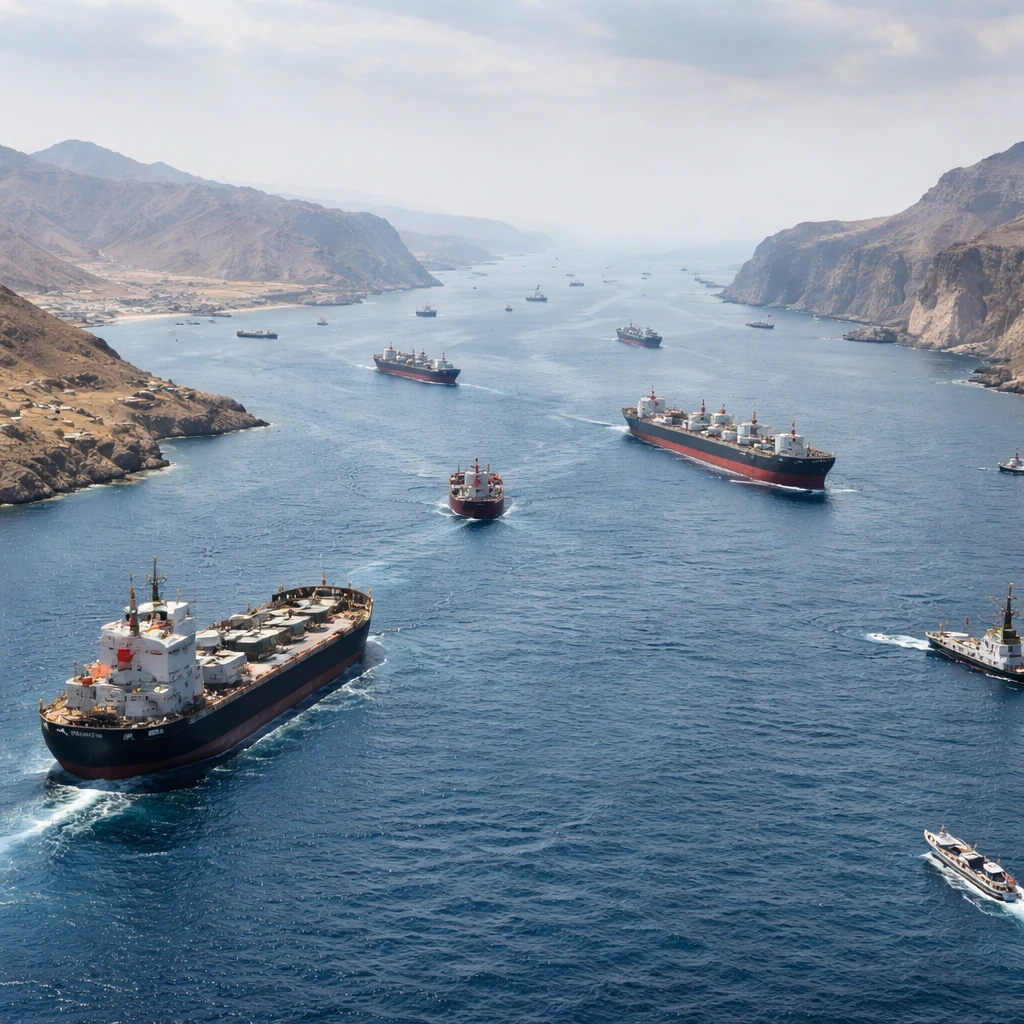
July 28 - Oman has put forward to Iran a framework for managing the Strait of Hormuz that would see the waterway run under a regional, cooperative mechanism and funded through voluntary transit contributions rather than under Tehran's declared plan to exercise control and charge for passage.
According to two diplomatic sources, the proposal was delivered to Iranian officials during talks in Tehran over the weekend. The plan envisions a joint regional body to coordinate navigation, environmental safeguards, search and rescue and related maritime services, financed by voluntary fees from ships using the strait. Oman bases the idea on the voluntary contribution system used by Indonesia, Malaysia and Singapore in the Strait of Malacca, where ships are asked to pay for services but are not compelled to do so.
Context and timing
The dispute over management of the narrow waterway that links the Gulf with the Indian Ocean has become a core sticking point in efforts to resolve the U.S.-Iran war. The strait carries roughly a fifth of the world's oil supplies and is also a key conduit for other essential goods, placing its administration at the heart of regional and global economic concerns.
Tensions escalated early in the conflict. Iran closed the strait after the war began on February 28 when U.S. and Israeli strikes killed its Supreme Leader Ayatollah Ali Khamenei. In the months that followed, Iran asserted what it described as a sovereign right to administer the strait and to collect fees for services, proposing to do so alongside Oman.
In June, an interim ceasefire accord between Iran and the United States explicitly assigned Oman a role in determining future arrangements for the strait. The ceasefire language required Iran to consult with Oman to define future administration and maritime services for the strait, to do so in discussion with other Gulf states and to act in line with international law. Oman has engaged Iran in dialogue on the issue and issued guidance in June for vessels transiting the strait through its waters that did not prescribe any fees.
Iran's position
Iran has pressed for the right, as part of any permanent peace settlement, to demand payments from ships passing through the strait. Tehran has not provided detailed terms for how such charges would be calculated. An Iranian official spoken to before the June interim truce said any fee scheme would depend on variables including the type and size of the vessel, its cargo and other unspecified conditions.
During the ceasefire, Iran took a hard line on adherence to what it regards as agreed terms. It fired on vessels that sought to transit the strait close to the Omani coastline, seeing such movements as violations of the truce. Tehran has also announced the creation of a Persian Gulf Strait Authority intended to administer transit, and senior Iranian officials have described cementing formal control over the strait as a principal objective in their approach to the conflict.
U.S. statements on fees
After the collapse of the ceasefire in July, U.S. President Donald Trump made a public declaration on social media that Washington would charge for use of the Strait of Hormuz, seeking 20% of the value of cargo shipped through it. The post appeared at odds with earlier positions from senior U.S. officials that transit of the strait should remain free. On June 25, U.S. Secretary of State Marco Rubio stated that "no country on Earth has the right to charge for the use of international waterways" and said fees for passage would not be part of any peace arrangement. President Trump later said that no one should charge for use of the strait while also expressing that he found it unfair the U.S. might have to pay for protecting the waterway.
Legal framework and practical navigation
The Strait of Hormuz comprises the territorial waters of Iran and Oman, with the maritime boundary running approximately down the middle. Under the United Nations Convention on the Law of the Sea (UNCLOS), states bordering straits are prohibited from demanding payments merely for passage. The convention does, however, permit the levying of limited charges to cover specific services such as pilotage, tug assistance or port services, and requires that such charges not be discriminatory against vessels of particular countries.
Neither Iran nor the United States are signatories to UNCLOS, but the convention is widely regarded as forming the basis of international maritime law and treats Hormuz as an international strait. In 1968, Iran and Oman agreed a traffic scheme with the International Maritime Organization (IMO) under which major vessels were expected to use sea lanes running along the middle of the strait. The IMO now regards some of these passages as unsafe after Iranian mine-laying during the war.
International precedent and industry response
Shipping-industry officials say there is no modern precedent for a coastal state unilaterally imposing a general toll on passage through a natural strait. Gulf states, whose principal routes to open seas for energy exports run through Hormuz, are particularly wary of any arrangement that would allow the levying of broad transit fees.
Other maritime passages are treated differently under international arrangements. Canals such as the Panama and Suez have been constructed and are governed on different terms than naturally occurring straits. The Turkish Straits - the Bosphorus, Sea of Marmara and the Dardanelles connecting the Black Sea to the Mediterranean - operate under the 1936 Montreux Convention, which guarantees free passage for merchant vessels in peacetime and allows Turkey only to impose standardised charges to cover service costs rather than a general transit fee. The Singapore Strait does not charge transit fees.
What remains uncertain
Key questions persist about whether regional states and the international shipping community would accept any new fee regime, whether voluntary or compulsory. The proposal from Oman aims to avoid unilateral tolls by offering a multilateral management model with voluntary contributions, but Iran's emphasis on sovereign control and a right to charge for transit marks a sharp divergence in positions.
How these competing visions - voluntary, regional management versus formalised sovereign control with fees - will be reconciled remains unsettled. The ceasefire accord placed Oman at the centre of discussions, but practical arrangements and enforcement mechanisms still need to be defined and agreed with other Gulf states and in line with international law.
Implications for shipping and energy flows
Because the Strait of Hormuz serves as a primary channel for a significant share of global oil shipments and other goods, the outcome of negotiations over its administration could have substantial consequences for commercial shipping and energy-exporting economies in the Gulf. The competing proposals - a voluntary, cooperative model or a fee-based sovereign approach - would raise different operational and cost considerations for carriers, while the security environment in the strait continues to be affected by incidents tied to the broader conflict.
For now, the proposal from Oman offers a pathway modelled on existing regional practice in the Strait of Malacca. Whether Tehran accepts the approach, and whether other Gulf states and the maritime industry endorse it, will help determine the practical regime governing one of the world's key maritime chokepoints.