
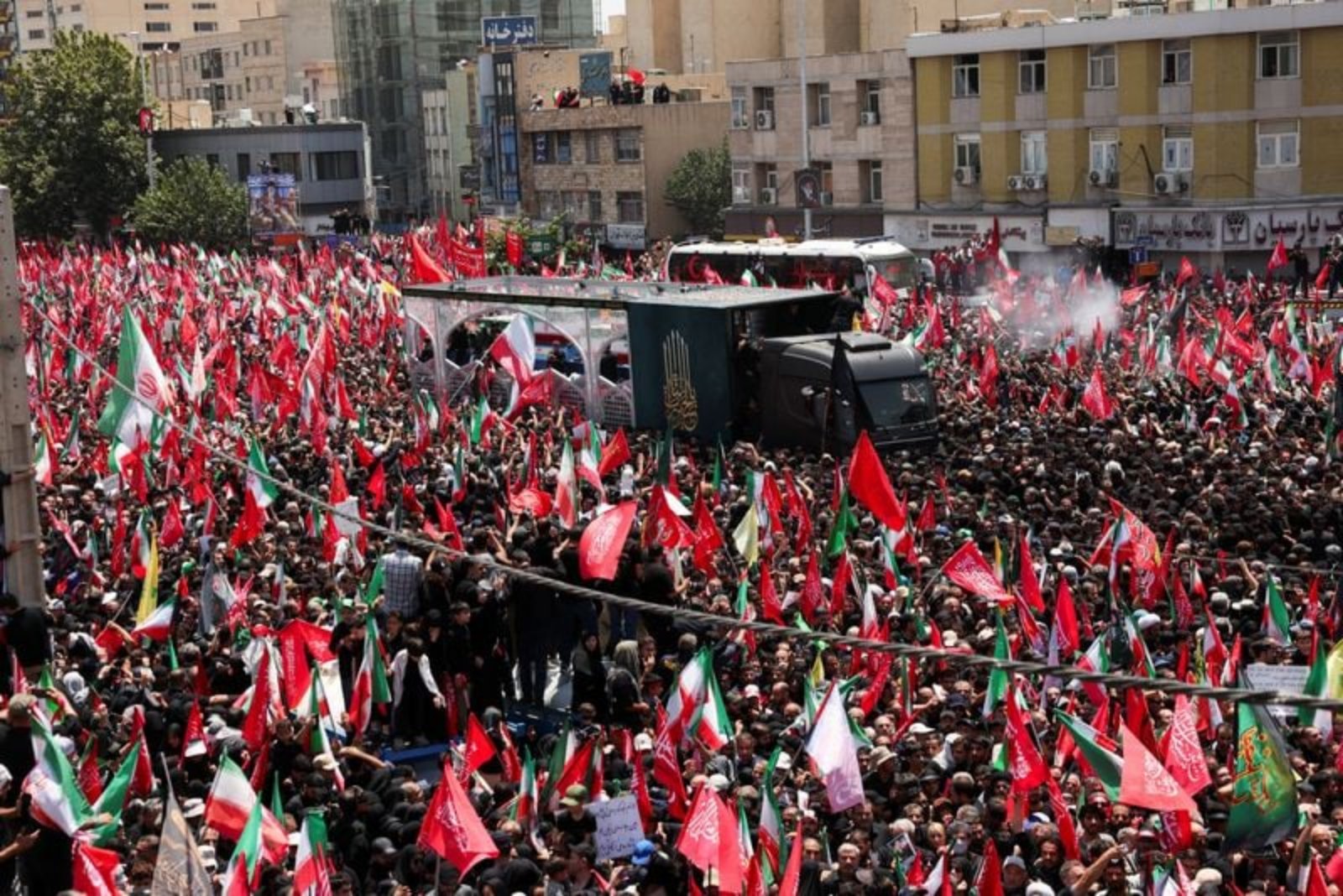
Tens of thousands of people packed a central Tehran boulevard on Monday to take part in a funeral procession for Ayatollah Ali Khamenei and four members of his family, marking the largest day so far in a sequence of state-led memorial events.
State television drone footage showed a dense mass of mourners lining the thoroughfare as a large truck carried the coffins of the slain leader and family members past the crowd. Fire hoses were used from above to douse marchers and offer relief from the heat as the procession moved through the city.
As the vehicle passed under an overpass, some marchers hurled stones at a billboard suspended above the roadway that displayed a portrait of U.S. President Donald Trump with an image of a bullet aimed at his head. The billboard bore text that declared: "The U.S. killed our father" and "We won't let you go!"
Participants waved Iranian flags and held aloft red banners invoking the slogan of the "avengers of Khamenei" - language adapted from a core Shi'ite motif that references historical calls for retribution dating to the seventh century.
Attendance by Khamenei sons, absence of Mojtaba
On Sunday, three sons of the slain leader were photographed praying beside the coffin inside a large Tehran prayer hall. Notably absent from public view was Mojtaba Khamenei, identified in reports as the son who succeeded him as Iran's supreme leader. The younger Khamenei has not appeared publicly since the war began on February 28 with Israeli and U.S. airstrikes on Iran, and he is believed to have been disfigured by wounds sustained in the attack that killed his father.
The public mourning rituals began on Friday, when the coffins of the elder Khamenei, one of his daughters and her 14-month-old child, a son-in-law, and the wife of Mojtaba were placed in state for officials and foreign dignitaries to pay respects. Additional large outdoor ceremonies took place on Saturday and Sunday prior to Monday's expansive procession.
Organizers have announced plans for further processions later this week. The body will be taken to Iran's Shi'ite seminary city of Qom and to two Shi'ite shrine cities in neighboring Iraq for additional public ceremonies before being returned to Iran for interment inside a medieval shrine complex in Mashhad.
Political backdrop and regional reactions
The funeral rites come after a war that concluded with a preliminary peace agreement reached last month. That deal maintained Iran's clerical leadership in power and left officials in Tehran asserting they had gained leverage, in part through increased influence over global energy flows via the Strait of Hormuz.
U.S. President Donald Trump has also stated that he considers the outcome a victory, though the objectives he articulated at the start of hostilities - including the destruction of Iran's nuclear and missile capabilities, ending its ability to attack neighboring states and creating conditions for Iranians to overthrow their leadership - remain unfulfilled.
Trump said over the weekend that planned peace talks with Iran had been postponed for a week because of the funeral ceremonies.
Israel's defence minister, Israel Katz, commented on Monday that the elder Khamenei had been killed because he led a programme aimed at destroying Israel. Katz added: "Any Iranian leader who will again try to pursue plans to destroy Israel will be killed as well."
The procession on Monday represented both a large public expression of grief and a display of the continued influence of Iran's clerical leadership following the conflict. Authorities have organized multiple stages of mourning across Tehran and beyond, and the events are scheduled to continue as the country prepares the final burial ceremonies.