
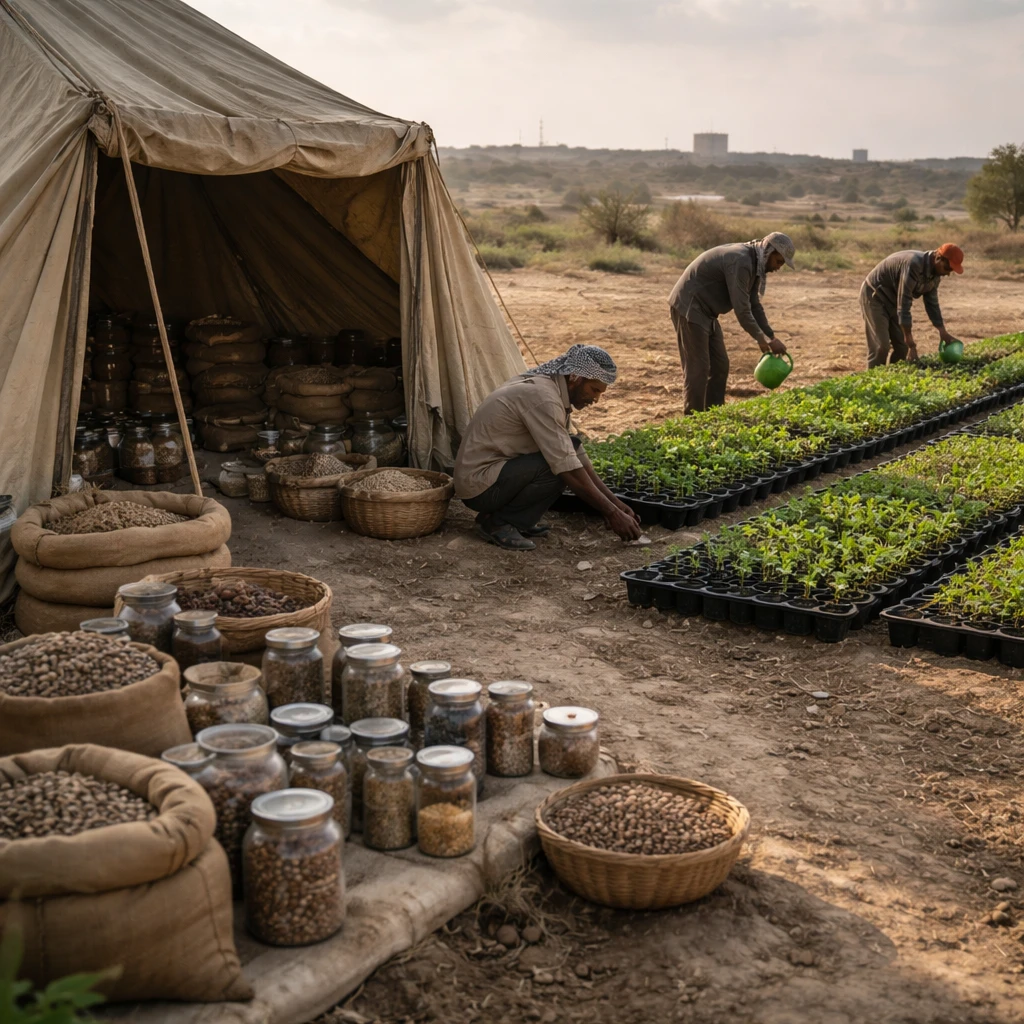
Gaza farmers are attempting to salvage part of the enclave’s agricultural heritage by reconstituting a local seed bank that was destroyed during Israel’s campaign and by encouraging cultivation on the limited land still available to residents.
Much of Gaza’s pre-war farmland is located in areas under Israeli military control, and two years of Israeli bombardment have left extensive damage across the territory. Around two million people now live in roughly 30% of the enclave, much of which has been laid waste, reducing the area available for farming.
The seed bank at the heart of the recovery effort once belonged to farmer Salama Muhanna and was destroyed in Qarara town, in the south of the strip, in early 2024, several months after the Hamas-led attacks that precipitated Israel’s military assault. Muhanna, who is 71, described the pre-war operation as fully equipped, saying they had "refrigerators, solar power, a dryer, a seed-cleaning and sorting machine - we had everything." The bank reportedly held 70 tons of seed stock covering 42 distinct crops, including black-eyed peas, watermelon and sage - crops Muhanna described as staples of Palestinian agricultural heritage.
In recent months Muhanna and a group of farmers who worked with the original operation have rebuilt a smaller collection of local varieties. The restored holdings now comprise about 32 seed types, collected through contributions from those who had been connected to the bank before the conflict. The seeds are stored in burlap sacks and plastic containers inside a makeshift tent in Deir Al-Balah in central Gaza, and the group also grows seedlings in surrounding plots of land.
Supporters point to a practical reason for preserving heirloom seeds: they are more resilient than some hybrid varieties that can be imported, and they can be saved and replanted from one season to the next. Those characteristics provide farmers with a means to cope when cross-border supplies are constrained.
The Israeli military did not immediately respond to a request for comment.
Scale of the challenge
Farmers and aid workers caution that while local seed banks offer a degree of protection against border closures and supply disruptions, they cannot compensate for the broader destruction of Gaza’s agricultural economy. A June report from Gaza’s Agriculture Ministry estimated that about 560,000 people were dependent either wholly or partly on agriculture and fishing for their livelihoods before the war.
"What is being done through the seed bank, and the seeds currently available, represents only a drop in the ocean compared with the needs facing the agricultural sector," said Osama Al-Mukhalalati, an agricultural engineer affiliated with the International Committee of the Red Cross.
Nursery operator Mustafa Al-Astal, who runs a facility in Khan Younis in the south, said local seed varieties had become "the only lifeline" during periods when Israel tightened import restrictions and humanitarian aid flows in 2025. The restrictions were described by Israeli authorities as pressure aimed at the militant group Hamas during ceasefire talks; Palestinians and rights groups condemned the measures as collective punishment, and a global hunger monitor reported famine conditions in parts of Gaza following the clampdowns.
Land access and security constraints
A substantial share of Gaza’s farmland lies along and beyond what is known as the "Yellow Line," the demarcation Israeli troops were supposed to withdraw to under an October 2025 ceasefire. It has been reported that concrete blocks marking the Yellow Line were moved deeper into territory controlled by Hamas, a shift local farmers say has placed more viable farmland off limits and exposed those working near the line to Israeli gunfire.
One Palestinian grower, Khaled Al-Astal, who has been planting seeds from Muhanna’s rebuilt collection roughly 500 metres (550 yards) from the Yellow Line, said he and fellow farmers do not intend to abandon their plots despite the threat of attacks. He said: "We only have about 25% to 30% left (of Gaza). So we say: we are here on our land, and we will cultivate it despite them."
Outlook
The seed bank restoration offers a localized resilience strategy: a small, community-led reserve of heirloom varieties and a network of growers propagating seedlings on remaining arable plots. Yet agricultural engineers and humanitarian workers emphasize the limits of that resilience in light of the scale of destruction, restricted access to much pre-war farmland and interruptions to aid and imports that have affected seed and input availability across the enclave.
For Gaza’s farmers, the preservation and replanting of traditional seed stocks is both a practical response to supply constraints and an effort to maintain cultural agricultural practices amid ongoing insecurity and constrained territory.