
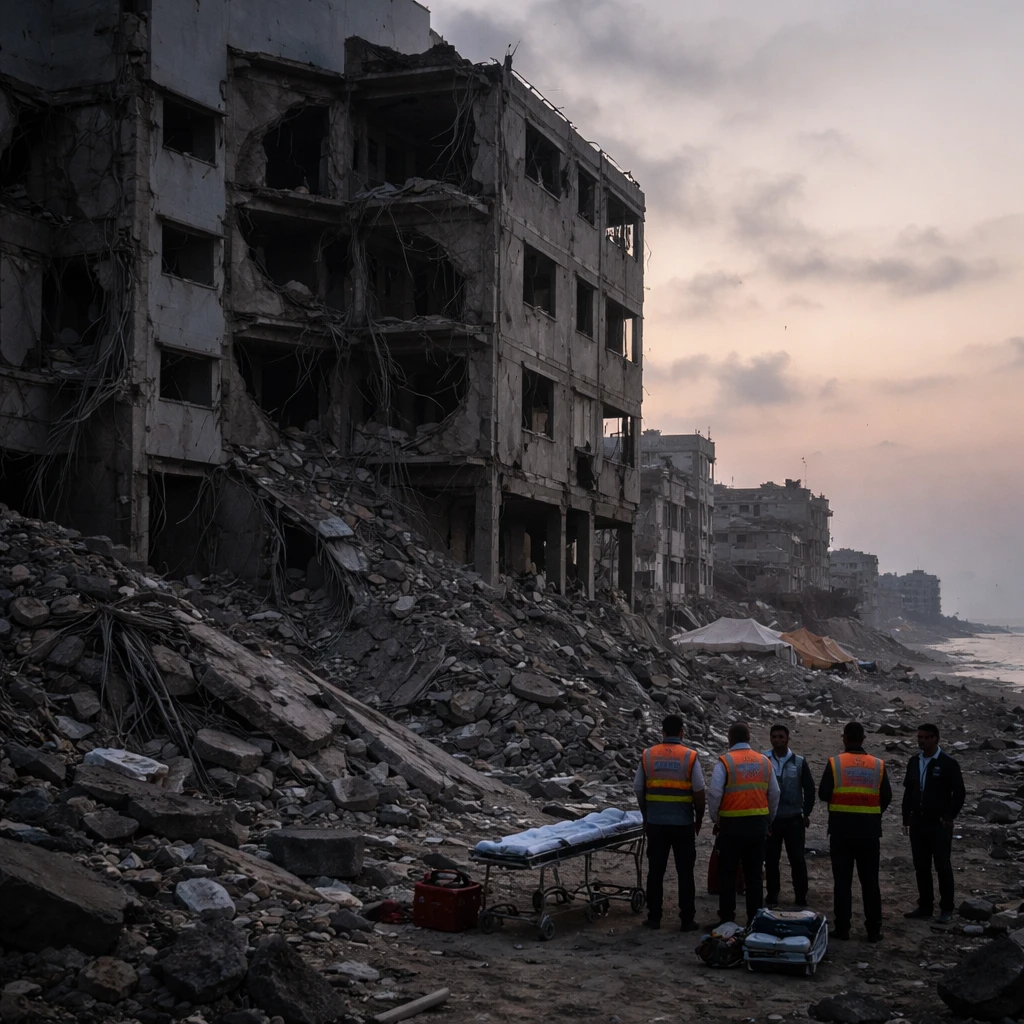
CAIRO - An Israeli airstrike on an apartment block in Deir Al Balah, in central Gaza, killed a man, his wife and their six-year-old daughter on Wednesday, Palestinian health officials reported. Medical sources identified the victims as Omar Abu Qassem, his wife, Asma, and their daughter, Habeeba. Their son survived the attack but sustained injuries, medics said.
The Israeli military said the strike was aimed at a Hamas militant. In a separate incident in the Sheikh Radwan neighbourhood of Gaza City, medics reported that an Israeli airstrike killed one person; the Israeli military did not immediately comment on that incident.
Those deaths increase a toll that Gaza health officials say now exceeds 1,100 Palestinians, the majority of them civilians, killed by Israeli strikes since an October ceasefire between Israel and Hamas took effect. The health authorities in the enclave provide the fatality counts; Hamas does not typically disclose information on its own casualties. While the truce has halted large-scale fighting between the parties, near-daily Israeli strikes have continued. During the same period, militants in Gaza have killed four Israeli soldiers, officials said.
Ceasefire Talks Stall
The fresh violence unfolded as Hamas leaders concluded another round of truce talks in Cairo on Tuesday. Those discussions were mediated by Egypt, Turkey and Qatar and were intended to advance implementation of the second phase of U.S. President Donald Trump’s Gaza peace plan.
According to sources close to the negotiations, the talks covered the disarmament of Hamas and the withdrawal of Israeli forces from the Gaza Strip. The sources said there had been little progress, attributing the lack of movement to deep distrust between the two sides.
The second phase of the plan also envisages a U.S.-backed Palestinian technocratic committee taking power from Hamas, the deployment of an international security force, and the commencement of reconstruction in Gaza, which has suffered extensive damage in the course of the conflict.
Five countries - Indonesia, Morocco, Kazakhstan, Kosovo and Albania - have pledged troops for the U.S.-backed International Stabilization Force. However, none of those contingents have been deployed, officials said, as negotiations between the Board of Peace backed by President Trump and Hamas have been stalled for months.
At an aid donor meeting in Brussels on Monday, Nickolay Mladenov, the Board of Peace envoy for Gaza, said he planned to visit Morocco to formalize that country's contribution to the International Stabilization Force and expressed hope that Moroccan troops would soon be on the ground to undertake their tasks. Mladenov described the October ceasefire as holding but "imperfectly," noting continued violations and saying that Hamas had not agreed to what he called a "roadmap" for negotiations.
Hamas official Basem Naim accused Mladenov of backing Israel's negotiating position and of failing to hold Israel accountable for ceasefire violations and for not implementing the first phase of the Trump peace plan's terms. The first phase had called for Israel to withdraw its troops to a demarcated "yellow" line; health and negotiating sources say Israel has been gradually moving forces forward and now effectively occupies more than 60% of the territory of the Gaza Strip.
Hamas has repeatedly stated that it cannot advance to the second phase of the plan until the commitments of the first phase are fulfilled.
Humanitarian Situation
Nearly all of Gaza's roughly 2 million inhabitants, many of whom have been displaced multiple times over the course of the conflict, now live on a narrow coastal strip. The majority reside in makeshift tents or damaged buildings, under the control of Hamas, according to local officials and medical sources.
The violence that erupted in October remains central to current tensions. Israeli tallies report that Hamas-led fighters killed 1,200 people during a cross-border attack into Israel on October 7, 2023. The Gazan health ministry says Israel's subsequent offensive on the strip has killed more than 73,000 Palestinians.
The combination of continuing strikes, stalled negotiations over disarmament and withdrawal, and the absence of deployed international stabilization forces contribute to persistent uncertainty over the durability of the ceasefire and the timeline for reconstruction and political transition in Gaza.