
Lead
An informal online network of engineers is playing a pivotal role in search-and-rescue operations in Nepal's Trishuli valley, where a flash flood on August 26 sent a wall of water, mud and rock down the Himalayan corridor. The group, created by engineers before the deluge struck, now supplements helicopters, excavators and frontline rescue teams as they probe tunnels and buried hydropower facilities for any survivors.
How the group formed and what it is doing
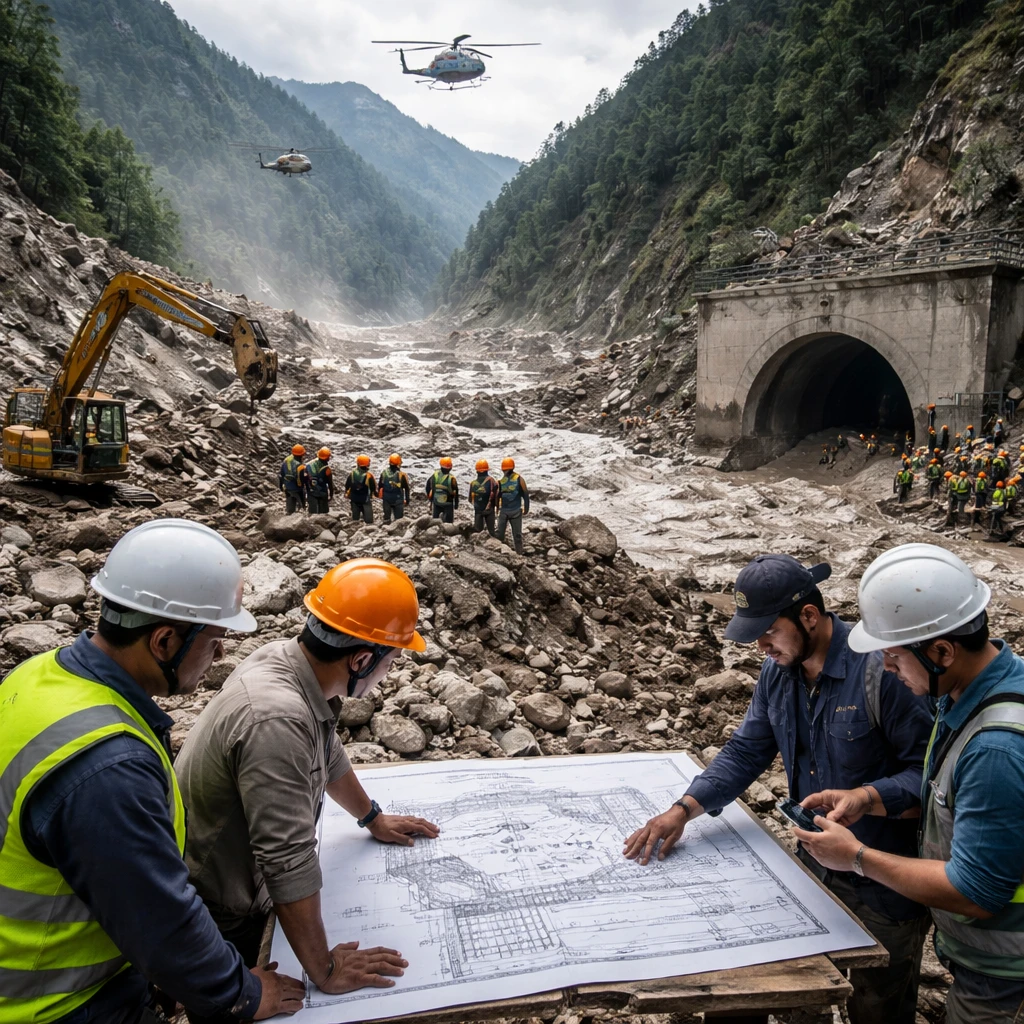
The messaging forum was established by engineers prior to the flood and has since been expanded to include additional experts called in to assist the rescue effort. The chat now comprises more than 500 members and has been used to exchange technical materials and operational intelligence in real time. One government official posted a direct request in the group - "Can you send me Chilime layout drawings" - and within minutes received diagrams showing the powerhouse and access tunnel details for the 22 MW Chilime hydropower plant, situated high in the Himalayan valley near the Chinese border.
That exchange reflects how the group has become a repository for drawings, contact lists and informal technical counsel that rescue personnel are relying on as they try to locate entrances and navigate internally damaged tunnel systems.
Scale of the damage and the search
Authorities report about 900 people are missing from six hydropower plants in the valley, at least three of which were under construction when the flood struck. Locating tunnel portals and internal routes is complicated by the enormous volume of material the flood carried: officials say 2.2 million tonnes of mud and debris settled across the valley, reshaping terrain and burying infrastructure.
At Chilime, rescue teams have been working among debris that rises to the ceiling a short distance inside a large tunnel entrance. So far, no one has been found alive in the Chilime tunnels or in the tunnels at other plants lower in the valley. The Independent Power Producers' Association has said at least eight people could be trapped at Chilime, while a Nepal Electricity Authority official has estimated 46 may be trapped at the Rasuwagadhi plant farther south.
Overall human toll figures related to the flood remain stark: more than 1,200 people have been reported killed, and more than 4,000 are missing, figures that include those who might be trapped inside tunnel networks. The disaster also damaged the country's electricity output, wiping out an estimated 10% of Nepal's generation capacity.
Technical and operational challenges
Search teams face complex conditions inside the tunnel systems. "The flood has altered the terrain around the tunnels and changed their structure, while mud, rocks, soil and other debris had accumulated inside," said Nepal army spokesperson Raja Ram Basnet. "This is not a normal closure of tunnels." That combination of altered terrain and internal blockage creates hazards for rescuers and makes standard tunnel-entry procedures impractical or unsafe in many places.
At Rasuwagadhi hydropower plant, teams reached about 250 metres into a tunnel before encountering a complete blockage. Officials say they have not abandoned efforts to advance further. "We are trying to reach there inside again to look for people," said Amshu Kiran Shahi, a board member of the Nepal Electricity Authority, noting there may be a chamber where people could have limited access to food and water.
In another case, entry to the tunnel at the Upper Trishuli 3A project was sealed by debris, delaying access for nearly six days. Once rescue teams reached the buried entrance, they attempted to push oxygen into cavities through pipes as a precaution in case individuals remained trapped inside.
Excavators have been deployed to dislodge massive boulders from tunnel mouths and to clear paths inward, and photographers at several sites recorded heavy machinery trying to move rock and mud from tunnel openings.
Role of former employees and local knowledge
Rescue crews and officials have also requested help from former plant employees via the WhatsApp group, seeking institutional knowledge about tunnel layouts and access routes. A manager at the Nepal Electricity Authority, speaking on condition of anonymity, said that drawings and advice posted in the group had proved useful to teams operating on the ground.
Those familiar with the tunnel systems have occasionally been able to help directly. Jan Jiwan Thakur, a civil engineer at the Upper Trishuli 1 plant, said a colleague warned him just before the flood arrived, allowing him and approximately 100 others from the facility to climb to higher ground. "We just ran away towards the hillside and, after two to three minutes when we looked down, everything was gone," he said. "The flood debris had entirely covered our office area."
Another worker, Dhan Bahadur Tamang, described escaping through a tunnel at the same plant when pipes and equipment were swept inside. With prior knowledge of the tunnel configuration, he and several others navigated a subterranean route to safety, though he recounted finding dead bodies during the escape.
Information sharing and attempts to locate missing workers
Participants in the engineers' messaging group have also compiled and circulated lists of missing personnel, including names and mobile phone numbers, asking officials to pass the information to telecom operators to try to determine each individual's last recorded location. That step represents an attempt to use available telecommunications data to narrow search areas.
Meanwhile, relatives of those who remain unaccounted for are holding on to hope. Rajesh Shrestha, who runs a workshop manufacturing window grills, said his 30-year-old son Rajish - an environmental engineer at the Upper Trishuli 1 plant - is among the missing. "Whenever I look outside, I imagine seeing him carrying a bag and coming home, just as he used to," Rajesh said. "I am surviving on the hope that he will return."
Continuing operations and constraints
Rescue teams continue to balance the urgency of reaching potential survivors with the structural dangers posed by altered terrain and debris-filled tunnels. The combination of a large number of missing people across multiple hydropower sites and the scale of material displaced by the flood has made the operation logistically complex and resource-intensive.
Beyond the immediate search, the disaster has disrupted a network of hydropower plants that formed part of an expanding system for national consumption and cross-border export of electricity. The loss of generation capacity underscores the broader implications for energy supply as recovery and reconstruction efforts progress.
Outlook
At present, teams are proceeding to clear tunnel entries, probe accessible passages and use any available technical information to guide their movements. The WhatsApp group established by engineers before the flood has become a practical channel to convey technical diagrams, recall personnel familiar with subterranean layouts and coordinate specific lines of inquiry. For families whose loved ones remain missing, progress in the field and information shared through those communications are a critical lifeline in a protracted and uncertain recovery effort.
This article presents details based strictly on accounts from officials, engineers, survivors and relatives involved in the post-flood search and rescue operations in Nepal's Trishuli valley.