
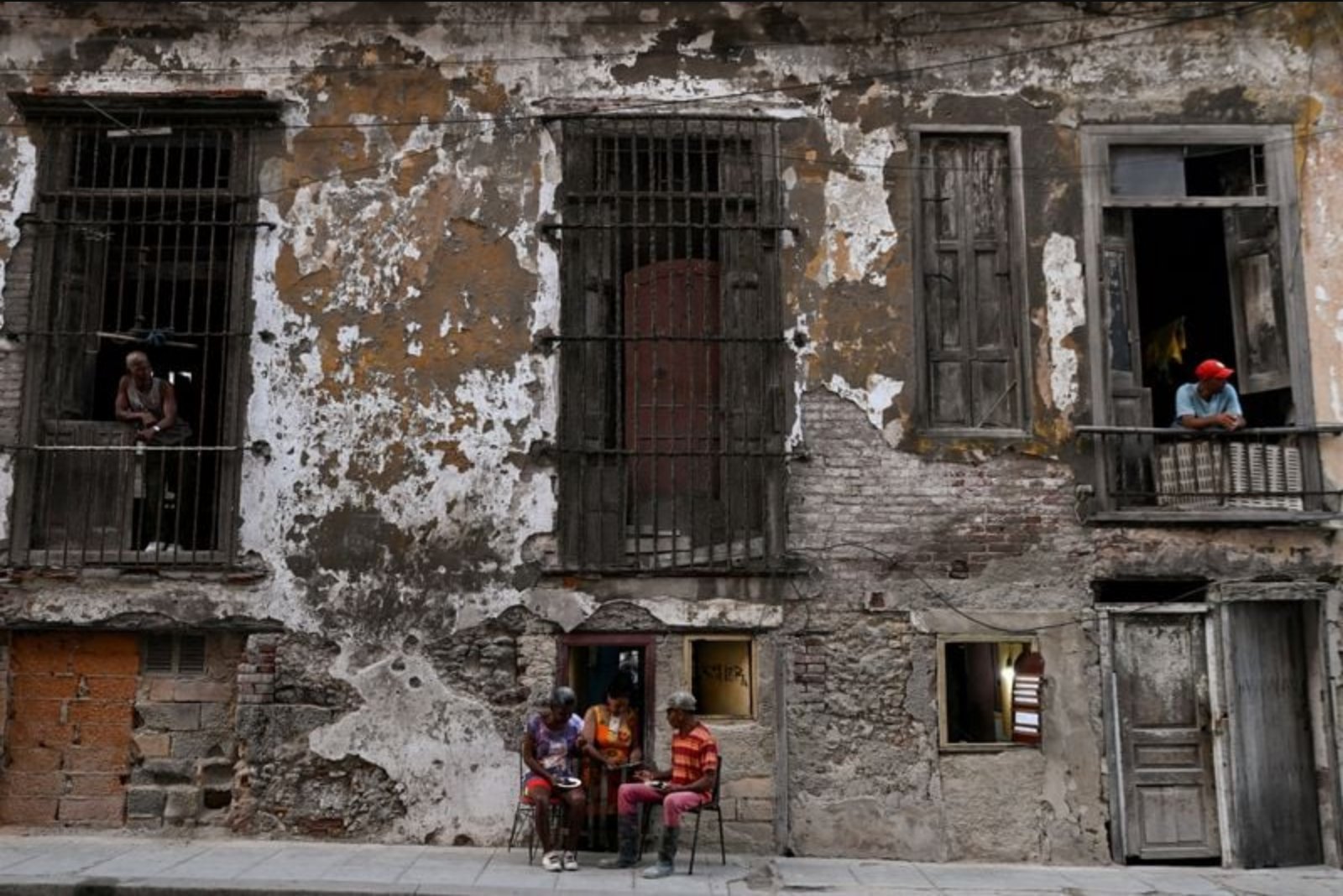
Havana - Felicia de la Caridad Alvarez, 64, is emblematic of many who now face entrenched scarcity on the island. A former hospital custodian, blind in one eye and living with hypertension and diabetes, she struggles with irregular water and electricity, spoiled food and a broken TV that leaves her uncertain about the precise sources of her troubles.
Alvarez's daily routine is a study in adaptation. She carries plastic containers and pots several blocks to collect water, relies on a nearby church soup kitchen for meals and copes without refrigeration. "In order to survive, I have to keep fighting," she said. "What choice do I have?"
Her situation is far from unique. Millions of Cubans face parallel pressure as the island's already inefficient state-run economy - long afflicted by shortages - has slid in recent months into what officials and residents describe as a deeper crisis following tougher sanctions and a fuel blockade imposed by the administration of U.S. President Donald Trump.
Resilience as doctrine
Part of why Cuba's political system remains intact amid pronounced hardship lies in a long-standing civic pedagogy: the exhortation to "resistir." Rooted in the revolutionary era, the term has become shorthand for a household-level determination to endure adversity. The ethos is both cultural and pragmatic, baked into the behavior of citizens who have endured recurring shortages over decades.
For people like Alvarez, the practice of "resistir" is literal. She avoids public protest out of fear for family safety: "They could take revenge on my kids," she said. That reluctance to demonstrate openly was a sentiment expressed by roughly two dozen Cubans interviewed in recent weeks. The specter of reprisals - and the reality of a government that enforces limits on dissent - constrains many from voicing public discontent, even where material conditions are clearly deteriorating.
Local improvisations and market adjustments
Across Havana, practical improvisation has proliferated. Farmers have managed to keep agricultural markets supplied by procuring diesel on the black market or by reverting to animal power, training oxen to pull plows where tractors cannot run. Streets are dominated by electric tricycles serving as taxis, having displaced gasoline-powered models. Solar panels and portable power banks have become common tools to illuminate homes and small businesses during lengthy outages.
These solutions blunt immediate pain but also underline the degree of resourcefulness required to maintain basic services. The ability of Cubans to find workarounds is testing the resolve of Washington policy, and has framed the relationship between external pressure and internal stability as a contest of endurance.
Sanctions, the blockade and the political test
In January, within 48 hours of a U.S. military raid that captured Venezuelan leader Nicolas Maduro, a key Havana ally, President Trump began forecasting Cuba's collapse. Since then, U.S. policy has included steps that have cut off the nation's oil supply, restricted remittances, curtailed travel by U.S. tourists and tightened sanctions that have prompted many foreign investors and private enterprises to withdraw from the island.
Those measures have affected daily life in visible ways, but have not produced an immediate political rupture. "Living conditions have sharply deteriorated but the political impact is far less clear," said Bert Hoffmann, a German academic who has studied Cuban politics for three decades. Hoffmann noted that even wealthy, well-organized countries would face severe emergency conditions after five months cut off from almost any fuel supply.
Personal responses to economic shock
For some residents, such as 65-year-old Omayra Blanca, the most recent pressures echo earlier privations. Blanca, a housewife who lives on the seventh floor of a building near the Malecon, said her elevator has been out for two years and she descends only once or twice weekly for necessities. She recalls the 1990s Special Period - the years of extreme hardship and international isolation after the collapse of the Soviet Union - and views the present moment through that memory. "We are fighters. With the little that we have, we survive," she said. "Everyone is just adapting to the times."
Yet other indicators point to a fraying public fabric. Medical personnel are leaving the profession as supplies in hospitals dwindle, contributing to understaffed wards. Essential medicines are scarce. A tumble in the peso has eroded household purchasing power, leaving many struggling to secure adequate food. Most of the country, including the capital, now experiences only a few hours of electricity a day. Schools have cut hours and rations. Trash accumulates on street corners, and in some neighborhoods the absence of functioning toilets has forced residents to relieve themselves in public.
International responses and human rights debates
The United Nations said last month that the decision to block fuel shipments to Cuba had "dramatically intensified the already severe effects" of the Cold War-era trade embargo, describing the action as "unlawful" and a violation of human rights. A team of U.N. experts stated that "energy starvation as a coercive tool is incompatible with international human rights norms."
The Trump administration, for its part, frames its actions as a response to Cuba's own human rights practices. U.S. officials argue Cuba's communist leaders routinely imprison dissenters, suppress free speech and free elections, and maintain an economic system that keeps millions in poverty. The conflicting assessments underscore the diplomatic and moral dimensions of the current pressure campaign.
Protests, limits of endurance
Despite a generally low tolerance by authorities for public uprising, there have been visible protests across Havana as blackouts lengthen - at times reaching as much as 18 hours of outage in a single day. Extended outages threaten to spoil frozen food and leave residents sleepless in high humidity and heat.
One protester, Rodolfo Alonso, said he decided to take part after his neighborhood endured more than 40 hours without electricity. "This isn't a political problem," he said. "We started banging pots (in protest) to see if they'd give us just three hours of electricity. That's all we want."
The government has at times responded by selectively restoring power to particular neighborhoods, a tactic that can tamp down unrest locally. However, blackouts and public demonstrations have both increased in recent weeks, a combination that some analysts interpret as evidence that social tolerance for hardship has limits.
Cuba-based sociologist Luis Emilio Aybar framed the situation in stark terms: "It's a resilient society because it hasn't had any other choice," he said. "But a country without fuel can't survive forever." His observation underscores the central vulnerability at the heart of the crisis - physical energy shortages that ripple through health, food, transportation and public services.
Outlook and constraints
The island's coping mechanisms - from black market diesel and animal labor to electric tricycles and solar panels - alleviate immediate pressures but do not address structural shortages in fuel, medicine and stable power. Political control remains firm for now, aided by a long tradition of inculcated endurance and the palpable fear among many citizens of reprisals for public dissent.
At the same time, the combination of stricter external pressure and internal degradation of services places the country at a crossroads where improvisation may no longer suffice if fuel access remains highly constrained. How long that dynamic can continue without producing larger political consequences is uncertain, but the immediate human cost is already evident in the daily hardships reported by residents across the island.